
Non-FictionAI OperatorPost-EditingTranslation Productivity
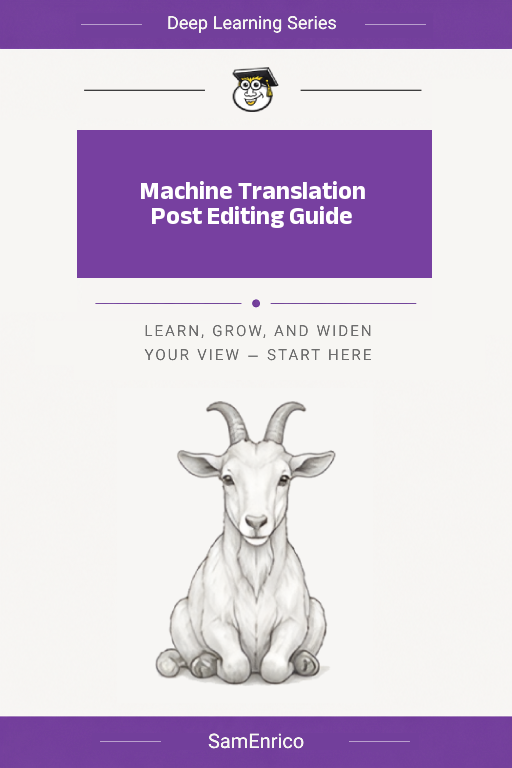
Machine Translation Post Editing Guide eBook
Leverage AI to pre-edit source text for better MT
Leverage AI to pre-edit source text for better MT output. Train reviewers to fix common errors faster using keyboard shortcuts and prediction models.
Formats
Free sample
Chapter 1: The Mouse Tax--–- Every time a post-editor reaches for their mouse, a small amount of money evaporates from the translation budget. Most organizations never notice the slow bleed because they measure quality but not motion. They track error rates, turnaround times, and customer satisfaction scores. They do not track how many times a human hand leaves the keyboard to click a button, scroll a menu, or highlight a word. That seemingly invisible motion—the mouse click—is actually the single largest unmeasured cost in the machine translation post-editing industry.
This chapter reveals why traditional post-editing workflows are failing, why the mouse is the enemy of speed, and how shifting from reactive correction to proactive prevention can cut editing effort by thirty to fifty percent before a single word is translated.The Cost of Fixing Later For the past decade, the localization industry has operated on a simple assumption: feed source text into a machine translation engine, then have a human fix whatever comes out. This assumption has become so deeply embedded that most project managers do not even question it. They select an MT engine—Google, Deep L, Microsoft, Amazon, or a custom model—run the source text through it, and assign the output to a post-editor. The post-editor opens the file, reads the first segment, compares it to the source, makes corrections, moves to the next segment, and repeats this process for eight hours a day.On the surface, this seems reasonable. Machine translation is fast and cheap.
Human correction ensures quality. Together, they should be the perfect marriage of automation and expertise.But beneath the surface, something is going terribly wrong.Consider a typical enterprise localization department handling two million words per month across twenty language pairs. Using traditional post-editing workflows, that department employs between forty and sixty post-editors, each processing roughly one thousand to fifteen hundred words per hour depending on content complexity and language pair. The direct labor cost is substantial, often exceeding three million dollars annually. But the hidden costs are far larger.The hidden cost that no one measures is what this chapter calls the Mouse Tax.
Every time a post-editor reaches for the mouse to click a correction button, navigate between segments, scroll through a document, or select text, they lose between one and three seconds. That does not sound like much until you calculate it across fifty editors making two hundred mouse-based actions per hour. The math is startling: fifty editors times two hundred actions per hour times two seconds per action equals twenty thousand seconds per hour, or five point five hours of wasted labor per hour of clock time. In monetary terms, a team of fifty editors paying an average fully burdened rate of forty dollars per hour loses two hundred twenty dollars every single hour to the Mouse Tax. Over a two thousand hour work year, that is four hundred forty thousand dollars of pure waste.And the Mouse Tax is only the beginning.The larger problem is that traditional post-editing workflows treat the symptom rather than the disease.
When a post-editor encounters an error—a wrong pronoun, a mistranslated term, a garbled date format—they fix it and move on. The next document, written by the same source author or the same technical writing team, contains the identical error pattern. The post-editor fixes it again. And again. And again.
The organization pays for the same correction hundreds or thousands of times because no one ever asked why the error occurred in the first place.This is the Fix It Later Trap. The trap works like this: machine translation is deployed because it is faster and cheaper than human translation. Post-editing is added because machine translation alone produces unacceptable quality. The combination seems efficient until you realize that the same errors appear repeatedly across documents, across projects, and across years. Each repetition is a small tax that no one measures and no one questions.
Over time, the cumulative cost of fixing the same errors exceeds the cost of preventing them at the source. But because the cost is distributed across hundreds of small corrections, it never triggers an alarm.Root Cause Analysis: Where Errors Really Come From To understand why traditional post-editing fails, we must understand where post-editing effort actually goes. The localization industry has long assumed that most post-editing effort is caused by machine translation inadequacy—that the engine simply is not good enough. This assumption has driven massive investment in neural MT, fine-tuning, and custom models. And indeed, modern MT is dramatically better than the statistical systems of a decade ago.But here is the uncomfortable truth revealed by analyzing post-editing logs across dozens of organizations: between fifty and seventy percent of post-editing effort is caused not by MT inadequacy but by source text problems.
The machine translation engine faithfully translates what it is given. If the source text is ambiguous, the translation will be ambiguous. If the source text contains long, nested clauses, the translation will be grammatically tortured. If the source text uses inconsistent terminology, the translation will be inconsistent. The post-editor then spends their time fixing problems that originated in the source language, never once touching the machine translation engine.Let us examine the most common source-originating errors that force post-editing effort.Ambiguous Pronouns are the number one source of post-editing waste.
Consider this source sentence: "The server connects to the database. It must be configured properly." The pronoun "It" could refer to the server or the database. A human reader with context knows the answer. A machine translation engine must guess, and it guesses correctly perhaps seventy percent of the time. The other thirty percent, the post-editor must correct a wrong pronoun.
The fix takes only a few seconds, but when ambiguous pronouns appear hundreds of times per document, those seconds add up to hours. And crucially, the problem could have been prevented by rewriting the source as: "The server connects to the database. The server must be configured properly."Long Noun Strings are the second major culprit. Technical writers love strings of nouns, such as "customer account management system integration requirements document." Machine translation engines struggle to parse which noun modifies which other noun. The resulting translation is often incomprehensible.
The post-editor must unravel the meaning and rewrite the entire sentence. A human writer could have prevented this by inserting prepositions: "requirements document for the integration of the customer account management system." The meaning is identical. The translation effort drops dramatically.Inconsistent Terminology creates a different kind of waste. When a source document uses "buy," "purchase," and "acquire" interchangeably, the machine translation engine will produce three different translations. A human reader might not notice the inconsistency.
A post-editor working to a glossary must normalize all three to a single approved term. The correction is simple but tedious. The same document translated into twenty languages requires twenty post-editors to perform the same tedious normalization. If the source author had simply chosen one term and used it consistently, all twenty post-editors would have been saved the work.Implicit Information is more subtle but equally damaging. Source authors often assume shared knowledge.
They write, "As previously discussed, the solution requires approval." Machine translation has no memory of previous discussions. It translates the…
This is the end of the free sample. Get the eBook to keep going. Buy now
About this book
Details
- Author
- Muniz Eusebio
- Publisher
- SamEnrico
- Language
- English
- Genre
- Non-Fiction, AI Operator, Post-Editing, Translation Productivity
- Released
- 2026-05-30
- Pages (approx.)
- 145
- Available as
- eBook, Audiobook

Read better in the ZLOADR app
Your eBooks on your phone or tablet. Sign in with your SamEnrico account and start reading.
More by Muniz Eusebio
 Net Promoter Score ValidationMuniz Eusebio$11.99
 Talking About Sexual BoundariesMuniz Eusebio$11.99
 Comeback Player Mindset ResetMuniz Eusebio$11.99
 Breaking Money Anxiety Cycle WorkbookMuniz Eusebio$11.99
 Wake Back To Bed TechniqueMuniz Eusebio$11.99
 Morning Habit StackMuniz Eusebio$11.99
 Thunberg Green New DealMuniz Eusebio$11.99
 People Pleasing Burnout CureMuniz Eusebio$11.99
 Daniel InouyeMuniz Eusebio$11.99
 The Stuxnet Saboteurs: How a Digital Weapon Changed War ForeverMuniz Eusebio$11.99The Stuxnet Saboteurs: How a Digital Weapon Changed War ForeverMuniz Eusebio$11.99
 The Amazon's Hidden Pulse: Mapping the World's Last Wild RiverMuniz Eusebio$11.99
You may also like
 Hong Kong Handover 1997Dunn Johnnie$11.99
 Zumba For Postnatal Recovery CourseNeal Christian$11.99
 Zumba for BeginnersLadner Nikia$11.99
 YouTube Comment Mining GuideHumes Pandora$12.99
 Worry Box MeditationCarlin Rudy$11.99
 Workplace Stress MeditationNguyen Lynn$11.99
 Workplace Stress and Sleep RepairHawley Ivory$11.99
 Workplace Perfectionism CureDelaney Jeffry$11.99
 Workplace Injustice Anger GuideWallen Isabelle$11.99
 Work Addiction and Burnout LinkGreenwood Ester$11.99
 Women in Yoga and WellnessBeattie Galina$11.99
 Women in Stand Up ComedyChun Evangeline$11.99