
Non-FictionHealth & WellnessLegumes
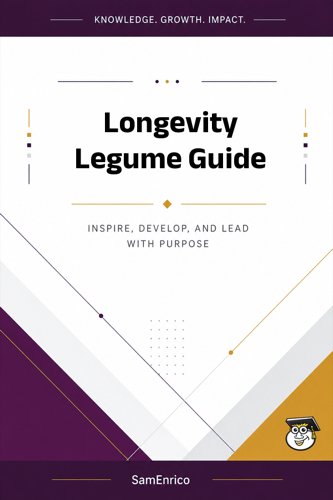
Longevity Legume Guide eBook
Cook chickpeas lentils and beans as daily protein
Cook chickpeas lentils and beans as daily protein foundation.
Formats
Free sample
Chapter 1: The Protein Flip--The first time I watched a patient break down in tears over a plate of beans, I was a second-year medical resident rotating through gastroenterology. She was sixty-three years old, recently diagnosed with prediabetes, and her well-meaning primary care doctor had told her to "eat more plants and cut the red meat." She had gone home, opened a can of black beans, eaten half of it cold from the can with a plastic fork while standing over her kitchen sink, and spent the next twelve hours in abdominal distress. Her conclusion, which she delivered to me with the exhausted certainty of someone who had been failed by the medical system one too many times, was simple: "Beans are not for people like me."She was wrong about the beans. But she was not wrong about the failure.The modern Western approach to dietary change is broken. We treat food like medication—identify the problem, prescribe the solution, and assume the patient will figure out the implementation.
Eat more fiber. Reduce saturated fat. Substitute plant protein for animal protein. These are not instructions. They are aspirations dressed up as advice.
And aspirations, as every dieter and every physician knows, do not survive contact with a can of cold beans eaten over a sink.This book exists because that moment in the gastroenterology clinic haunted me for a decade. Not because the patient was unusual—she was, in fact, entirely typical—but because her failure was not her fault. She had been told what to eat without being told how to eat it. She had been given a destination without a map. And when she predictably failed, she internalized that failure as a personal moral weakness rather than a failure of instruction.The destination, however, was correct.The Blue Zone Evidence That Changed Everything Between 2004 and 2019, National Geographic Fellow Dan Buettner and a team of demographers, epidemiologists, and anthropologists identified five regions of the world where people lived significantly longer than average, with significantly lower rates of chronic disease.
They called these regions Blue Zones: Okinawa (Japan), Sardinia (Italy), Nicoya (Costa Rica), Ikaria (Greece), and Loma Linda (California).The researchers expected to find a single unifying dietary factor—perhaps a specific superfood, a particular macronutrient ratio, or a genetic quirk shared across these geographically disparate populations. Instead, they found something almost boring in its simplicity: the longest-lived people in the world ate beans every single day.Not sometimes. Not as a side dish. Every day.In Okinawa, the traditional diet featured soybeans in multiple forms (tofu, miso, edamame) as a non-negotiable daily protein source. In Sardinia, fava beans and chickpeas appeared in minestrone, pasta e fagioli, and as standalone side dishes.
In Nicoya, black beans were (and remain) the foundation of breakfast, lunch, and dinner. In Ikaria, black-eyed peas and chickpeas formed the protein backbone of a diet so effective at reducing cardiovascular mortality that middle-aged men on the island had the same heart disease rates as Greek teenagers. And in Loma Linda, the Seventh-day Adventist community—many of whom followed a plant-based diet for religious reasons—consumed legumes at more than double the American average and lived seven to ten years longer than their non-Adventist neighbors.The Adventist Health Study-2, which followed ninety-six thousand participants for more than a decade, quantified what the Blue Zone researchers observed qualitatively. After controlling for exercise, smoking, alcohol consumption, and socioeconomic status, the study found that consuming one cup of cooked legumes daily (about the volume of a standard coffee mug) was associated with a twelve to fifteen percent reduction in all-cause mortality compared to consuming legumes less than twice per week. To put that in perspective: that single dietary substitution—replacing one serving of red meat with one serving of legumes—had a mortality benefit comparable to eliminating smoking for a former light smoker.But here is what the headlines did not tell you.
The Adventist study participants were not eating cold beans over a kitchen sink. They were not choking down flavorless lentil soup from a can. They had, over decades or generations, developed systems for making legumes not just edible but desirable—the foundation of every satisfying meal, the protein source they craved rather than tolerated.The difference between those participants and my patient in the gastroenterology clinic was not willpower, genetics, or socioeconomic status. It was technique.Why the Meat-Centric Plate Is Failing You Before we can rebuild your plate, we must understand how it became broken. The modern Western meal structure—meat as the centerpiece, starches as the supporting cast, vegetables as an afterthought—is not ancient tradition.
It is a twentieth-century invention, driven by agricultural subsidies that made grain-fed beef artificially cheap, by marketing campaigns that conflated protein with masculinity and strength, and by a food industry that discovered meat was more profitable than plants.Consider the plate of an average American in 1950 versus 2020. In 1950, meat appeared in most households three to four times per week, often in small portions stretched by beans, grains, or vegetables in stews, casseroles, and soups. A typical Sunday dinner might include a ham hock used primarily to flavor a pot of white beans, with the meat itself serving as a garnish rather than the main event. By 2020, the average American consumed meat at two out of three daily meals, with portions that had tripled in size while bean consumption had declined by nearly half.This shift has consequences that extend far beyond the dinner plate. The standard American diet now derives nearly forty percent of its calories from animal products, a ratio that is neither nutritionally necessary nor historically normal.
The human species evolved as opportunistic omnivores, capable of digesting meat when available but never dependent upon it. Our teeth, our gut length, our relatively low stomach acidity, and our long intestinal transit time all point to an evolutionary history in which plants—including legumes—played a dominant role and meat played a supplementary one.The protein obsession of the past three decades has only worsened the imbalance. We have been told, through advertising and through well-meaning but misinformed fitness culture, that we need enormous quantities of protein, that protein must come from animal sources to be "complete," and that plant proteins are somehow inferior. None of these claims hold up to scientific scrutiny.The recommended dietary allowance for protein is 0.8 grams per kilogram of body weight per day for sedentary adults. For a 150-pound (68 kilogram) person, that is approximately 55 grams of protein daily.
One cup of cooked lentils contains 18 grams. One cup of chickpeas contains 15 grams. One cup of black beans contains 15 grams. A serving of whole grain rice or quinoa adds another 5 to 8 grams. A handful of nuts or seeds adds 6 to 10 grams.
A single day of legume-based eating, without any animal products, can easily surpass the protein RDA while simultaneously delivering fiber, resistant starch, folate, iron, magnesium, and potassium—nutrients that are systematically lacking in meat-centric diets.The "complete protein" myth—the idea that plant proteins are missing essential amino acids and must be carefully combined at every meal—was disproven decades ago but refuses to die. All plant foods contain all nine essential amino acids, though in varying proportions. The…
This is the end of the free sample. Get the eBook to keep going. Buy now
About this book
Details
- Author
- Martino Krissy
- Publisher
- SamEnrico
- Language
- English
- Genre
- Non-Fiction, Health & Wellness, Legumes
- Released
- 2026-06-09
- Pages (approx.)
- 131
- Available as
- eBook, Audiobook

Read better in the ZLOADR app
Your eBooks on your phone or tablet. Sign in with your SamEnrico account and start reading.
More by Martino Krissy
 Flow While ExercisingMartino Krissy$11.99
 Quantity Over Quality MethodMartino Krissy$11.99
 Leading Overland Australia OutbackMartino Krissy$11.99
 The Iron Titan: George Stephenson and the Birth of the Railway AgeMartino Krissy$11.99
 Employment Posters Legal Requirement TrapMartino Krissy$12.99
 How to Produce Caller ID BoxesMartino Krissy$11.99
 Home AutomationMartino Krissy$11.99
 How to Start a Armoured Hose Made of Rubber Business (Beginners Guide)Martino Krissy$11.99
You may also like
 Hong Kong Handover 1997Dunn Johnnie$11.99
 Zumba For Postnatal Recovery CourseNeal Christian$11.99
 Zumba for BeginnersLadner Nikia$11.99
 YouTube Comment Mining GuideHumes Pandora$12.99
 Worry Box MeditationCarlin Rudy$11.99
 Workplace Stress MeditationNguyen Lynn$11.99
 Workplace Stress and Sleep RepairHawley Ivory$11.99
 Workplace Perfectionism CureDelaney Jeffry$11.99
 Workplace Injustice Anger GuideWallen Isabelle$11.99
 Work Addiction and Burnout LinkGreenwood Ester$11.99
 Women in Yoga and WellnessBeattie Galina$11.99
 Women in Stand Up ComedyChun Evangeline$11.99