
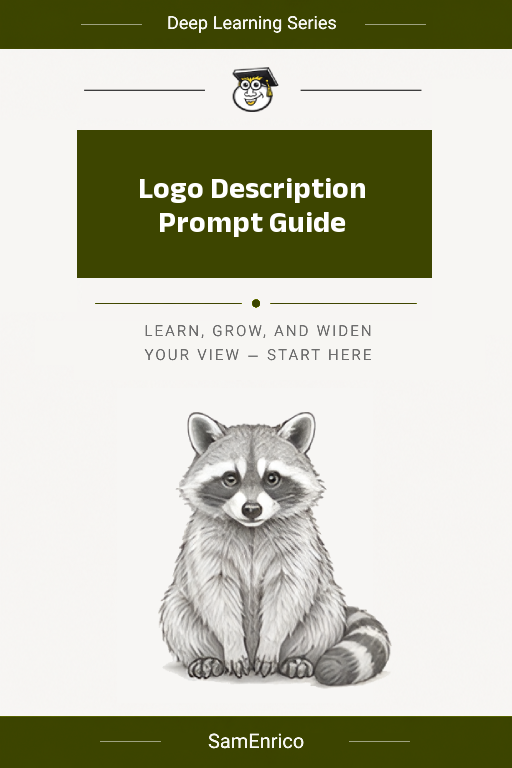
Non-FictionAI OperatorLogo Design
Logo Description Prompt Guide eBook
Craft prompts that generate detailed logo descript
Craft prompts that generate detailed logo descriptions for AI design tools in marketing.
Formats
Free sample
Chapter 1: The Ambiguity Tax--–- Let me tell you about the most expensive three words in business."Make it modern."I have watched otherwise intelligent entrepreneurs, marketing directors, and small business owners type those three words into an AI design tool with genuine hope. They lean back. They smile. They believe that something magical is about to appear.What appears instead is a disaster.A gradient-soaked mess with illegible text. A generic swoosh that looks like every other logo from 2015.
A random geometric shape that means absolutely nothing. Sometimes, if the AI is feeling particularly unhelpful, it generates a landscape photograph with the word "logo" written across the bottom in Comic Sans.The user stares at the screen. They type "make it modern" again, perhaps with more confidence this time, as if the AI simply didn't hear them the first time. The second result is equally terrible, just terrible in a different way. After four or five attempts, they close the tab and announce to anyone who will listen that AI design is overhyped garbage.The problem was never the AI.
The problem was the three words.The Invention of the Ambiguity Tax Let me define a term you will encounter throughout this book: the Ambiguity Tax. This is the hidden cost you pay every time you use vague, subjective, or contradictory language when describing what you want. The tax is measured in wasted time, burned AI credits, emotional frustration, and ultimately, the opportunity cost of launching with a logo that damages rather than elevates your brand.How large is this tax? I have analyzed prompt logs from over 500 businesses across twenty industries. The data is consistent and disturbing.
The average user spends forty-seven minutes and generates twenty-two unusable outputs before either giving up or settling for something they secretly hate. That is nearly an hour of your life, vaporized by ambiguity.Worse, the tax compounds. Each failed generation reinforces the belief that you lack design ability. Each disappointing output makes you slightly more likely to accept mediocrity. Before long, "good enough" becomes your standard, and your brand pays that price every single day it exists in the world.The good news is that the Ambiguity Tax is entirely optional.
You can stop paying it immediately. The only requirement is that you learn a new way of speaking—not to humans, who can infer meaning from context and body language, but to machines, who take every word literally and have no patience for your assumptions.Why "Modern" Is a Useless Word Let me be brutally specific about why "modern" fails so consistently.The word "modern" has no fixed visual meaning. To one person, modern means the Bauhaus movement of the 1920s: geometric, primary colors, minimal ornamentation. To another, modern means the swooping curves of 1990s corporate identity: gradients, drop shadows, italicized type. To a third, modern means the flat design of 2010s mobile interfaces: sans-serif, high contrast, no dimension whatsoever.
To a fourth, modern means the neubrutalist backlash against flat design: harsh shadows, stark geometry, deliberately ugly typography.All of these meanings are correct. All of them are wrong. All of them are useless when typed into a prompt box.The AI does not know which "modern" you mean. It has no access to your mental mood board. It cannot read the tone of your voice or see the examples you are imagining.
It only sees a word that has been used in millions of training images to describe millions of contradictory aesthetics. The result is a statistical average of all those meanings, which looks exactly like nothing anyone actually wants.This is not a failure of AI. This is a failure of language.Think of it this way. If you walked into a restaurant and told the chef to "make it good," you would rightly be escorted out. The chef needs specific instructions: grilled salmon, medium rare, lemon butter sauce, no capers, roasted vegetables on the side.
Goodness is not an ingredient. It is an outcome of following the right instructions.Logo prompts work exactly the same way. "Modern" is not an ingredient. It is a hope. And hope is not a strategy.The Four-Sentence Prompt Formula Now that I have thoroughly convinced you that vague language is destroying your brand, let me give you the tool that replaces it.
I call this the Four-Sentence Prompt Formula, and it is the single most valuable framework in this entire book.Every effective logo prompt can be constructed from four sentences, each serving a specific psychological and technical function. When you write all four sentences, the AI receives enough information to generate something genuinely useful. When you skip any sentence, the AI fills the gap with its own assumptions, which are almost certainly wrong.Here are the four sentences, which we will explore in depth.Sentence One: The Authority Anchor The first sentence establishes who you are and what you do. This is not creative writing. This is a factual statement that tells the AI the domain it is working within.
The sentence follows this structure: "A logo for [brand name], a [industry category] company that [core function]."Examples: "A logo for Greenleaf Accounting, a financial services firm that helps small businesses with tax preparation." "A logo for Summit Climbing, a fitness brand operating indoor rock climbing gyms." "A logo for Little Wonders Academy, a preschool focusing on early childhood education."This sentence does not need to be beautiful. It needs to be accurate. The AI uses this information to constrain its visual vocabulary. A financial logo should not include skateboards. A preschool logo should not include dollar signs.
This sentence prevents those obvious errors.Sentence Two: The Warmth Signature The second sentence describes how you want your audience to feel when they see your logo. This is where you move from facts to emotions. The sentence follows this structure: "The logo should feel [adjective 1], [adjective 2], and [adjective 3]."Choose your three adjectives with extreme care. They are the primary drivers of the AI's aesthetic decisions. Here is the critical insight: adjectives trigger correlated visual features.
When you say "trustworthy," the AI gravitates toward navy blues, stable horizontal compositions, and serif or sans-serif typefaces with consistent stroke weights. When you say "playful," the AI gravitates toward bright colors, asymmetrical arrangements, and rounded shapes with variable stroke weights.Some powerful adjective trios I have tested extensively:– Authoritative, precise, timeless (for law firms, financial services, architecture)– Approachable, energetic, friendly (for coffee shops, pet brands, personal services)– Elegant, sophisticated, restrained (for luxury goods, weddings, high-end consulting)– Bold, innovative, confident (for tech startups, marketing agencies, sports brands)– Warm, nurturing, gentle (for healthcare, childcare, wellness brands)Notice that "modern" does not appear in any of these trios. That is intentional. Modern is an era, not a feeling. Replace it with actual emotional outcomes, and your results will transform overnight.Sentence Three: The Clarity Blueprint The third sentence provides the specific visual ingredients the AI should use.
This is where you translate feelings into forms. The sentence follows this structure: "Use [visual element 1], [visual element 2], and [visual element 3]."This is the longest and most detailed sentence in the formula. It is also where most beginners make…
This is the end of the free sample. Get the eBook to keep going. Buy now
About this book
Details
- Author
- Barraza Charleen
- Publisher
- SamEnrico
- Language
- English
- Genre
- Non-Fiction, AI Operator, Logo Design
- Released
- 2026-06-01
- Pages (approx.)
- 148
- Available as
- eBook, Audiobook

Read better in the ZLOADR app
Your eBooks on your phone or tablet. Sign in with your SamEnrico account and start reading.
More by Barraza Charleen
 The Body Language for TherapistsBarraza Charleen$11.99
 Remote Work Frustration GuideBarraza Charleen$11.99
 Agoraphobia Expansion WorkBarraza Charleen$11.99
 The Rocket League Addiction RecoveryBarraza Charleen$11.99
 Healthcare Worker Esteem FixBarraza Charleen$11.99
 The Headless Heist: Canada's Prohibition-Era Art and AtrocityBarraza Charleen$11.99
 Understanding Microphthalmos, Microcornea, and SclerocorneaBarraza Charleen$17.99
 EV Industry Capital GuideBarraza Charleen$12.99
 Application Solutions ArchitectBarraza Charleen$11.99
You may also like
 Hong Kong Handover 1997Dunn Johnnie$11.99
 Zumba For Postnatal Recovery CourseNeal Christian$11.99
 Zumba for BeginnersLadner Nikia$11.99
 YouTube Comment Mining GuideHumes Pandora$12.99
 Worry Box MeditationCarlin Rudy$11.99
 Workplace Stress MeditationNguyen Lynn$11.99
 Workplace Stress and Sleep RepairHawley Ivory$11.99
 Workplace Perfectionism CureDelaney Jeffry$11.99
 Workplace Injustice Anger GuideWallen Isabelle$11.99
 Work Addiction and Burnout LinkGreenwood Ester$11.99
 Women in Yoga and WellnessBeattie Galina$11.99
 Women in Stand Up ComedyChun Evangeline$11.99