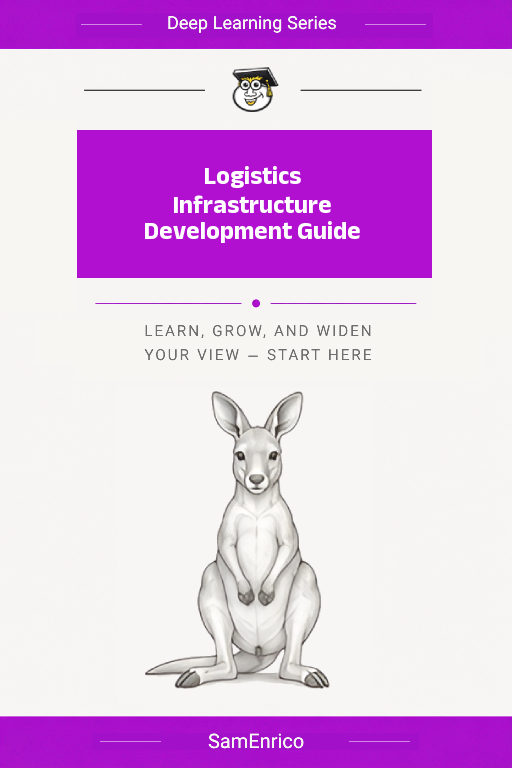
Logistics Infrastructure Development Guide eBook
Project port modernization in Mombasa, Dakar, and
by Hogg Raina
Project port modernization in Mombasa, Dakar, and Durban; railway corridors; and inland container depots.
Formats
Free sample
Chapter 1: The Container's Journey...–- The blue metal box arrives on a ship the size of four football fields, stacked twelve high with identical boxes, each one carrying a story that the shipping line does not know and does not care to know. Inside this particular box—a standard twenty-foot equivalent unit, or TEU, leased from a Chinese firm and tracked by a German software system—are four thousand pairs of sneakers manufactured in Vietnam, bound for a warehouse in Nairobi, and from there to shops in Kampala and Kigali. The box has traveled nine thousand nautical miles across the Pacific and Indian Oceans, passing through three transshipment ports, and has now arrived at its first African landfall: the port of Mombasa, Kenya. What happens next—how long the box waits, how it is unloaded, whether it is scanned or stolen, whether it transfers to rail or road, and when it finally reaches its destination—is the subject of this book. And what happens next is, by global standards, shockingly inefficient.The container's journey from ship to shelf in Africa takes three to four times longer, and costs two to three times more, than the same journey in Southeast Asia or Latin America.
This is not because Africa lacks intelligent people or willing workers. It is because the physical infrastructure of African logistics—the ports, the rails, the inland depots, and the digital systems that connect them—was designed for a different era and has not kept pace. The container does not care about politics or history. It cares about friction: how many times it is handled, how many signatures are required, how many days it sits under the sun waiting for a customs officer who did not show up for work. This chapter is about that friction.
It is about the three ports that will serve as our case studies throughout this book—Mombasa, Dakar, and Durban—and about the strategic landscape that connects them. Before we can fix the infrastructure, we must understand the geography, the economics, and the legacy of extraction that shaped it.The Geography of African Trade: Why Ports Sit Where They Sit Look at a map of Africa’s coastline—30,000 kilometers of it, from the Mediterranean to the Cape of Good Hope—and you will notice something strange. The natural harbors are few and far between. Unlike Europe’s fjords or Southeast Asia’s sheltered straits, Africa’s coast is remarkably straight, with deepwater anchorages clustered at specific points where geology and colonial ambition intersected. Mombasa sits on a coral-reef-protected channel carved by ancient volcanoes.
Dakar juts into the Atlantic on the Cap-Vert peninsula, a rare deepwater location on the otherwise shallow West African coast. Durban occupies a natural lagoon formed by the Bluff, a sandstone ridge that protects the harbor from the Indian Ocean’s heavy swells.These three ports were not chosen at random. They were chosen because they offered the only safe anchorages for hundreds of kilometers in either direction. The colonial powers—Britain in Mombasa and Durban, France in Dakar—built railways that ran from these ports straight into the interior, not to connect Africa to itself but to extract its resources: ivory and rubber from the Congo Basin, groundnuts and cotton from the Sahel, gold and diamonds from the Transvaal. The result is a logistics network that looks like a radial diagram: ports connected to mines and farms, but not to each other.
A container arriving in Mombasa and destined for Lagos must travel 6,000 kilometers by road, crossing a dozen borders, because no railway connects the Indian Ocean to the Atlantic across the continent’s waist. This fragmentation is the single most important fact about African logistics. Everything else follows from it.The Three Ports: A Strategic Overview Mombasa: The Eastern Gateway Mombasa is not just Kenya’s largest port; it is the maritime lifeline for Uganda, Rwanda, Burundi, South Sudan, and the eastern provinces of the Democratic Republic of Congo. These landlocked nations have no other practical outlet to the sea. Dar es Salaam to the south offers an alternative, but the Central Corridor through Tanzania is longer and less developed for containerized cargo.
Lamu to the north, part of the ambitious LAPSSET project, remains partially operational but drastically underutilized—a cautionary tale we will return to later in this chapter.The port handles over 35 million tonnes of cargo annually, of which roughly 1.5 million TEUs are containerized. Its deepwater channel at Kilindini has a draft of 15 meters, sufficient for mid-range vessels of up to 5,500 TEUs. The Mombasa Container Terminal (MCT) operates two terminals with a combined quay length of 1.2 kilometers and twelve ship-to-shore cranes. On paper, the numbers are respectable. In practice, the port suffers from chronic congestion, with average vessel waiting times of four to six days and import dwell times averaging six days—double the target set by the Kenya Ports Authority.Why the gap between capacity and performance?
Part of the answer is physical: the port’s hinterland connections, particularly the rail link to the Nairobi Inland Container Depot, are bottlenecked. Part of the answer is digital: the Port Community System, intended to streamline customs clearance, operates in parallel with paper processes, creating confusion and opportunities for corruption. And part of the answer is political: the Kenya Ports Authority faces pressure to keep tariffs low, limiting its ability to invest in automation. These are not unique problems. As we will see, Dakar and Durban face their own versions of the same underlying challenge: governance, not concrete, is the binding constraint.Dakar: The Atlantic Pivot If Mombasa is the gateway to the east, Dakar is the hinge of the west.
The port of Dakar handles approximately 20 million tonnes of cargo annually, including 700,000 TEUs of containerized goods. Its 16-meter draft accommodates mid-range to large vessels, and its location on the westernmost point of Africa makes it a natural transshipment hub for traffic between Europe, South America, and the Cape route.Dakar’s strategic importance, however, extends beyond its physical capacity. It is the primary port for Mali, one of West Africa’s largest economies, connected by the 1,200-kilometer Dakar–Bamako railway—a colonial-era line that has been revived through a public-private partnership. The condition of that railway directly determines Dakar’s port performance. When the railway functions, containers move from ship to train to Bamako in seven to ten days.
When it fails—as it did for extended periods between 2010 and 2018—the cargo shifts to trucks, clogging the port, damaging the roads, and increasing costs by as much as 40 percent.Dakar’s recent modernization has been driven by two forces. The first is digitization: the Port Autonome de Dakar (PAD) implemented a single-window platform that reduced import clearance from twelve days to five days, and for low-risk goods, to forty-eight hours. The second is energy: the Sangomar offshore oil field, which began production in 2024, has transformed Dakar into a logistics hub for drilling equipment and pipeline modules. These dual drivers—efficiency and energy—make Dakar the most balanced of the three ports in terms of performance metrics. But as we will see in Chapter 8, the railway corridor to Mali runs through a region plagued by insurgency, and no…
This is the end of the free sample. Get the eBook to keep going. Buy now
About this book
Details
- Author
- Hogg Raina
- Publisher
- SamEnrico
- Language
- English
- Genre
- Non-Fiction, Forecast & Outlook, Logistics
- Released
- 2026-05-29
- Pages (approx.)
- 151
- Available as
- eBook, Audiobook

Read better in the ZLOADR app
Your eBooks on your phone or tablet. Sign in with your SamEnrico account and start reading.
More by Hogg Raina
 Burnout In Mental Health ProvidersHogg Raina$11.99
 Senior Financial Management WorkbookHogg Raina$11.99
 Pre Talk Silence PracticeHogg Raina$11.99
 French Maquis Sabotage OperationsHogg Raina$11.99
 Overcoming the Clumsy Child LabelHogg Raina$11.99
 Chevalier de Saint-Georges: The Swashbuckling Virtuoso of VersaillesHogg Raina$11.99
 How to Become a Cocoa-room OperatorHogg Raina$11.99
 Live Data Presentation TipsHogg Raina$12.99
 Understanding Macrocephaly Pigmentation Large Hands FeetHogg Raina$17.99
 Lead Controls Systems TechnicianHogg Raina$11.99