
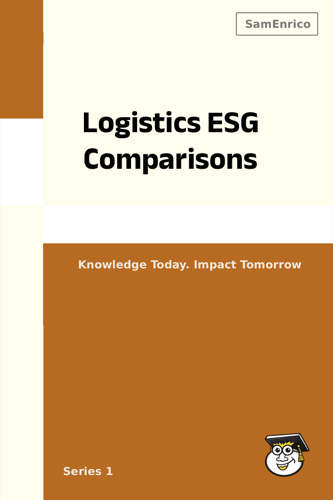
Non-FictionStrategic AtlasLogistics ESG
Logistics ESG Comparisons eBook
Rank fleet electrification and last mile efficienc
by Hinds Luanne
Rank fleet electrification and last mile efficiency among shipping and delivery firms.
Formats
Free sample
Chapter 1: The Ranking Mandate--The memo arrived on a Tuesday, buried between a fleet utilization report and a reminder about quarterly driver safety training. For most logistics managers, it would have been deleted without a second thought. But for those paying attention—the ones who noticed that their largest shipper had just updated their supplier code of conduct for the third time in eighteen months—the memo was a warning shot. A major retail client was now requiring all third-party logistics partners to disclose their fleet's emissions per package delivered, broken down by zip code, and to provide a public-facing ESG scorecard by the end of the fiscal year. No disclosure meant no contract renewal.
No contract renewal meant the end of a relationship that accounted for nearly forty percent of annual revenue.This is not a hypothetical scenario. It is already happening.The logistics industry stands at a precipice unlike any it has faced since the deregulation waves of the 1980s. But this time, the disruption is not coming from new entrants with cheaper rates or innovative routing algorithms. It is coming from a fundamental redefinition of what constitutes a "good" logistics partner. The metrics that have governed carrier selection for decades—price, speed, reliability—are now being joined by a fourth, more complex, and arguably more consequential dimension: ESG performance.
Environmental, Social, and Governance criteria, once the domain of sustainability officers and corporate social responsibility reports, have become core financial and operational imperatives. And for the first time in the history of freight transport, logistics firms are being ranked, compared, and selected or rejected based on how their fleet electrification and last-mile efficiency stack up against their competitors.This chapter establishes the foundational thesis of this book: comparing ESG performance in logistics is no longer a voluntary exercise for sustainability reports. It is a core financial and operational imperative that will determine which firms survive the next decade and which become cautionary tales taught in business schools. The shift from diesel to electric is inevitable, but more importantly, the ability to rank and be ranked on that transition has become the single most important competitive differentiator in modern logistics.The E-Commerce Tipping Point That Broke the Old Model To understand why ranking matters now, we must first understand how the ground shifted beneath the logistics industry. The COVID-19 pandemic did not invent e-commerce, but it did something more profound: it compressed a decade of growth into three months.
In April 2020, e-commerce penetration in the United States jumped from roughly sixteen percent to over twenty-seven percent in a single month—a leap that had been projected to take five to six years. Overnight, delivery networks designed for predictable, steady-state volumes were overwhelmed by a tsunami of packages, each with its own destination, time window, and customer expectation.The old logistics model was built on a set of assumptions that no longer hold. It assumed that fuel prices would remain relatively stable and that diesel would continue to be the most cost-effective energy source for moving goods. It assumed that cities would continue to allow diesel deliveries during daytime hours without restriction. It assumed that drivers would tolerate the noise, vibration, and heat of diesel cabs because that was simply how the job had always been.
And it assumed that customers cared primarily about speed and price, with environmental considerations relegated to a distant third priority.All of these assumptions have been systematically dismantled.Consider the sheer volume of the challenge. Global e-commerce sales exceeded five trillion dollars in 2022 and are projected to reach eight trillion by 2027. Each of those dollars represents physical goods that must be picked, packed, and delivered. The last mile—the final leg of the journey from distribution center to customer doorstep—accounts for roughly fifty-three percent of total shipping costs and a disproportionate share of emissions. A single delivery van making a hundred stops per day in an urban area can emit more than fifty metric tons of carbon dioxide annually, along with nitrogen oxides and particulate matter that contribute to respiratory disease in the communities it serves.The pandemic did not cause these problems.
It simply exposed them with brutal clarity. Delivery networks that had been optimized for cost and speed revealed their fragility when confronted with simultaneous pressures: surging volume, driver shortages, supply chain disruptions, and the sudden realization that diesel dependency is not just an environmental issue but a strategic vulnerability.The Risk of Standing Still: Three Lenses on a Changing Landscape For logistics firms that choose to maintain the status quo, the risks are no longer theoretical or distant. They are immediate, quantifiable, and accelerating. These risks manifest through three distinct but interconnected channels: regulatory penalties and access restrictions, reputational damage and capital costs, and shifting customer preferences. Each channel alone would be sufficient to justify a strategic response.
Together, they create an overwhelming case for action.Regulatory Risk: The Rising Cost of Diesel Access The first and most immediate risk is regulatory. Cities around the world are systematically restricting diesel vehicles from their urban cores, and the pace of these restrictions is accelerating.London provides the most advanced and instructive example. The city's Ultra Low Emission Zone (ULEZ), which initially covered only the central congestion zone, was expanded in 2021 to encompass the entire area within the North and South Circular roads—a fifteen-fold increase in size. Diesel trucks that do not meet strict emissions standards now face a daily charge of one hundred pounds (approximately one hundred twenty-five dollars). For a delivery firm operating twenty trucks making daily trips into London, that adds up to over nine hundred thousand dollars annually in compliance costs alone.
And London is not an outlier. Over two hundred European cities have implemented or announced plans to implement Low Emission Zones, with many planning to transition to Zero Emission Zones by 2030. Paris has banned diesel vehicles from its center entirely. Brussels has restricted access for pre-Euro 6 diesel trucks. Madrid has implemented a city-wide Low Emission Zone covering the entire municipality.The trend is spreading beyond Europe.
In the United States, California has led the way with the Advanced Clean Fleets regulation, which requires drayage trucks operating at ports and rail yards to be zero-emission by 2035 and all last-mile delivery vans to be zero-emission by 2040. New York City has established the nation's first congestion pricing zone, with higher fees for diesel trucks. Los Angeles and Long Beach, which together form the busiest port complex in the Western Hemisphere, have mandated that all new drayage truck registrations be zero-emission. China has established green logistics demonstration zones in over a dozen cities, with preferential access for electric delivery vehicles.The pattern is consistent and unmistakable. Diesel access is becoming more expensive, more restricted, and ultimately untenable in the world's most valuable delivery markets.
Logistics firms that cannot offer zero-emission delivery options will find themselves excluded from the very markets where demand is densest and margins are highest.Reputational and Capital Risk: The Financial Cost of Being Dirty The second category of risk is financial but operates through reputational channels. Major shippers—the Walmart's, Unilever's, and IKEA's of the world—have made aggressive decarbonization commitments and are now demanding that their logistics partners…
This is the end of the free sample. Get the eBook to keep going. Buy now
About this book
Details
- Author
- Hinds Luanne
- Publisher
- SamEnrico
- Language
- English
- Genre
- Non-Fiction, Strategic Atlas, Logistics ESG
- Released
- 2026-06-08
- Pages (approx.)
- 139
- Available as
- eBook, Audiobook

Read better in the ZLOADR app
Your eBooks on your phone or tablet. Sign in with your SamEnrico account and start reading.
More by Hinds Luanne
 Cremation Burial Memorial Planning CourseHinds Luanne$11.99
 Stress And Witness AccuracyHinds Luanne$11.99
 Metta for Family ConflictHinds Luanne$11.99
 The Letting Go of Anger GuideHinds Luanne$11.99
 The Terracotta Warriors: How King Zheng Forged an EmpireHinds Luanne$11.99
 Business Email Credit ImpactHinds Luanne$12.99
 Connection Requests That Get AcceptedHinds Luanne$12.99
 Understanding Say–Meyer SyndromeHinds Luanne$17.99
 Physical ScientistHinds Luanne$11.99
 How to Become a Drying-unit-felting-machine OperatorHinds Luanne$11.99
You may also like
 Hong Kong Handover 1997Dunn Johnnie$11.99
 Zumba For Postnatal Recovery CourseNeal Christian$11.99
 Zumba for BeginnersLadner Nikia$11.99
 YouTube Comment Mining GuideHumes Pandora$12.99
 Worry Box MeditationCarlin Rudy$11.99
 Workplace Stress MeditationNguyen Lynn$11.99
 Workplace Stress and Sleep RepairHawley Ivory$11.99
 Workplace Perfectionism CureDelaney Jeffry$11.99
 Workplace Injustice Anger GuideWallen Isabelle$11.99
 Work Addiction and Burnout LinkGreenwood Ester$11.99
 Women in Yoga and WellnessBeattie Galina$11.99
 Women in Stand Up ComedyChun Evangeline$11.99