
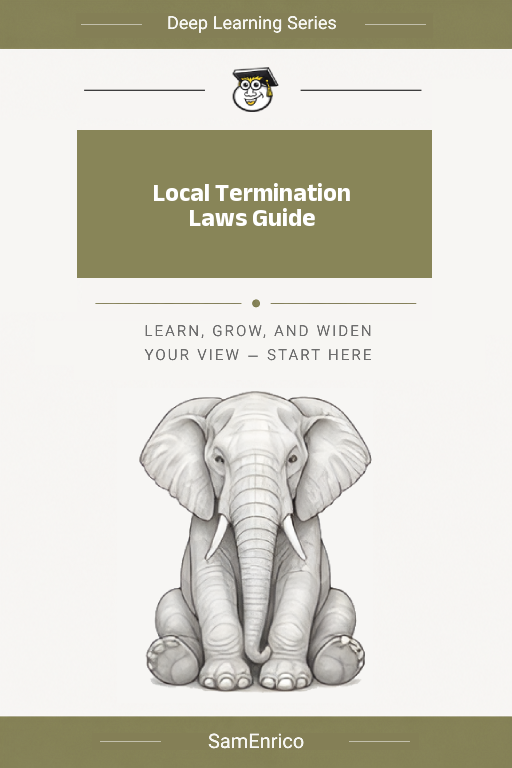
Local Termination Laws Guide eBook
Understand franchise termination protections in ea
by Baum Su
Understand franchise termination protections in each target country. Some jurisdictions require good cause and extended notice periods before termination.
Formats
Free sample
Chapter 1: The Paper Lie--Most franchise owners believe their contract is a shield. They sign it after weeks of negotiation, file it in a cabinet, and assume that its words—"termination for cause," "material breach," "thirty days' notice"—will govern any future dispute. This belief is wrong. In some cases, it is catastrophically wrong.Consider two franchisees, both operating the same national brand. Both fall behind on royalties by three months.
Both receive identical termination notices citing the same contract section. One loses everything. The other keeps his store, collects damages, and watches his franchisor pay his legal fees. The difference between them was not their performance. It was their zip code.The first franchisee operated in Texas.
Texas has no specific franchise relationship law. His contract said the franchisor could terminate for "any material breach," and three months of unpaid royalties qualified. A judge enforced the contract as written. His business closed within sixty days.The second franchisee operated in Wisconsin. Wisconsin has a franchise investment law that requires "good cause" for termination—and defines "good cause" narrowly.
His franchisor sent the same termination letter. The franchisee challenged it. The court ruled that three months of late payments, while serious, was a curable breach. The franchisor had not offered a cure period as Wisconsin law required. The termination was void.
The franchisee kept his store, and the court ordered the franchisor to pay $147,000 in statutory damages plus attorney's fees.Same brand. Same default. Same contract language. Different outcome based entirely on geography.This is the central reality that this book will drill into every page: the risk of terminating a franchise is not determined by the language of your contract alone. It is determined by the specific laws of the jurisdiction where the store is located.
Those laws—often called "relationship laws"—override contract terms, create mandatory notice periods, require cure rights, impose repurchase obligations, and in some cases shift the burden of proof to the franchisor. And they vary so dramatically that a lawful termination in one state can be a six-figure liability in the next.This chapter dismantles the foundational misconception that a signed franchise agreement is the final word on termination. It introduces the concept of regulatory override—how statutes and judicial precedings can nullify or transform contractual provisions. It maps the complex U.S. patchwork of state laws, from the most protective "fortress" states to the deceptively risky "no statute" states.
It contrasts the common law world, where contract text dominates, with civil law jurisdictions, where statutory duties of good faith permeate every commercial relationship. And it establishes the key terminology—"good cause," "just cause," "justifiable reason," "legitimate business reason"—that will appear throughout the book, always with the same consistent meaning.By the end of this chapter, you will understand why your contract is not the shield you think it is. And you will be prepared to navigate the far more important document: the map of local termination laws that actually governs your rights and risks.The Regulatory Override: When Statutes Trump Contracts Franchise relationship laws are a specific category of legislation that limits the ability of franchisors to terminate, non-renew, or transfer franchise agreements. These laws are fundamentally different from the disclosure laws (such as the FTC Franchise Rule) that govern what information franchisors must provide before a sale. Relationship laws govern what happens after the sale—sometimes years or decades later.The legal mechanism at work is simple but powerful: a statute overrides contrary contract terms.
If a state law says termination requires "good cause," a contract clause saying "we may terminate for any reason" is void. If a state law requires ninety days' notice, a contract clause saying "ten days' notice" is unenforceable. If a state law requires a sixty-day cure period, a franchisor who terminates without offering cure has not terminated at all—the franchise remains in effect, and the franchisor may owe damages.This override principle is not controversial. Courts have uniformly held that franchise relationship laws are exercises of a state's police power—the authority to regulate for the health, safety, and general welfare of its citizens. In the franchise context, the citizen being protected is the franchisee: typically a small business owner who has invested life savings, retirement funds, and years of labor into a single location.
The state's interest is preventing economic coercion, protecting local investment, and maintaining small business stability.Consider the language of a typical franchise relationship law. The New Jersey Franchise Practices Act declares:"The Legislature finds that the substantial investment of a franchisee in the franchisor's business enterprise is made upon the mutual understanding that the relationship is a continuing one. The franchisee relies upon the continuation of the relationship for the return on its investment. It is therefore the public policy of this State to protect franchisees from the use of unfair or inequitable contractual provisions that permit the termination or non-renewal of a franchise without good cause."This is not subtle. The legislature is telling courts: ignore contract terms that would allow termination without good cause.
The contract is not the final word. The statute is.The same principle applies internationally. South Korea's Fair Franchise Transactions Act states that a franchisor "shall not refuse to renew a franchise agreement without justifiable reason." Brazil's Civil Code provides that notice of termination for a commercial relationship of continuous duration "shall be proportional to the length of the relationship." Germany's courts have held that an implied duty of good faith restricts termination even when the contract says otherwise.The pattern is clear across jurisdictions: relationship laws exist to protect franchisees from the raw exercise of contractual power. And they work. A franchisor who ignores them does so at its own peril.The U.S.
Patchwork: Red, Yellow, and Green The United States has no federal franchise relationship law. Instead, individual states have enacted their own statutes, creating a patchwork that ranges from extremely protective to entirely absent. Understanding this patchwork is essential for any franchisor operating across state lines—and for any franchisee wanting to know their rights.This book uses a three-color system to categorize states. The colors are not judgments about which states are "good" or "bad" for franchisors or franchisees. They are descriptors of the legal landscape: the presence or absence of specific statutes, the content of those statutes, and the judicial environment that interprets them.Red States have enacted specific franchise relationship statutes that provide significant protections to franchisees.
These statutes typically require good cause for termination, mandate notice and cure periods, and in some cases require repurchase of inventory or impose other obligations on franchisors. The red states include California, Illinois, Michigan, Wisconsin, New Jersey, and approximately fourteen others, depending on how one counts variations in coverage (some statutes apply only to specific industries like gasoline or farm equipment). Chapters 3 and 4 provide detailed analysis of the key red states.Yellow States have no specific franchise relationship statute, but common law doctrines—particularly the implied covenant of good faith and fair dealing—provide meaningful protections that courts have used to block terminations. The yellow states include New York, Texas, Georgia, and Nevada. In these states, a franchisor cannot simply rely on…
This is the end of the free sample. Get the eBook to keep going. Buy now
About this book
Details
- Author
- Baum Su
- Publisher
- SamEnrico
- Language
- English
- Genre
- Non-Fiction, Business Brief
- Released
- 2026-05-29
- Pages (approx.)
- 145
- Available as
- eBook, Audiobook

Read better in the ZLOADR app
Your eBooks on your phone or tablet. Sign in with your SamEnrico account and start reading.
More by Baum Su
 Nap Environment SetupBaum Su$11.99
 Road Rage for Delivery DriversBaum Su$11.99
 Alternative Depreciation System GuideBaum Su$11.99
 Loving Kindness for a Teenage RebelBaum Su$11.99
 Stress And Hives ScienceBaum Su$11.99
 Immigrant SaaS Unicorn Builder GuideBaum Su$11.99
 Working Memory MythsBaum Su$11.99
 Benigno AquinoBaum Su$11.99
 Anger Transformation With NVCBaum Su$11.99
 The Great Balloon Blunder: How a Skyward Empire Fell to EarthBaum Su$11.99
 The Dragon’s Last Lament: A Breton Ballad of Fire and SorrowBaum Su$11.99
 Liza with a Z: The Unstoppable Force of Liza MinnelliBaum Su$11.99
You may also like
 Hong Kong Handover 1997Dunn Johnnie$11.99
 Zumba For Postnatal Recovery CourseNeal Christian$11.99
 Zumba for BeginnersLadner Nikia$11.99
 YouTube Comment Mining GuideHumes Pandora$12.99
 Worry Box MeditationCarlin Rudy$11.99
 Workplace Stress MeditationNguyen Lynn$11.99
 Workplace Stress and Sleep RepairHawley Ivory$11.99
 Workplace Perfectionism CureDelaney Jeffry$11.99
 Workplace Injustice Anger GuideWallen Isabelle$11.99
 Work Addiction and Burnout LinkGreenwood Ester$11.99
 Women in Yoga and WellnessBeattie Galina$11.99
 Women in Stand Up ComedyChun Evangeline$11.99