
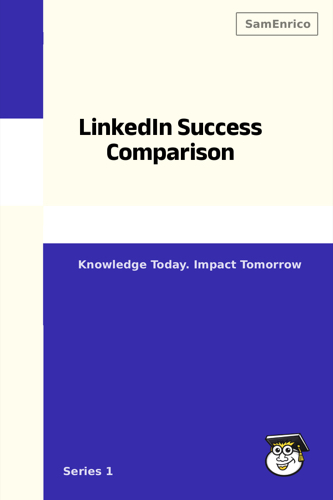
LinkedIn Success Comparison eBook
Resists comparing your career path to curated prof
Resists comparing your career path to curated professional achievements.
Formats
Free sample
Chapter 1: The $100,000 Tax--Let me tell you about a woman named Maya. She is thirty-two years old. She is a product manager at a mid-sized software company that you have probably heard of but would not name-drop at a dinner party. She makes a comfortable living, enough to afford a one-bedroom apartment in a city where that is no longer a given, enough to save for retirement, enough to take one nice vacation a year. By any objective measure, Maya is successful.
She is good at her job. Her performance reviews are consistently strong. Her team respects her. Her manager has mentioned her name in conversations about "future leadership." She delivers. She shows up.
She does the work.And yet, every evening, after she has closed her laptop and poured herself a glass of wine, Maya opens Linked In. She tells herself she is just checking messages, just keeping up with industry news, just maintaining her professional network. But within sixty seconds, she has seen something that makes her stomach twist. A former classmate from her MBA program has been promoted to "Senior Director of Product" at a startup that just raised a Series B. The post includes a photograph of the celebratory dinner, the team toasting with champagne, the words "thrilled to announce" glowing like a beacon of other people's success.
Maya closes the app. She finishes her wine. She wonders, for the thousandth time, what she is doing wrong.Maya is not alone. She is not broken. She is not failing.
She is falling victim to a system that is older than the internet but has been supercharged by it: the toxic asymmetry of curated professional success. This chapter is about that asymmetry. It is about why Linked In specifically triggers such intense comparison, why your brain cannot help but fall into the trap, and what it is costing you. The answer, as the title of this chapter suggests, is approximately one hundred thousand dollars over the course of your career. That is the Career Confidence Tax—the lifetime earnings you lose to stalled momentum, avoided opportunities, and chronic under-negotiation caused by comparison-driven imposter syndrome.The Highlight Reel Industrial Complex What Maya sees on Linked In is not a representative sample of anyone's career.
It is a curated highlight reel. She sees the job promotions, the certificates, the "thrilled to announce" posts, the work anniversaries, the photos of new offices with city views, the humblebrags about speaking at conferences, the earnest declarations of gratitude that are really declarations of achievement. What she never sees are the rejections, the failed interviews, the projects that went nowhere, the layoffs, the quiet afternoons spent staring at a screen wondering if any of it matters. She does not see the imposter syndrome that plagues the Senior Director of Product. She does not see the burnout behind the champagne toast.
She does not see the nights spent crying in the bathroom, the therapy bills, the marriages strained by ambition, the quiet desperation of people who have everything and feel nothing.This asymmetry is not an accident. It is the product of what this book calls The Highlight Reel Industrial Complex—the self-perpetuating system of platform design, social pressure, and psychological vulnerability that tricks you into believing everyone is succeeding except you. The term is deliberately provocative because the phenomenon demands provocation. Linked In, like all social media platforms, is not a neutral window into other people's lives. It is a hall of mirrors, carefully engineered to keep you looking, clicking, and comparing.
Your anxiety is not a bug. It is a feature. It is the engine that drives engagement. And engagement, as every public company will tell you, is the only metric that matters.The Highlight Reel Industrial Complex has three components. First, there is the platform architecture—the notification badges, the endorsement counts, the "people also viewed" features, the feed algorithms that prioritize celebratory announcements over nuanced reflection.
We will dissect these in Chapter 3. Second, there is the social pressure—the unspoken rule that Linked In is for professional polish, not honest struggle. No one posts about the interview they bombed or the project that failed. To do so would be unprofessional. And so the struggles remain invisible, and the successes multiply, and the gap between appearance and reality widens with every scroll.
Third, there is the psychological vulnerability—the wiring in your brain that makes social comparison automatic, involuntary, and exhausting. That wiring kept your ancestors alive. It is now keeping you stuck.The Social Comparison Trap In 1954, a psychologist named Leon Festinger published a paper that would become one of the most cited in the history of social science. Its title was "A Theory of Social Comparison Processes." Festinger's insight was simple and profound: humans have an innate drive to evaluate themselves, and when objective measures are unavailable, they evaluate themselves by comparing themselves to other people. This is not a character flaw.
It is a survival mechanism. If you are a caveman and you do not know whether you are strong enough to fight a saber-toothed tiger, you look at the other cavemen. If they are running, you run. If they are fighting, you fight. Comparison saves lives.But here is the problem.
Career success is deeply ambiguous. There is no single scoreboard. There is no objective measure of whether you are "on track" or "falling behind." You cannot look at a number on a dashboard and know if you are winning. So your brain does what it evolved to do: it looks for comparisons. It scans your environment for other people who seem to be in a similar situation.
It asks: How am I doing compared to them? And because the environment you are scanning is Linked In, which shows you only the greatest hits, your brain concludes that everyone else is crushing it. The availability heuristic makes this worse. The availability heuristic is the tendency to judge the frequency or likelihood of an event based on how easily examples come to mind. When your feed is full of success stories, success stories come to mind easily.
Your brain concludes that success is everywhere and that you are being left behind.This is not paranoia. It is pattern recognition. The problem is not that your brain is broken. The problem is that the pattern it is recognizing is a lie. The availability heuristic works beautifully when the examples in your environment are representative of reality.
They are not. Linked In is not a representative sample of professional life. It is a funhouse mirror. And your brain, poor thing, does not know it is looking into a funhouse mirror. It thinks it is looking at reality.The Negativity Bias There is another psychological quirk that makes the comparison trap so difficult to escape.
It is called the negativity bias. Your brain remembers setbacks more vividly than successes. It weights negative information more heavily than positive information. It reacts more strongly to threats than to opportunities. This bias evolved for the same reason as social comparison: survival.
A caveman who forgot a saber-toothed tiger was a dead caveman. A caveman who forgot a delicious berry was just hungry. The brain prioritizes…
This is the end of the free sample. Get the eBook to keep going. Buy now
About this book
Details
- Author
- Marshall Wilbur
- Publisher
- SamEnrico
- Language
- English
- Genre
- Non-Fiction, Self-Help / Career
- Released
- 2026-06-07
- Pages (approx.)
- 104
- Available as
- eBook, Audiobook

Read better in the ZLOADR app
Your eBooks on your phone or tablet. Sign in with your SamEnrico account and start reading.
More by Marshall Wilbur
 Sitting Posture for MeditationMarshall Wilbur$11.99
 ABC Prioritization for Military PersonnelMarshall Wilbur$11.99
 The Priority and Hofstadter LawMarshall Wilbur$11.99
 Alcohol Recovery Phone Apps GuideMarshall Wilbur$11.99Alcohol Recovery Phone Apps GuideMarshall Wilbur$11.99
 James Van Praagh GuideMarshall Wilbur$11.99
 Pomodoro For Anxiety ManagementMarshall Wilbur$11.99
 Mentally Ill Parent RecoveryMarshall Wilbur$11.99
 Yuki-Onna's Lament: The Snow Woman's Unspoken LoveMarshall Wilbur$11.99
 Loke's Lament: The Hidden Ballads of the Norse TricksterMarshall Wilbur$11.99
 Mastering The Art of Longquan (龙拳) Dragon FistMarshall Wilbur$11.99
 How to Produce Handbag and Wallet AccessoriesMarshall Wilbur$11.99
You may also like
 Hong Kong Handover 1997Dunn Johnnie$11.99
 Zumba For Postnatal Recovery CourseNeal Christian$11.99
 Zumba for BeginnersLadner Nikia$11.99
 YouTube Comment Mining GuideHumes Pandora$12.99
 Worry Box MeditationCarlin Rudy$11.99
 Workplace Stress MeditationNguyen Lynn$11.99
 Workplace Stress and Sleep RepairHawley Ivory$11.99
 Workplace Perfectionism CureDelaney Jeffry$11.99
 Workplace Injustice Anger GuideWallen Isabelle$11.99
 Work Addiction and Burnout LinkGreenwood Ester$11.99
 Women in Yoga and WellnessBeattie Galina$11.99
 Women in Stand Up ComedyChun Evangeline$11.99