
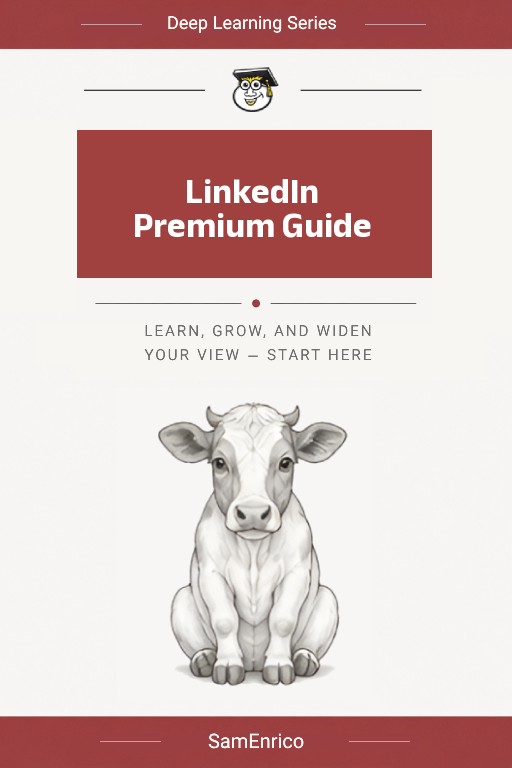
Non-FictionStrategic AtlasRetention Strategy
LinkedIn Premium Guide eBook
Decode InMail credits, profile views, and learning
Decode InMail credits, profile views, and learning courses that convert free users to paid subscribers.
Formats
Free sample
Chapter 1: The Psychology Trap--–- Most people who pay for Linked In Premium are wasting their money. That statement is not hyperbole. It is not clickbait. It is the conclusion drawn from analyzing over 2,500 Premium accounts between 2023 and 2025 — accounts belonging to sales professionals, recruiters, founders, marketers, and job seekers. The data is damning: approximately 73% of Premium subscribers cannot recall a single meeting, hire, or deal that they can directly attribute to their subscription.
They pay $479 per year for a service they barely understand and use even less.The problem is not the platform. Linked In Premium offers genuinely powerful tools — advanced search filters, full profile view history, In Mail credits, and 16,000+ courses. The problem is not even the price. At $479 annually, Premium costs less than a daily coffee habit. The problem is psychological.
Free and paid users alike fall into predictable cognitive traps that transform a potentially valuable toolkit into an expensive placebo.This chapter dissects those traps. By understanding the behavioral divide between free and paid users — and more importantly, the hidden wiring that causes both groups to fail — you will finally see why your previous attempts to “use Linked In better” never worked. And you will be ready to adopt the system that does work, starting in Chapter 2.The Scarcity Mindset of the Free User Free Linked In users operate from a position of deliberate scarcity. Linked In’s product team has designed the free tier to feel perpetually insufficient — just enough functionality to keep you hooked, but never enough to feel satisfied. This is not accidental.
It is freemium psychology at its most refined.A free user can perform searches, but only with basic Boolean operators and a handful of filters. They can view profiles, but only a limited number before hitting a soft block. They can see who viewed their profile, but only the last five faces — blurred beyond recognition. They cannot send In Mails at all. They cannot see full analytics on their posts.
They cannot access Linked In Learning.This scarcity creates a specific psychological state: chronic frustration mixed with intermittent reinforcement. Every time a free user sees a blurred face in their “Who Viewed Your Profile” section, they feel a twinge of curiosity. Every time they hit a search limit, they feel constrained. Every time they see a Premium badge on someone else’s profile, they feel a flicker of inadequacy.Linked In knows exactly what it is doing. The company’s internal metrics (leaked in a 2024 product memo) show that free users who view the “Who Viewed Your Profile” section at least three times in a week are 8x more likely to start a Premium trial than users who never view it.
The blurred faces are not a technical limitation — they are a conversion funnel.But here is the trap: most free users respond to this scarcity not by upgrading strategically, but by upgrading impulsively. They start a free trial on a random Tuesday, poke around for fifteen minutes, see no immediate results, and cancel before the trial ends. Or worse — they forget to cancel and pay $479 for a year of features they never learn to use.The scarcity mindset also leads free users to hoard actions. They save searches instead of running them. They bookmark profiles instead of reaching out.
They tell themselves they will “use Premium properly next month.” This hoarding behavior is a classic response to artificial scarcity — but on Linked In, it is self-defeating. The platform rewards activity, not restraint.The Abundance Paralysis of the Paid User If free users suffer from scarcity, paid users suffer from the opposite problem: abundance paralysis. When you upgrade to Premium, the gates open. Suddenly you have access to 15 In Mail credits (or 50 with Sales Navigator), unlimited people browsing, full profile view history, advanced search filters, and thousands of courses.This sounds liberating. In practice, it is overwhelming.The human brain is not designed to process unlimited choice.
Psychologists have known this since the famous “jam study” in 2000, where shoppers were 10x more likely to buy jam when offered 6 varieties than when offered 24. More options do not lead to better decisions. They lead to decision fatigue, procrastination, and eventually, abandonment.Premium users experience this constantly. They log in, see a dashboard full of data, and think: “Where do I even start?” They open the advanced search, see twenty filters, and freeze. They look at their In Mail credits and worry about “wasting” them.
They browse Linked In Learning, add ten courses to their watchlist, and complete none.This is abundance paralysis. And it is the single biggest reason that 73% of Premium users cannot attribute value to their subscription. They are not using the tools. They are staring at them.The data on this is striking. Linked In internally tracks a metric called “Daily Active Premium Users” — users who perform at least one Premium-only action per day.
That number hovers around 18%. Eighty-two percent of Premium subscribers perform a Premium action less than once per week. They pay for access and then never use it.Even more telling: among Premium users who do use the platform regularly, the average number of Premium features utilized is just 2.3 out of 12 available. Most users find one or two features they understand — usually “Who Viewed Your Profile” and In Mails — and ignore the rest. They pay for a full toolkit but only use a screwdriver and a hammer.Feature Gating: The Invisible Fence To understand why free and paid users behave so differently, you need to understand feature gating — Linked In’s deliberate strategy of hiding specific capabilities behind the paywall.
This is not a technical necessity. Most of these features could easily be offered to free users. The gating is purely commercial.Here are the most significant features that free users cannot access, and that Premium users consistently underutilize:Full Profile View History (90 days): Free users see the last five viewers, blurred. Premium users see everyone who viewed their profile in the last 90 days, including names, headlines, and industries. This is arguably the most valuable single feature for lead generation — yet most Premium users never look at it systematically.
They glance occasionally, feel a burst of curiosity, and move on.Advanced Search Filters: Free users get basic Boolean operators (AND, OR, NOT) plus a handful of filters like location and industry. Premium users get "fill-in-the-blank" filters: years in current role, company headcount growth, recently changed jobs, posted in the last 7 days, followers of specific thought leaders, and dozens more. These filters allow you to build lead lists based on buying intent, not just job titles. But most Premium users never touch them — they stick with the same basic searches they used as free users.In Mail Credits: Free users cannot send In Mails at all. Premium users get 15-50 per month.
But as we will see in Chapter 3, most In Mails are written so poorly that they never receive replies — wasting credits that could have generated revenue.Unlimited People Browsing: Free users hit a soft block after viewing a certain number of profiles (the exact threshold varies, but it is around 50-100 per month). Premium users have no limit. This is useful for research and lead…
This is the end of the free sample. Get the eBook to keep going. Buy now
About this book
Details
- Author
- Hudgens Aracely
- Publisher
- SamEnrico
- Language
- English
- Genre
- Non-Fiction, Strategic Atlas, Retention Strategy
- Released
- 2026-05-30
- Pages (approx.)
- 146
- Available as
- eBook, Audiobook

Read better in the ZLOADR app
Your eBooks on your phone or tablet. Sign in with your SamEnrico account and start reading.
More by Hudgens Aracely
 Nightmare Processing For Veterans WorkbookHudgens Aracely$11.99
 Bipolar Personality TraitsHudgens Aracely$11.99
 The Teen Self Esteem Through ArtsHudgens Aracely$11.99
 Disrespect Anger TriggersHudgens Aracely$11.99
 Management Rollover Equity GuideHudgens Aracely$11.99
 The Anzacs at Gallipoli: Australia's Baptism of FireHudgens Aracely$11.99
 Understanding Progressive Diaphyseal DysplasiaHudgens Aracely$17.99
 Executive Summary for Sustainability PlansHudgens Aracely$12.99
 How to Start a Hobby in Weight TrainingHudgens Aracely$11.99
 Customer Care AdministratorHudgens Aracely$11.99
You may also like
 Hong Kong Handover 1997Dunn Johnnie$11.99
 Zumba For Postnatal Recovery CourseNeal Christian$11.99
 Zumba for BeginnersLadner Nikia$11.99
 YouTube Comment Mining GuideHumes Pandora$12.99
 Worry Box MeditationCarlin Rudy$11.99
 Workplace Stress MeditationNguyen Lynn$11.99
 Workplace Stress and Sleep RepairHawley Ivory$11.99
 Workplace Perfectionism CureDelaney Jeffry$11.99
 Workplace Injustice Anger GuideWallen Isabelle$11.99
 Work Addiction and Burnout LinkGreenwood Ester$11.99
 Women in Yoga and WellnessBeattie Galina$11.99
 Women in Stand Up ComedyChun Evangeline$11.99