
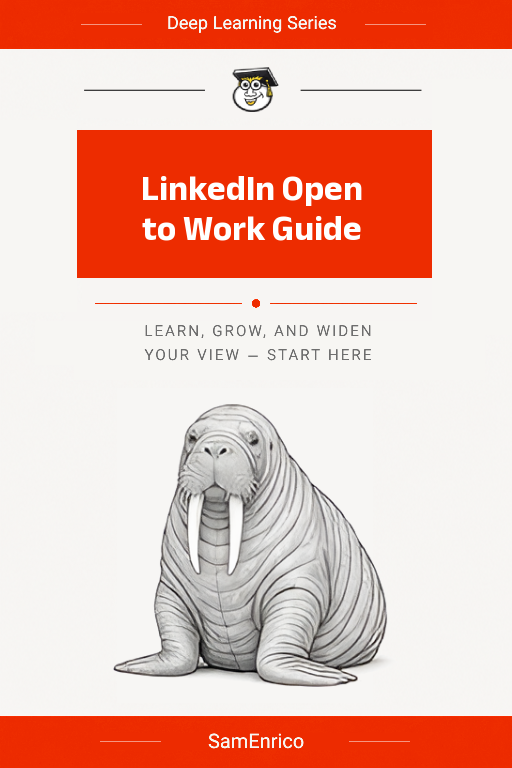
Non-FictionProfessional's Cheat SheetPersonal Branding
LinkedIn Open to Work Guide eBook
Use Open to Work feature effectively. Settings for
Use Open to Work feature effectively. Settings for recruiters only and privacy considerations.
Formats
Free sample
Chapter 1: The Loyalty Trap--–- It begins with a lie you have been told your entire career. The lie whispers that loyalty is rewarded, that silence is safe, and that the only honorable way to find a new job is to do it in secret, after hours, with your profile picture dimmed and your ambitions hidden. This chapter dismantles that lie completely.Every professional has heard the warning: do not let your boss catch you looking. Update your resume quietly. Browse job boards in incognito mode.
Never, ever turn on that green “Open to Work” badge because someone might see it. These warnings have been passed down through cubicles and corner offices for decades, masquerading as wisdom. But they are not wisdom. They are fear dressed in a suit and tie.The modern job market has fundamentally changed, yet the advice about how to navigate it remains stuck in the 1990s. In that era, the average worker stayed with a single employer for nearly ten years.
Pensions were common. Loyalty was a two-way street—or so it seemed. Companies offered stability, and workers offered decades of service. Job searching was something you did only when absolutely necessary, and you did it with the stealth of a spy.That world is gone. It has been replaced by something faster, more transparent, and infinitely more demanding.
The average American worker today changes jobs every four years. Among younger professionals, that number drops to every two years. Pensions have been replaced by 401(k)s that follow you from role to role. And the most successful professionals do not wait until they are miserable to start looking. They keep their options open continuously, strategically, and yes—publicly.This shift is not anecdotal.
The data tells a clear story. Passive candidates—those who are employed and not actively applying but remain open to hearing about opportunities—receive three times more recruiter outreach than active applicants who spend hours filling out online applications. Three times. The professional who quietly signals availability without desperation receives more offers than the one who applies to one hundred jobs through company career portals.Why does this happen? Because recruiters are lazy in the most efficient way possible.
Their job is not to find the best candidate. Their job is to find a good enough candidate as quickly as possible. Sorting through thousands of applications is expensive, time-consuming, and demoralizing. Searching for passive candidates who have already signaled openness is fast, cheap, and produces candidates who are employed—which recruiters irrationally prefer over unemployed candidates, even when qualifications are identical.This preference for passive candidates is called the “employed candidate bias,” and it is well documented in hiring research. Recruiters assume that someone who is currently employed must be competent because another company has already validated them.
Someone who is unemployed, regardless of circumstances, carries a stigma of uncertainty. Was she fired? Did she quit without a plan? Is there something wrong that other employers have noticed?The “Open to Work” feature on Linked In directly addresses this bias. When you enable it—even in “Recruiters Only” mode—you signal to the market that you are employed but curious.
You are not desperate. You are not scrambling. You are a professional who knows their worth and is willing to listen to offers that exceed it. That single signal changes how recruiters perceive you before they read a single word of your experience.But the benefits go beyond recruiter psychology. There is a deeper, more uncomfortable truth about career advancement that most professionals do not want to acknowledge.
Staying at the same company for a long time does not reward loyalty. It punishes it.Consider two identical professionals who start their careers at the same time. Professional A stays with one company for ten years, receiving annual raises of three percent. Professional B changes jobs every two to three years, receiving a ten to twenty percent increase with each move. After a decade, Professional B earns twice as much as Professional A, sometimes more.
This is not speculation. This is the data from the Federal Reserve Bank of Atlanta’s wage growth tracker, which has consistently shown that job switchers outearn job stayers by a significant and growing margin.Why does this happen? Because companies budget more for recruiting external talent than they do for retaining existing talent. It is an absurd and widely documented phenomenon. A company will happily pay a new hire twenty percent more than the person who has been doing the same job for five years, simply because the new hire’s salary comes from a different budget line item.
Internal raises come from the “merit increase” budget, which is typically capped at three to five percent. External offers come from the “recruiting” budget, which has no such cap.The “Open to Work” feature is the most direct tool you have for escaping this trap. By signaling your availability to the market, you invite external offers that reset your salary trajectory. You do not need to actively apply. You do not need to spend weekends rewriting cover letters.
You simply need to be findable.This brings us to the central framework of this book: the Human 5Cs. Originally developed by Linked In’s editorial team and expanded in the work of Ryan Roslansky and Aneesh Raman, the 5Cs represent the five human skills that artificial intelligence cannot replicate and that recruiters actively seek. They are Curiosity, Courage, Creativity, Compassion, and Communication. And the “Open to Work” feature directly signals two of them.Curiosity is the first signal. A professional who enables “Open to Work” is curious about what else exists.
They are not satisfied with the status quo. They want to know what other companies are doing, what other roles might fit their skills, what market rate actually looks like for their position. Curiosity is the engine of career growth. Without it, you stagnate.Courage is the second and more powerful signal. Enabling “Open to Work” takes courage because it carries real risk.
Your boss might see it. Your colleagues might ask questions. Your company’s recruiters might flag you as a flight risk. Choosing to signal openness despite these risks demonstrates courage—and recruiters recognize this. They know that a candidate who has the courage to market themselves is the same candidate who will have the courage to negotiate, to push back, to lead through uncertainty.Creativity, Compassion, and Communication are not directly signaled by the feature itself, but they become visible in how you use it.
The creative professional crafts a headline and announcement post that stands out. The compassionate professional engages with recruiters respectfully even when declining opportunities. The communicative professional responds within twenty-four hours and builds relationships that outlast any single job search.Together, these five skills form the foundation of what the modern labor market values. Technical skills can be taught. Software can be learned.
But the 5Cs are human, and they are increasingly rare in a world of automated applications and AI-generated cover letters. The “Open to Work” feature, used correctly, broadcasts that you possess the first two and are developing the other three.But there is another reason to embrace strategic visibility…
This is the end of the free sample. Get the eBook to keep going. Buy now
About this book
Details
- Author
- Tripp Reynalda
- Publisher
- SamEnrico
- Language
- English
- Genre
- Non-Fiction, Professional's Cheat Sheet, Personal Branding
- Released
- 2026-05-29
- Pages (approx.)
- 126
- Available as
- eBook, Audiobook

Read better in the ZLOADR app
Your eBooks on your phone or tablet. Sign in with your SamEnrico account and start reading.
More by Tripp Reynalda
 IP Protection For BootstrapTripp Reynalda$11.99
 The Office Chair Stretch RoutineTripp Reynalda$11.99
 Presentation Persuasion SkillsTripp Reynalda$11.99
 Conflict Resolution Self WorthTripp Reynalda$11.99
 The Samurai of the Pitch: How a Japanese Tactician Revolutionized 18th-Century FootballTripp Reynalda$11.99
 How to Start a Bowling Alley Equipment Business (Beginners Guide)Tripp Reynalda$11.99
 Learn to Play the LangeleikTripp Reynalda$11.99
 MeditationTripp Reynalda$11.99
You may also like
 Hong Kong Handover 1997Dunn Johnnie$11.99
 Zumba For Postnatal Recovery CourseNeal Christian$11.99
 Zumba for BeginnersLadner Nikia$11.99
 YouTube Comment Mining GuideHumes Pandora$12.99
 Worry Box MeditationCarlin Rudy$11.99
 Workplace Stress MeditationNguyen Lynn$11.99
 Workplace Stress and Sleep RepairHawley Ivory$11.99
 Workplace Perfectionism CureDelaney Jeffry$11.99
 Workplace Injustice Anger GuideWallen Isabelle$11.99
 Work Addiction and Burnout LinkGreenwood Ester$11.99
 Women in Yoga and WellnessBeattie Galina$11.99
 Women in Stand Up ComedyChun Evangeline$11.99