
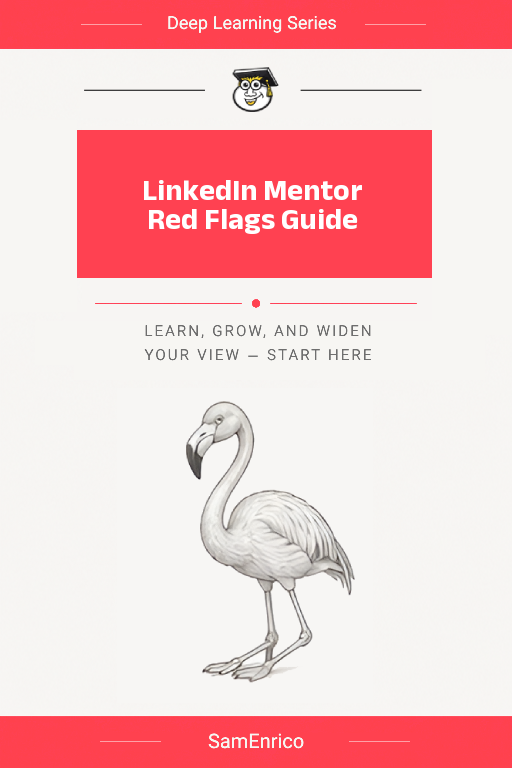
Non-FictionFirst 30 DaysRed Flags
LinkedIn Mentor Red Flags Guide eBook
Identify warning signs of bad potential mentors. A
Identify warning signs of bad potential mentors. Avoid time-wasters, toxic advice, and one-sided relationships.
Formats
Free sample
Chapter 1: The Energy Audit...--Most professionals walk into mentorship with a dangerous, unspoken assumption: if it feels uncomfortable, it must be working. This single belief has destroyed more careers than bad advice ever will.Think about your own experience for a moment. Have you ever left a conversation with a senior colleague feeling smaller than when you arrived? Did you tell yourself that this was just “tough love”? That real growth requires pain?
That you needed to develop thicker skin? If so, you are not alone. This chapter exists because that assumption is wrong—and it is keeping you trapped in relationships that damage rather than develop.The central problem is simple but devastating: we have no cultural vocabulary for distinguishing between difficult mentors and toxic ones. The word “mentor” itself has been so overused and romanticized that it now covers everything from a weekly coffee chat to a psychologically abusive power dynamic. And because the professional world celebrates “resilience” and “grit,” too many of us tolerate the intolerable, believing our suffering is the tuition we pay for success.This chapter draws a sharp, actionable line between two very different experiences.
A difficult mentor challenges you in ways that ultimately build you up. A toxic mentor tears you down under the guise of helping. One leaves you tired but directed. The other leaves you depleted and confused. One attacks your work.
The other attacks your worth.By the end of this chapter, you will have a simple, repeatable system—the Energy Audit—that takes less than sixty seconds after any mentor conversation and tells you exactly what you need to know. You will learn the three questions that separate productive discomfort from relationship harm. And you will understand why most professionals get this wrong, and how you can be the exception.Let us begin with a story.The Story of Sarah and the VPSarah was twenty-eight years old, ambitious, and grateful. She had landed a role at a mid-sized tech company and been assigned a mentor: Marcus, a forty-five-year-old vice president with an impressive Linked In profile and a reputation for “developing talent.” Sarah was thrilled. She had read Marcus’s posts about leadership, about pushing through fear, about holding yourself to a higher standard.
She believed she had won the mentorship lottery.For the first three months, Marcus was demanding but exciting. He gave Sarah ambitious projects. He critiqued her work line by line. He told her she had “potential” but needed to “stop being so sensitive.” When Sarah presented a marketing deck that had taken her twenty hours to prepare, Marcus said, “I’m surprised you thought this was ready. Did you even try?” Sarah laughed nervously and apologized.
She worked harder.Six months in, Sarah noticed a pattern. Every meeting with Marcus left her exhausted. Not the good exhaustion of a hard workout—the kind of exhaustion that comes from having your sense of self quietly dismantled. She started preparing for hours before their calls, trying to anticipate every possible criticism. She stopped sharing ideas freely.
She began to believe that she simply wasn’t good enough.When Sarah finally mentioned her fatigue to a colleague, the colleague shrugged. “That’s Marcus,” she said. “He’s tough. But he’s making you better, right?”Sarah wasn’t sure anymore.Two years later, long after Sarah had left the company, she learned that three other junior employees had filed complaints about Marcus. He was eventually asked to resign.
Sarah spent six months in therapy untangling the damage. She had not been mentored. She had been abused—by someone who knew exactly how to disguise cruelty as coaching.Sarah’s story is not rare. It is the rule.The Great Confusion: Why We Tolerate the Intolerable Why do so many professionals stay in damaging mentorship relationships? The answer lies in three overlapping psychological traps.The first trap is the “no pain, no gain” fallacy.
We have been told so many times that growth requires discomfort that we have lost the ability to distinguish between productive discomfort and destructive harm. Productive discomfort feels like a hard workout: you are tired, but you know why, and you see the path forward. Destructive harm feels like an injury: you are confused, diminished, and uncertain of what just happened. But because both are uncomfortable, we lump them together.The second trap is the authority bias. When someone has a senior title, a large following, or an impressive resume, we assume their behavior must be justified.
If Marcus was a vice president, his criticism must be valid. If a Linked In guru has five hundred thousand followers, their dismissiveness must be a sign of their expertise. This bias is so strong that we will override our own instincts to protect the image of the person above us.The third trap is gratitude. When someone agrees to mentor us, we feel indebted. We believe we should be grateful for any attention, any feedback, any time they offer.
This gratitude becomes a cage. We tolerate poor treatment because we are afraid that speaking up—or walking away—would make us ungrateful. But mentorship is not charity. It is a mutual relationship. And gratitude does not require you to accept harm.Together, these three traps keep smart, capable professionals locked in relationships that are slowly eroding their confidence, their judgment, and their careers.The Critical Distinction: Difficult vs.
Toxic Let us get precise about the difference between a difficult mentor and a toxic one. This distinction is the foundation of everything that follows in this book.A difficult mentor is someone who challenges you in ways that ultimately serve your growth. They give specific, actionable feedback. They hold you to high standards. They do not let you off the hook.
They say things that are hard to hear—but when you hear them, you recognize the truth. A difficult mentor might say, “Your analysis here is shallow. Go back and dig into the data. I want to see three more sources by Friday.” That stings. But it is clear.
It is specific. It points toward a solution.A toxic mentor is someone who leaves you feeling confused, attacked, or diminished. Their feedback is vague or personal. They criticize without offering a path forward. They make you feel small and then tell you that you are “too sensitive.” A toxic mentor might say, “I’m surprised you even tried presenting that.” Or “Maybe this field isn’t for you.” Or “You need to figure out why you keep missing the mark.” Notice the difference: the difficult mentor attacks the work.
The toxic mentor attacks the person.Here is a side-by-side comparison:Situation Difficult Mentor Toxic Mentor Your presentation has gaps“Your data is thin in sections three and four. Here are two sources to review.”“I’m surprised you thought this was ready.”You make a mistake“Let’s walk through what happened and create a checklist so it doesn’t happen again.”“You always do this. Maybe you’re not paying attention.”You ask for feedback“Here are three specific things to improve and one thing that worked.”“I’ll let you know when I see something worth commenting on.”You share a struggle“I’ve been there. Here’s what I tried.”“That’s just how it…
This is the end of the free sample. Get the eBook to keep going. Buy now
About this book
Details
- Author
- Olivas Fredia
- Publisher
- SamEnrico
- Language
- English
- Genre
- Non-Fiction, First 30 Days, Red Flags
- Released
- 2026-05-29
- Pages (approx.)
- 133
- Available as
- eBook, Audiobook

Read better in the ZLOADR app
Your eBooks on your phone or tablet. Sign in with your SamEnrico account and start reading.
More by Olivas Fredia
 Remote Review Data Privacy GuideOlivas Fredia$11.99
 Affirmations For Trust Issues CourseOlivas Fredia$11.99
 Stress And Post Surgical PainOlivas Fredia$11.99
 Trauma Response at SchoolOlivas Fredia$11.99
 Renewable Energy Investment StrategyOlivas Fredia$11.99
 The Poisoned Punch: Argentina's Deadly Tango of Deception (1880s)Olivas Fredia$11.99
 Understanding ParagangliomaOlivas Fredia$17.99
 Electrical InspectorOlivas Fredia$11.99
 Banking and Finance ESG ComparisonOlivas Fredia$12.99
 How to Start a Investment Advice BusinessOlivas Fredia$11.99
You may also like
 Hong Kong Handover 1997Dunn Johnnie$11.99
 Zumba For Postnatal Recovery CourseNeal Christian$11.99
 Zumba for BeginnersLadner Nikia$11.99
 YouTube Comment Mining GuideHumes Pandora$12.99
 Worry Box MeditationCarlin Rudy$11.99
 Workplace Stress MeditationNguyen Lynn$11.99
 Workplace Stress and Sleep RepairHawley Ivory$11.99
 Workplace Perfectionism CureDelaney Jeffry$11.99
 Workplace Injustice Anger GuideWallen Isabelle$11.99
 Work Addiction and Burnout LinkGreenwood Ester$11.99
 Women in Yoga and WellnessBeattie Galina$11.99
 Women in Stand Up ComedyChun Evangeline$11.99