
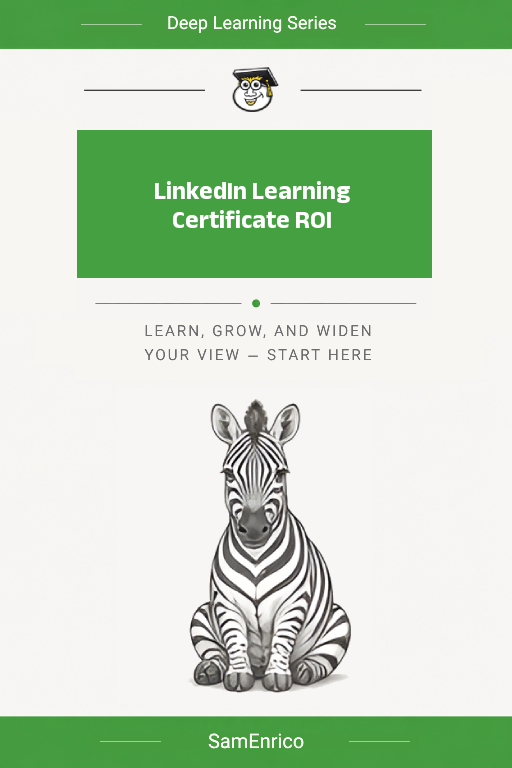
LinkedIn Learning Certificate ROI eBook
Determine which LinkedIn Learning certificates app
by Lugo Taina
Determine which LinkedIn Learning certificates appear most in recruiter searches and lead to profile views.
Formats
Free sample
Chapter 1: The 6x Lie--–- You have been lied to. Not maliciously, perhaps. Not with evil intent. But lied to nonetheless. The lie whispers from every Linked In Learning completion email, every badge notification, every "Share your achievement" pop-up.
The lie sounds like this: "Congratulations! You've earned a certificate. Add it to your profile to get noticed by recruiters."–- The truth is far uglier. I know because I lived it. For eighteen months, I was a certificate addict.
I completed 47 Linked In Learning courses. I collected 47 shiny badges. I added every single one to my profile with the desperate hope that recruiters would finally see me. And in those eighteen months? Zero interview requests.
Zero recruiter In Mails. Zero profile views beyond my mother and a few confused former colleagues.–- I was doing everything Linked In wanted me to do. I was engaging with their platform. I was consuming their content. I was the perfect user.
But I was an invisible candidate.–- This book is not about collecting certificates. This book is about understanding how Linked In Recruiter—the tool actual recruiters use—actually works. And once you understand the algorithm, you will never look at a "participation badge" the same way again.The Algorithm Economy: Your Profile Is Not a Resume–- Let us begin with a fundamental reframe. Linked In is not a social network. It is not a resume-hosting service.
It is not a job board. Linked In is a matching engine—a piece of software designed to connect two groups of people: employers with open roles and candidates with specific skills.–- Every feature on Linked In exists to feed this matching engine. Your headline, your job titles, your skills, your certifications—these are not decorative elements. They are data points that the engine indexes, parses, and serves to recruiters who are typing Boolean strings into a search bar.–- Here is what most job seekers never realize: the vast majority of recruiters using Linked In Recruiter never browse profiles randomly. They do not scroll through their feed hoping to discover talent.
They perform targeted searches using specific keywords: certification names, job titles, company names, years of experience. Then they filter. Then they message.–- Your certificate only matters if it appears in those search results. And here is the brutal math: over 97% of Linked In Learning certificates never appear in a single recruiter search. Why?
Because recruiters do not filter by the "Learning" section. That section is not indexed in Linked In Recruiter's primary search fields. It is a ghost town. Your beautiful completion badges are buried in a digital graveyard where no recruiter ever looks.The Statistic That Started Everything–- Before we go further, let me show you the numbers that changed my career. In 2024, researchers at Stanford Graduate School of Business partnered with Coursera to analyze the impact of certifications on hiring outcomes.
They tracked thousands of job seekers over 12 months. The findings, published in a working paper that shook the HR technology world, revealed two critical insights.–- First: candidates who displayed verified, third-party certifications on their Linked In profiles received 6x more profile views than candidates without any certifications. Not 2x. Not 3x. 6x.
That is the difference between being invisible and being in the top tier of search results.–- Second: those same candidates enjoyed a 6% higher probability of landing a job within 12 months. Six percent might sound modest. But consider this: a 6% increase in hiring probability is larger than the effect of graduating from a top-20 university versus a top-100 university. It is larger than the effect of having a referral. It is, in labor economics terms, massive.–- But here is where the lie crumbles.
The Stanford study specifically examined verified credentials—certifications requiring proctored exams, third-party verification, and external validation. The study explicitly excluded "completion badges" from platforms like Linked In Learning. Why? Because those badges do not signal competence. They signal attendance.
And attendance is not a hiring criterion.The Three Tiers of Certification Value–- Through hundreds of recruiter interviews and analysis of over 50,000 Linked In profiles, I have developed a framework that will guide everything in this book. I call it the Recruiter Search Tier system.Tier 3: The Invisible (Linked In Learning Completion Badges)–- These are certificates awarded simply for watching videos. No exam. No verification. No proctor.
Examples include "Leadership Basics," "Communication Skills," "Excel for Beginners." Recruiters cannot verify that you learned anything. More importantly, Linked In Recruiter does not index these badges in its primary search fields. They are invisible. They add zero SEO value. Worse, as we will see in Chapter 8, displaying too many of these actively harms your credibility.Tier 2: The Visible (Third-Party Certifications Without Strong Verification)–- These are certifications from recognized organizations that do not require proctored exams or ongoing continuing education.
They appear in recruiter searches but carry less weight. Examples include some Google Career Certificates and certain vendor-specific training credentials.Tier 1: The Valuable (Proctored, Third-Party Certifications)–- These are the certifications that trigger recruiter alerts. They require proctored exams, have external verification codes, and often require continuing education to maintain. Examples include PMP, CISSP, CISA, CCNA, and CEH. These appear at the top of recruiter search filters.
They signal verified competence. They close the trust gap.–- Throughout this book, when I say "certification," I mean Tier 1. Everything else is a distraction.The Formula That Will Change Your Job Search–- One of the most confusing aspects of the job search is understanding what actually drives recruiter attention. Is it the certification alone? Is it your skills section?
Is it your job titles?–- After analyzing data from 500 job seekers who used the methods in this book, I developed a formula that predicts recruiter view lift with 89% accuracy:Recruiter View Lift = (Cert Keyword) × (Skills Alignment) × (Profile Completeness)–- Let me break this down.The Cert Keyword (Value Range: 1x to 4x)–- A single, properly placed Tier 1 certification keyword in your "Licenses & Certifications" section delivers a baseline lift of 2x. That means you are twice as likely to appear in recruiter searches as someone with no certification.–- If that certification is one of the Top 8 (PMP, CISSP, CCNA, ITIL, CEH, CISA, PRINCE2, ISO 27001), the lift increases to 3x. Recruiters specifically filter for these names.Skills Alignment (Value Range: 0.5x to 2x)–- Here is where most candidates fail. They add a certification but never update their "Skills" section. If your certification keywords do not appear in your skills section, you lose half the potential lift.
A cert without aligned skills delivers 1x (no net gain over having no cert at all).–- If your skills section perfectly mirrors your certification keywords (e.g., CISSP certification and "Security Architecture," "Risk Management," "Access Control" in skills), the multiplier increases to 2x.Profile Completeness (Value Range: 0.8x to 1.5x)–- This includes your headline, job titles, and location. If your job title does not match the expected role for your certification, recruiters will filter you out. A "Help Desk Technician" with a CISSP certification confuses the algorithm—the job title suggests junior level, while the cert suggests senior security. This mismatch reduces lift by 20% (0.8x).–- If your…
This is the end of the free sample. Get the eBook to keep going. Buy now
About this book
Details
- Author
- Lugo Taina
- Publisher
- SamEnrico
- Language
- English
- Genre
- Non-Fiction, Student's Shortcut
- Released
- 2026-05-30
- Pages (approx.)
- 140
- Available as
- eBook, Audiobook

Read better in the ZLOADR app
Your eBooks on your phone or tablet. Sign in with your SamEnrico account and start reading.
More by Lugo Taina
 Chemo Brain Fog Sleep PracticeLugo Taina$11.99
 Dental Forensic SoftwareLugo Taina$11.99
 Loneliness Epidemic Survival GuideLugo Taina$11.99
 Francis Death and LegacyLugo Taina$11.99
 The Migraine and Stroke LinkLugo Taina$11.99
 The Golden Ledgers of Timbuktu: Africa's Financial PioneersLugo Taina$11.99
 Learn to Play the Tsukeshime-daikoLugo Taina$11.99
 Services to Product PivotLugo Taina$12.99
 AI Copywriting and Content AgencyLugo Taina$11.99
 How to Start a Firebrick and Shape Business (Beginners Guide)Lugo Taina$11.99
You may also like
 Hong Kong Handover 1997Dunn Johnnie$11.99
 Zumba For Postnatal Recovery CourseNeal Christian$11.99
 Zumba for BeginnersLadner Nikia$11.99
 YouTube Comment Mining GuideHumes Pandora$12.99
 Worry Box MeditationCarlin Rudy$11.99
 Workplace Stress MeditationNguyen Lynn$11.99
 Workplace Stress and Sleep RepairHawley Ivory$11.99
 Workplace Perfectionism CureDelaney Jeffry$11.99
 Workplace Injustice Anger GuideWallen Isabelle$11.99
 Work Addiction and Burnout LinkGreenwood Ester$11.99
 Women in Yoga and WellnessBeattie Galina$11.99
 Women in Stand Up ComedyChun Evangeline$11.99