
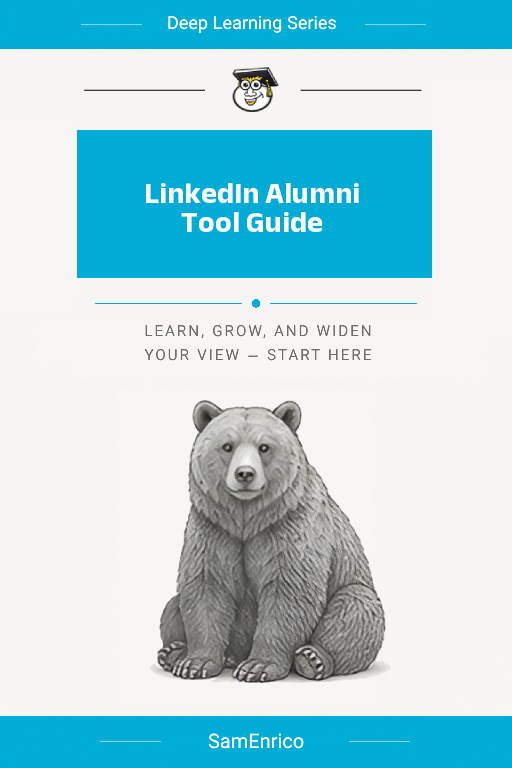
Non-FictionFirst 30 DaysAlumni
LinkedIn Alumni Tool Guide eBook
Use the alumni search tool to find potential mento
by Diaz Clara
Use the alumni search tool to find potential mentors from your university or past employers.
Formats
Free sample
Chapter 1: The $10 Million Blind Spot--–- What if I told you that the mentors you desperately need are not strangers you have to cold-email, but people you already share a deep, unspoken bond with? And what if I told you that Linked In has buried a tool—deliberately, some might say—that gives you direct access to hundreds of thousands of these people, and that almost nobody uses it?Let me start with a confession.For the first seven years of my career, I was a terrible networker. I use the past tense generously, because the truth is I wasn't networking at all. I was collecting business cards like Pokémon, sending connection requests to strangers I had never met, and attending "networking events" where I would stand in a corner holding a warm Sprite, trying to summon the courage to interrupt a conversation between two people who clearly already knew each other.My Linked In strategy was simple and pathetic: find someone with an impressive title at a company I wanted to join, click "Connect," and pray. Sometimes I would add the default message: "I'd like to add you to my professional network on Linked In." Other times, feeling bold, I would write something equally forgettable like "Love your work at Google!" It didn't matter.
The results were always the same.Crickets.Occasionally, someone would accept my request. Then nothing. No messages, no meetings, no mentorship. Just another digital trophy in my collection, another name on a list that I felt too awkward to actually message. I had 500+ connections and zero people I could call for advice.I assumed the problem was me.
I wasn't interesting enough. My school wasn't prestigious enough. My job history wasn't impressive enough. I convinced myself that networking was a game for extroverts with trust funds and family connections, and I had neither.Then, three years ago, I discovered something that changed everything.I was clicking around Linked In, trying to find a former classmate from my university, when I stumbled onto a page I had never seen before. It was buried under a tab I had always ignored: "Alumni." The page showed me a dashboard with charts and filters and thousands of names—all people who had attended my school.
I could see where they lived, where they worked, what they did, what they studied, what skills they had, and how we were connected.I had been on Linked In for years, and I had no idea this existed.That afternoon, I spent two hours exploring. I filtered by alumni who lived in my city, worked in my industry, and had a job title I wanted in five years. The search returned 47 people. Forty-seven potential mentors, all connected to me by a shared educational experience, whom I had never contacted because I didn't know they existed.The next week, I sent 15 connection requests using a simple message: "Fellow [University] alum here. I noticed you moved from [old role] to [current role]—a path I'm exploring.
Would you be open to connecting?" Fourteen people accepted. Twelve replied to my follow-up message. I scheduled 10 informational interviews over the following month.That month changed my career trajectory.One of those conversations led to a referral for a job I hadn't even known existed. Another introduced me to a mentor who reviewed my portfolio and helped me refine my pitch. A third told me about a skills gap I didn't know I had, which I closed with a three-week online course.
Within 90 days, I had received two job offers, both from companies where I had alumni connections.I didn't get those offers because I was the most qualified candidate. I got them because I had stopped cold-networking and started alumni-networking.This book is the system I developed from that discovery. It is the step-by-step playbook for using Linked In's most powerful and most ignored feature: the Alumni Tool. And here is the first and most important thing you need to understand before we go any further.You Are Sitting on a Goldmine and You Don't Even Know It Let me ask you a question.Think about every school you have ever attended. Not just the university where you got your degree.
Think about community college. Think about that bootcamp you did to learn coding. Think about the certificate program your company paid for three years ago. Think about your high school if you are early in your career. Think about the internship you hated but completed anyway.Now think about every company you have ever worked for.
Your first job out of school. That three-month contract that went nowhere. The startup that imploded. The corporate giant you escaped. The part-time gig you took while freelancing.Now multiply those institutions by the number of people who have ever attended or worked at them.
Every single one of those people is an alumnus of that institution. And every single one of them is connected to you by something more powerful than a Linked In algorithm: shared identity.Here is the number that stops people cold when I present this at workshops. Take a moment to guess.The average professional with a bachelor's degree and three previous jobs has access to approximately 47,000 alumni on Linked In. If you have a graduate degree, add another 15,000. If you have attended a bootcamp or certificate program, add another 5,000.
If you have had an internship, add another 2,000.Do the math for yourself. List every institution you have been affiliated with. Go to each one's Linked In alumni page (we will cover exactly how in Chapter 2). Add up the numbers.Most people I work with discover they have access to between 30,000 and 100,000 alumni.That is not a typo.You have access to tens of thousands of potential mentors, advisors, referrers, and advocates—right now, without sending a single cold email to a stranger. They are already there, waiting for you to find them.Why Alumni Help Each Other (The Psychology You Need to Exploit)Stop and think about the last time a stranger asked you for help.
Maybe someone stopped you on the street to ask for directions. Maybe a cold email landed in your inbox from someone you had never met, asking for "15 minutes of your time." How did you feel?If you are like most people, you felt a small prickle of annoyance. A tiny defense mechanism that said: I don't know this person. Why should I help them? What do they want from me?Now think about the last time a fellow alumnus reached out to you.
Someone who went to your school. Someone who worked at your former company. Someone who shared a piece of your history. How did that feel different?For most people, it feels completely different. It feels warmer.
Safer. More natural. You think: Oh, they went to State too. They probably sat in the same awful lecture hall. They survived the same terrible cafeteria food.
They are one of us.This is not just sentimentality. This is a well-documented psychological phenomenon called in-group bias.In-group bias is the human brain's tendency to favor people who share our group memberships over those who do not. It is the reason sports…
This is the end of the free sample. Get the eBook to keep going. Buy now
About this book
Details
- Author
- Diaz Clara
- Publisher
- SamEnrico
- Language
- English
- Genre
- Non-Fiction, First 30 Days, Alumni
- Released
- 2026-05-28
- Pages (approx.)
- 118
- Available as
- eBook, Audiobook

Read better in the ZLOADR app
Your eBooks on your phone or tablet. Sign in with your SamEnrico account and start reading.
More by Diaz Clara
 Meditation for Date AnxietyDiaz Clara$11.99
 Loci for Historical DatesDiaz Clara$11.99
 Pittsburgh Talent RevivalDiaz Clara$11.99
 Mindfulness Meditation for Teens WorkbookDiaz Clara$11.99
 The Assignment Overload GuideDiaz Clara$11.99
 Moonlight Meditation JourneyDiaz Clara$11.99
 Palace for ScienceDiaz Clara$11.99
 Self Worth Meditation ChildhoodDiaz Clara$11.99
 Metta For Your BodyDiaz Clara$11.99
 The Siege of Vukovar: Europe's Forgotten Bloodbath (1991)Diaz Clara$11.99
 The Siege of Calais: Blood, Gold, and the Birth of a NationDiaz Clara$11.99
 Justinian's Plague: The Empire's Deadly Turning PointDiaz Clara$11.99
You may also like
 Hong Kong Handover 1997Dunn Johnnie$11.99
 Zumba For Postnatal Recovery CourseNeal Christian$11.99
 Zumba for BeginnersLadner Nikia$11.99
 YouTube Comment Mining GuideHumes Pandora$12.99
 Worry Box MeditationCarlin Rudy$11.99
 Workplace Stress MeditationNguyen Lynn$11.99
 Workplace Stress and Sleep RepairHawley Ivory$11.99
 Workplace Perfectionism CureDelaney Jeffry$11.99
 Workplace Injustice Anger GuideWallen Isabelle$11.99
 Work Addiction and Burnout LinkGreenwood Ester$11.99
 Women in Yoga and WellnessBeattie Galina$11.99
 Women in Stand Up ComedyChun Evangeline$11.99