
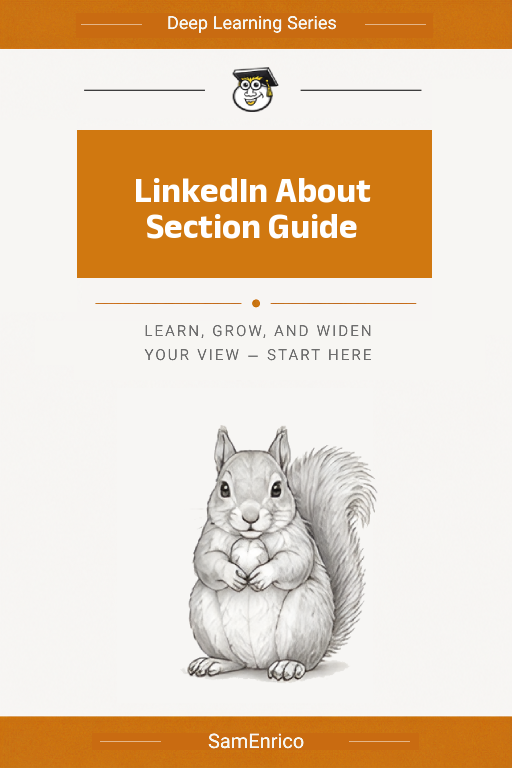
LinkedIn About Section Guide eBook
Write an About section that sells your skills to r
by Litwin Shin
Write an About section that sells your skills to recruiters. Storytelling, achievements, and call to action.
Formats
Free sample
Chapter 1: The Six-Second Graveyard--You are already invisible.Not because you lack skills. Not because your resume is weak. Not because you haven't worked hard enough. You are invisible because the system is designed to make you invisible.Every day, recruiters open Linked In Recruiter and type in search terms for candidates exactly like you. They need someone with your years of experience, your industry background, your specific technical skills.
And every day, your profile fails to appear in those search results. Not because you aren't qualified. Because you haven't given the algorithm what it needs to find you.Even when you do appear—even when a recruiter finally lands on your profile—you have approximately six seconds before they decide to stay or leave.Six seconds.That is less time than it takes to read this paragraph.In six seconds, a recruiter's brain makes a series of lightning-fast calculations. Not conscious calculations. Neurological ones.
The human brain is wired for efficiency, which means it is wired for rejection. Cognitive bias means recruiters look for reasons to say no, not reasons to say yes. Every element of your profile is scanned for what psychologists call "negative dominance"—the tendency for negative information to carry more weight than positive information.One awkward phrase. One generic opener. One wall of text.
And you are out.The "About" section is the only place on your entire Linked In profile where you control the narrative during those six seconds. Your headline is constrained by character limits and job titles. Your experience section is backwards-looking, a list of what you already did. But the About section is pure, unmediated you. It is the only space where you can speak directly to the recruiter's pain before they have decided to reject you.Yet 90 percent of professionals treat this section as an afterthought.
They paste in their resume summary. They write a generic paragraph about being "passionate" and "results-driven." They end with the limpest possible closing: "I'm open to opportunities."And then they wonder why no one calls.This book exists because that pattern is broken. Not subtly broken. Catastrophically broken. The difference between a profile that gets ignored and a profile that generates weekly recruiter DMs is not a matter of luck, connections, or even raw talent.
It is a matter of understanding one fundamental principle that this chapter will drill into your skull:Recruiters do not care about your history. They care about their pain.Let me say that again, because it is the single most important sentence you will read in this entire book.Recruiters do not care about your history. They care about their pain.Every single word of your About section must be filtered through this lens. Not "I am a project manager with five years of experience." That is history. That is a biography.
That is the sound of a recruiter's eyes glazing over.But "You need someone who can rescue a failing software launch before your VP cancels the entire product line"—that is a solution. That is a response to pain. That is the sound of a recruiter leaning forward.This distinction—history versus solution, biography versus value proposition—is the entire thesis of this book. Every chapter that follows is machinery designed to help you execute this shift. But you cannot execute what you do not understand.
So we are going to spend this entire chapter making sure you understand, because if you walk away from this book having learned nothing else, learn this:Your About section is not about you.It never was.The Neuroscience of Rejection Let me tell you a story about a woman named Sarah. (All names in this book are changed, but the profiles are real.)Sarah was a senior operations manager with twelve years of experience at two Fortune 500 companies. She had saved her employer $4 million through supply chain optimizations. She had led teams of thirty people. Her resume was a masterpiece of achievement language.Her Linked In About section read as follows:*"Senior Operations Manager with 12+ years of experience in supply chain logistics and team leadership.
Proven track record of driving efficiency improvements and cost reductions. Passionate about operational excellence and continuous improvement. Looking for new opportunities in the logistics space."*Technically, this is fine. Grammatically correct. Professionally appropriate.
No typos.Sarah could not get a single recruiter to respond to her applications for eight months.She came to me frustrated, convinced the job market was broken. I asked to see her Linked In profile. She sent me the link. I read her About section and immediately understood the problem.Her About section was a biography. It told me what she had done.
It told me what she cared about. It told me absolutely nothing about what problem she solved for a recruiter.I asked her: "What is the specific pain of a logistics recruiter right now?"She thought for a moment. "Supply chain disruptions," she said. "Everyone is still recovering from post-pandemic volatility. Freight costs are unpredictable.
Lead times are a mess.""Good," I said. "Now rewrite your About section as if you are answering that pain."She wrote:"Supply chain volatility is costing your company 15 percent on every shipment. I know because I fixed it twice—once during the 2021 container crisis and again during the 2023 carrier collapse. When I joined my last company, freight costs were eating 22 percent of margin. Eighteen months later, we were at 11 percent.
Here is exactly how."She posted the new version on a Tuesday. By Friday, she had three recruiter DMs. Within two weeks, she had seven interviews. She accepted an offer at a 30 percent salary increase.Same experience. Same resume.
Same woman. Different About section.Why did this work? Because Sarah stopped asking recruiters to care about her history and started speaking directly to their pain. The neuroscience behind this is fascinating and crucial to understand.When a recruiter scans a profile, their brain is operating in what psychologists call "System 1 thinking"—fast, automatic, unconscious. System 1 is the brain's energy-saving mode.
It relies on heuristics, shortcuts, and pattern recognition. It is also profoundly lazy.System 1 does not want to read a paragraph and infer relevance. System 1 wants the relevance delivered immediately, or it moves on.This is where negative dominance comes in. The human brain is wired to weigh negative information more heavily than positive information because, evolutionarily speaking, missing a threat could kill you. Missing an opportunity just means you stay where you are.
So the brain defaults to rejection.Every element of your profile is scanned for rejection triggers. A gap in employment? Rejection trigger. A typo? Rejection trigger.
A generic opener that sounds like every other candidate? Rejection trigger.The About section is your only chance to override these rejection triggers before they fire. But you cannot override them with biography. Biography triggers rejection because it forces the recruiter to do work. They have to read your paragraph and then translate it into relevance for their problem.
That translation takes mental energy. System 1 hates mental energy. System 1 would rather reject you and move to the next profile.Solution language, by contrast, requires no translation. When you say "Supply chain volatility…
This is the end of the free sample. Get the eBook to keep going. Buy now
About this book
Details
- Author
- Litwin Shin
- Publisher
- SamEnrico
- Language
- English
- Genre
- Non-Fiction, Professional's Cheat Sheet, Personal Branding
- Released
- 2026-05-30
- Pages (approx.)
- 157
- Available as
- eBook, Audiobook

Read better in the ZLOADR app
Your eBooks on your phone or tablet. Sign in with your SamEnrico account and start reading.
More by Litwin Shin
 The Hip Opener Stretch RoutineLitwin Shin$11.99
 Online Persuasion TechniquesLitwin Shin$11.99
 Solo Founder Business PlanLitwin Shin$11.99
 Trust Issues Self EsteemLitwin Shin$11.99
 The Invisible Architects: How Newton, Leibniz, and the Scientific Revolution Remade the WorldLitwin Shin$11.99
 Ultimate Handbook Guide to Dehui : (China) Travel GuideLitwin Shin$11.99
 Medical AdvisorLitwin Shin$11.99
 Learn to Play the KoraLitwin Shin$11.99
You may also like
 Skills Endorsement StrategySigler Nereida$11.99
 Profile Photo ChecklistKaminski Elva$11.99Profile Photo ChecklistKaminski Elva$11.99
 Custom URL OptimizationWooden Karleen$11.99
 Recruiter LinkedIn Search GuideTipton Natashia$12.99
 LinkedIn Profile Photo GuidePeyton Gearldine$12.99
 LinkedIn Profile for Recruiters GuideVerdun Charlyn$12.99
 LinkedIn Recommendations GuideKlein Brett$12.99
 LinkedIn Featured Section GuidePeel Ivory$12.99
 LinkedIn Skills Section GuideLundy Elenor$12.99
 LinkedIn Open to Work GuideTripp Reynalda$12.99
 LinkedIn Headline for RecruitersHyde Merle$12.99