
Non-FictionInformativeEducational
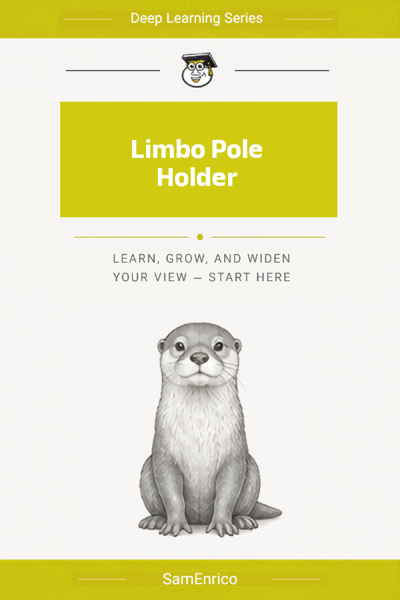
Limbo Pole Holder
A Coursebook on Limbo Pole Holder
by Canada Aide
A Coursebook on Limbo Pole Holder
Formats
About this book
Free sample
Chapter 1: The Invisible Architect--–- Every limbo dancer remembers the moment they fell. The crowd gasped. The music stuttered. Someone’s cousin filmed it sideways on a phone that would never see the light of day again. But no one—not a single person at that party, barbecue, or beach gathering—remembers who was holding the pole.That is the first and most important truth of this book.
You are about to become the most strategically essential person at any limbo event, and absolutely no one will thank you for it. The dancer who clears a twelve-inch pole will be celebrated. The dancer who touches the pole will be comforted. The DJ who played “Limbo Rock” for the seventeenth time will be tolerated. You, the pole holder, will be ignored.
And that is exactly how it should be.This chapter introduces the foundational philosophy that transforms a person holding a stick into a master facilitator of one of the world’s most deceptively complex games. You will learn why the holder matters more than the dancer, the single ethical principle that overrides all other considerations, and how to use this book as a progressive skill-building tool. By the end of this chapter, you will never look at a limbo pole the same way again.The Great Misconception: Why the Dancer Gets All the Credit The limbo originated in Trinidad and Tobago in the nineteenth century, evolving from funeral celebrations into the competitive dance form popularized by calypso musician Julia Edwards and later immortalized by Chubby Checker in the 1960s. For most of that history, the pole holder has been treated as furniture—a necessary but uninteresting component of the game, like the floor or the speakers.This is a catastrophic misunderstanding.The dancer’s job is straightforward: bend backward, shuffle forward, do not touch the pole. The holder’s job is exponentially more complex.
You must judge clearance in real time without obstructing the dancer’s view. You must lower the pole at consistent, fair intervals while maintaining perfect horizontal leveling. You must read the dancer’s physical condition to anticipate failure…
This is the end of the free sample. Get the eBook to keep going. Buy now
Contents
- Chapter 1
- Chapter 2
- Chapter 3
- Chapter 4
- Chapter 5
- Chapter 6
- Chapter 7
- Chapter 8
- Chapter 9
- Chapter 10
- Chapter 11
- Chapter 12
Details
- Author
- Canada Aide
- Publisher
- SamEnrico
- Language
- English
- Genre
- Non-Fiction, Informative, Educational
- Released
- 2026-06-02
- Pages (approx.)
- 159
- Available as
- eBook, Audiobook

Read better in the ZLOADR app
Your eBooks on your phone or tablet. Sign in with your SamEnrico account and start reading.
More by Canada Aide
 Body Language for SecurityCanada Aide$11.99
 Vocal Warmup For NervesCanada Aide$11.99
 Handling Q&A Like a ProCanada Aide$11.99
 Senior Yoga BasicsCanada Aide$11.99
 Dot-Bomb Diaries: The Rise and Fall of a Silicon Valley Ghost TownCanada Aide$11.99
 How to Become a Corset FitterCanada Aide$11.99
 Two Part Tariff Inflation StrategyCanada Aide$12.99
 How to Produce Carbon FiberCanada Aide$11.99
You may also like
 Hong Kong Handover 1997Dunn Johnnie$11.99
 Zumba For Postnatal Recovery CourseNeal Christian$11.99
 Zumba for BeginnersLadner Nikia$11.99
 YouTube Comment Mining GuideHumes Pandora$12.99
 Worry Box MeditationCarlin Rudy$11.99
 Workplace Stress MeditationNguyen Lynn$11.99
 Workplace Stress and Sleep RepairHawley Ivory$11.99
 Workplace Perfectionism CureDelaney Jeffry$11.99
 Workplace Injustice Anger GuideWallen Isabelle$11.99
 Work Addiction and Burnout LinkGreenwood Ester$11.99
 Women in Yoga and WellnessBeattie Galina$11.99
 Women in Stand Up ComedyChun Evangeline$11.99