
Non-FictionSelf-HelpStudy Spaces
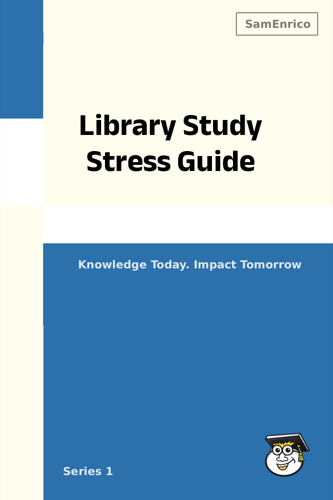
Library Study Stress Guide eBook
Use library resources, quiet zones, and peer study
Use library resources, quiet zones, and peer studying to enhance focus.
Formats
Free sample
Chapter 1: The Geography of Concentration--Your brain is lying to you about where you study.Every time you open a textbook on your bed, your hippocampus—the memory center of your brain—receives a mixed signal. The same pillow that cradled you through eight hours of sleep is now propping up a calculus problem set. The same desk lamp that illuminated twelve hours of Netflix illuminates your organic chemistry notes. The same chair where you scroll through social media for hours is where you now try to parse Kant’s critiques of pure reason. And your brain, being a remarkably efficient but not particularly clever organ, does the only logical thing: it serves you a blend of all those competing impulses at once.
You feel tired. You feel distracted. You feel the urge to check your phone. And somewhere underneath all that noise, you feel a vague, nameless anxiety about the work you are not doing.This is not a moral failing. This is not laziness.
This is not a lack of discipline.This is environmental conditioning gone wrong.The Geography of Concentration is the first and most fundamental principle of stress-free studying: your brain anchors specific emotional and behavioral responses to physical locations. Psychologists call this context-dependent memory. Pavlov called it classical conditioning. You will call it the reason you cannot focus in your dorm room no matter how hard you try. The good news is that the same mechanism that sabotages your focus can be rewired to serve it.
The library—yes, that building with the dusty books and the fluorescent lights and the inexplicable temperature fluctuations—is not just a place to store resources. It is a neurological trigger waiting to be activated. It is a sanctuary designed to reduce cognitive load, lower cortisol, and transform anxiety into anticipation. But you have to use it correctly. And that means understanding, for the first time, why your brain needs a dedicated study space more than it needs another productivity app, another color-coded planner, or another five-hour marathon of “study with me” videos on You Tube.Let us begin by dismantling the single most destructive myth in academic life: that you can study effectively anywhere.The Myth of the Versatile Student Walk onto any college campus and you will hear variations of the same boast: “I can study anywhere.” Students say this with pride, as if adaptability were the highest form of academic virtue.
They study on buses, in coffee shops, in bed, on the floor of the gym while waiting for a treadmill, in the back seat of a friend’s car, in airport terminals, in the waiting rooms of dentists’ offices. And then they wonder why they feel perpetually exhausted, perpetually behind, and perpetually on the verge of panic.The truth is that the human brain was not designed for this kind of cognitive promiscuity. Every time you shift contexts, your brain performs a hidden cost: it must suppress the associations of the old environment while establishing new ones for the task at hand. This is called attentional residue, and it is the silent killer of academic productivity. When you study in a location that already has strong competing associations—sleep, entertainment, socializing, eating—your brain works against you.
It does not matter how motivated you are. It does not matter how pressing the deadline is. The neurological architecture of context-dependent memory is stronger than willpower.Consider a landmark study from the University of California, Los Angeles. Researchers asked students to memorize a list of 40 unrelated words. Half the students studied in a small, windowless room with beige walls and fluorescent lighting.
The other half studied in a large, sunlit room with plants, artwork, and soft music playing in the background. Both groups were given the same amount of time and the same instructions. When tested immediately, both groups performed identically. But when tested one week later—in a neutral classroom with no environmental cues—the students who studied in the beige room remembered significantly more words than those who studied in the pleasant room. Why?
Because the pleasant room had too many associations. The brain encoded not just the words but also the sunlight, the music, the plants, the feeling of comfort. In a neutral test environment, those extra cues became interference. The beige room, by contrast, offered nothing but the task itself.This is the paradox of study environments: the more comfortable and multi-functional a space is, the worse it serves focused learning. Your dorm room is a beige room on steroids.
It contains your bed (sleep), your phone (social connection), your snacks (eating), your gaming console (entertainment), your roommate’s conversations (distraction), and a thousand other memory cues that have nothing to do with studying. When you try to read a textbook in that space, your brain does not simply ignore those competing associations. It processes them in parallel, consuming cognitive bandwidth that should be devoted to comprehension and retention. You feel tired not because the material is difficult but because your brain is fighting itself.The library offers the opposite. Libraries are deliberately, almost brutally, stripped of competing cues.
The lighting is consistent, not variable. The furniture is functional, not comfortable. The sounds are predictable—page turns, footsteps, the soft hum of HVAC systems—not eruptive. The visual field is filled with books and walls, not notifications and pillows. And crucially, libraries have no competing behavioral history for most students.
You have likely never slept in a library (at least not intentionally). You have never watched Netflix in a library. You have never argued with a friend or scrolled through Instagram for three hours in a library. The library is a blank slate, and a blank slate is exactly what your brain needs to build a new, powerful association: this place means deep work.The Physiology of Focus Before we go further, let us be precise about what happens in your body when you study in a distraction-rich versus a distraction-free environment. Stress is not an emotion.
It is a physiological state with measurable markers: cortisol, heart rate variability, pupil dilation, electrodermal activity, and the ratio of sympathetic to parasympathetic nervous system activation. When you study in a space that creates cognitive conflict—the dorm room, the coffee shop, the kitchen table—your sympathetic nervous system (the “fight or flight” branch) remains mildly but persistently activated. Your cortisol levels stay elevated. Your heart rate stays slightly too fast. Your pupils stay slightly too dilated.
You are, in a very real physiological sense, in a low-grade state of emergency.This is not sustainable. Cortisol is designed for short bursts of intense activity, not for hours of sustained focus. When cortisol remains elevated for extended periods, it begins to impair the very cognitive functions you need most: working memory, pattern recognition, cognitive flexibility, and the transfer of information from short-term to long-term memory. You are not just distracted. You are actively damaging your ability to learn.The library environment reverses this cascade.
When you enter a well-designed library—consistent lighting, stable temperature, minimal unpredictable sounds, no visual clutter—your parasympathetic nervous system (the “rest and digest” branch) gradually activates. Your heart rate slows. Your cortisol levels drop. Your…
This is the end of the free sample. Get the eBook to keep going. Buy now
About this book
Details
- Author
- Pinckney Filiberto
- Publisher
- SamEnrico
- Language
- English
- Genre
- Non-Fiction, Self-Help, Study Spaces
- Released
- 2026-06-10
- Pages (approx.)
- 155
- Available as
- eBook, Audiobook

Read better in the ZLOADR app
Your eBooks on your phone or tablet. Sign in with your SamEnrico account and start reading.
More by Pinckney Filiberto
 Meditation for First Responder AnxietyPinckney Filiberto$11.99
 Mindfulness Meditation Walking PracticePinckney Filiberto$11.99
 Narcissistic Parent RecoveryPinckney Filiberto$11.99
 Family Boundary WorkbookPinckney Filiberto$11.99
 Cryptocurrency Supply DemandPinckney Filiberto$11.99
 Remote Work Talent ShiftPinckney Filiberto$11.99
 Metta For Addiction RecoveryPinckney Filiberto$11.99
 The Dark Money Playbook: How a Shadow Network Funded the Tea Party RevolutionPinckney Filiberto$11.99
 Growing DracunculusPinckney Filiberto$11.99
 The Mineral Guide to ChromitePinckney Filiberto$11.99
 Telling Employees About Founder DepressionPinckney Filiberto$12.99
 Mentor for Negotiation SkillsPinckney Filiberto$12.99
You may also like
 Hong Kong Handover 1997Dunn Johnnie$11.99
 Zumba For Postnatal Recovery CourseNeal Christian$11.99
 Zumba for BeginnersLadner Nikia$11.99
 YouTube Comment Mining GuideHumes Pandora$12.99
 Worry Box MeditationCarlin Rudy$11.99
 Workplace Stress MeditationNguyen Lynn$11.99
 Workplace Stress and Sleep RepairHawley Ivory$11.99
 Workplace Perfectionism CureDelaney Jeffry$11.99
 Workplace Injustice Anger GuideWallen Isabelle$11.99
 Work Addiction and Burnout LinkGreenwood Ester$11.99
 Women in Yoga and WellnessBeattie Galina$11.99
 Women in Stand Up ComedyChun Evangeline$11.99