
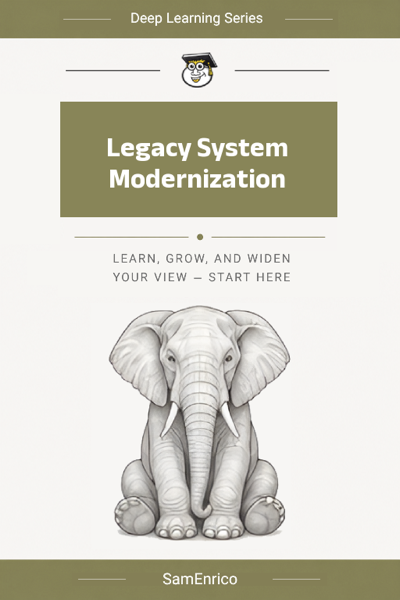
Non-FictionInformativeEducational
Legacy System Modernization eBook
A Coursebook on Legacy System Modernization
by Graf Meda
A Coursebook on Legacy System Modernization
Formats
Free sample
Chapter 1: The Legacy Lie...–- Let me tell you a story about the most expensive mistake in software engineering. It’s a story you’ve probably lived yourself, or watched a colleague live, or read about in the post-mortem of a company that no longer exists. The mistake begins with a single, seductive sentence: “We should just rewrite the whole thing from scratch.”I first heard this sentence in 2015, standing in a conference room on the thirty-second floor of a Manhattan bank. The senior vice president of engineering—a sharp, frustrated man named Marcus—had just spent forty-five minutes listening to his team describe the horrors of the core trading system. The codebase was twenty-three years old, written in a dialect of C++ that had been obsolete for a decade.
The team had just spent six weeks adding a single field to a transaction report. The test suite took eleven hours to run. The only person who understood the overnight batch process had retired to Florida, and his documentation was a single text file named “notes.txt” last modified in 2004.Marcus looked around the table and said the words that would haunt him for the next two years: “How hard could it be to just rebuild it? We’re smarter now. We have better tools.
Let’s start over.”That sentence cost his company forty-two million dollars and nearly cost Marcus his career. The rewrite launched eighteen months late, missing thirty-one critical features that turned out to be essential, and was eventually abandoned in favor of—irony of ironies—rehabilitating the original system. The original system, the one they had called “legacy,” outlived the rewrite by seven years.This book is about why that happens, why it happens so often, and how to stop it from happening to you. But before we can talk about solutions—the Strangler Fig pattern, characterization testing, strangulated databases, and all the other tools in this book’s toolbox—we have to confront a deeper problem. We have to understand what “legacy” actually means.
And I promise you, it is not what you think.The Great Misunderstanding When most people hear the word “legacy” applied to a software system, they hear the word “old.” This is natural. We talk about legacy hardware, legacy processes, legacy thinking. Age and obsolescence are culturally linked. So when a team calls their system “legacy,” they are usually signaling that it is ancient, decrepit, and overdue for replacement.This is wrong in a way that is not merely inaccurate but dangerous. Dangerous because it leads directly to Marcus’s fateful sentence.
If legacy equals old, then modernization equals replacement. And if replacement is the goal, then the only question is how to do it faster, cheaper, with better technology. This framing is seductive because it turns a complex organizational problem into a simple technical one. You don’t need to understand the existing system. You just need to rebuild it.But here is the truth that reframes everything: age is almost entirely irrelevant to legacy status.
A thirty-year-old mainframe system running COBOL, with clear structure, thorough documentation, automated tests, and a team that understands it deeply, is functionally not legacy at all. It is a well-maintained asset. Conversely, a two-year-old microservices cluster written in the hottest new language, with circular dependencies, no tests, no documentation, and a team that has already forgotten why certain decisions were made, is deeply legacy. It is a burden.I have seen both. In 2018, I consulted for a regional bank that still ran its core ledger on an IBM mainframe that had been installed in 1989.
The system was written in COBOL, a language that many developers would dismiss as prehistoric. But here’s what I found: the code was organized into clear modules with documented interfaces. Every major function had a corresponding set of regression tests that had been maintained for decades. The team of six engineers, average tenure fourteen years, could trace any transaction from user input to database commit within minutes. When I asked the lead engineer how long it would take to add a new account type, he said, “About four hours, including testing.”That same year, I worked with a venture-backed startup that had built a fraud detection platform in Node.js.
The system was fourteen months old. The engineering team had already turned over twice. No one alive understood how the scoring algorithm had been calibrated. The test suite had been broken for six weeks, and no one had noticed because no one ran it. Adding a single new data source took three weeks because no one could trace the data flow through the spaghetti of event handlers.
That system was legacy. The mainframe was not.So if age is not the definition, what is?A Precise Definition of Legacy After reviewing the research literature on software maintenance—particularly the work of the Software Engineering Institute at Carnegie Mellon, and the accumulated wisdom of practitioners in the brownfield development community—this book adopts a single, consistent definition that will guide everything that follows:A software system is legacy when it exhibits high risk of change combined with low level of understanding among the current team.This definition has three measurable components. Let me unpack each one.Component one: High risk of change. This means that modifying the system is likely to introduce unintended consequences. The risk can come from many sources: lack of automated tests (so you cannot detect regressions), high coupling (so changes ripple unpredictably), complex control flow (so you cannot reason about execution paths), or missing documentation (so you cannot identify dependencies).
You can measure risk of change by asking a simple question: if I need to add a new feature to this system, how confident am I that I won’t break something else? If the answer is “not confident at all,” the system is legacy.Component two: Low level of understanding. This means that the team responsible for the system does not have a complete mental model of how it works. Understanding can be missing for many reasons: the original authors left, documentation was never written or has decayed, the system evolved in ways that were never recorded, or the complexity simply exceeds the cognitive capacity of the team. You can measure understanding by asking a different question: if the system failed at 2 AM, how long would it take to identify the root cause?
If the answer is “hours or days,” the system is legacy.Component three: The combination is what matters. A system can be high-risk but well-understood (for example, a tightly coupled system that has perfect documentation and tests). That system is not legacy—it’s fragile but manageable. A system can be poorly understood but low-risk (for example, a trivial script that no one comprehends but that never changes). That system is not legacy—it’s obscure but harmless.
The dangerous combination—the one that defines legacy—is when risk is high and understanding is low. This is the system that terrifies teams. This is the system that makes good engineers quit.Notice what this definition does not include. It does not include age. It does not include programming language.
It does not include architectural style (monoliths can be healthy; microservices can be legacy). It does not include tooling or…
This is the end of the free sample. Get the eBook to keep going. Buy now
About this book
Details
- Author
- Graf Meda
- Publisher
- SamEnrico
- Language
- English
- Genre
- Non-Fiction, Informative, Educational
- Released
- 2026-05-09
- Pages (approx.)
- 149
- Available as
- eBook, Audiobook

Read better in the ZLOADR app
Your eBooks on your phone or tablet. Sign in with your SamEnrico account and start reading.
More by Graf Meda
 Dreams And Enmeshment TraumaGraf Meda$11.99
 Hospice Nurse Self CareGraf Meda$11.99
 The International Student StressGraf Meda$11.99
 DBT For Empty NestersGraf Meda$11.99
 The Syndication Investor Relations GuideGraf Meda$11.99
 The Imperial Menagerie: Habsburgs and Their Animal AmbassadorsGraf Meda$11.99
 How to Become a Contestant CoordinatorGraf Meda$11.99
 Security Pop Up LagosGraf Meda$12.99
 Agri-Green Incentives Field ManualGraf Meda$12.99
 Understanding Taybi SyndromeGraf Meda$17.99
You may also like
 Hong Kong Handover 1997Dunn Johnnie$11.99
 Zumba For Postnatal Recovery CourseNeal Christian$11.99
 Zumba for BeginnersLadner Nikia$11.99
 YouTube Comment Mining GuideHumes Pandora$12.99
 Worry Box MeditationCarlin Rudy$11.99
 Workplace Stress MeditationNguyen Lynn$11.99
 Workplace Stress and Sleep RepairHawley Ivory$11.99
 Workplace Perfectionism CureDelaney Jeffry$11.99
 Workplace Injustice Anger GuideWallen Isabelle$11.99
 Work Addiction and Burnout LinkGreenwood Ester$11.99
 Women in Yoga and WellnessBeattie Galina$11.99
 Women in Stand Up ComedyChun Evangeline$11.99