
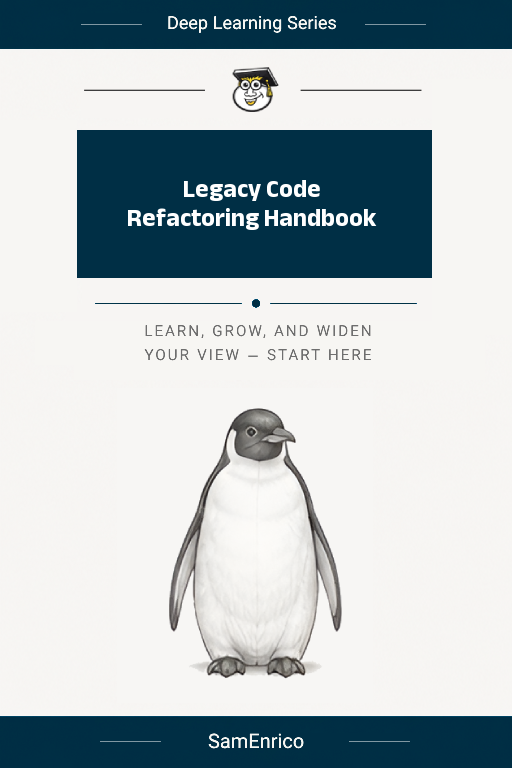
Legacy Code Refactoring Handbook eBook
Use AI to understand undocumented codebases, sugge
by Dix Rebbecca
Use AI to understand undocumented codebases, suggest decompositions, and generate safe refactoring steps. Reduce technical debt without breaking changes.
Formats
Free sample
Chapter 1: The Understanding Gap--–- In the winter of 2023, a well-funded e-commerce startup called Vibe Cart made a decision that seemed entirely rational at the time. Their engineering team of twelve people was struggling to ship features fast enough to keep up with an aggressive growth target. They had a backlog of 140 story points, a CTO who had promised the board a Black Friday release, and a newly approved budget for Git Hub Copilot. The mandate was simple: use AI to write more code, faster. The engineers complied enthusiastically.
They generated entire features with single prompts. They accepted AI suggestions without close inspection because the suggestions looked plausible and the tests passed. By November, they had shipped the Black Friday release, complete with dynamic pricing, personalized recommendations, and a new checkout flow. The board was thrilled. The engineers were exhausted but proud.
And the codebase had doubled in size.Three weeks after Black Friday, the pager started going off. First it was once a day, then five times, then twenty. The dynamic pricing engine, which had worked flawlessly during the traffic spike, began applying discounts twice—first correctly, then again on the discounted amount, producing prices that were mathematically wrong but still within the range of plausible human error. The personalized recommendation engine started suggesting adult diapers to teenagers and skateboards to retirees. The checkout flow, the crown jewel of the AI-assisted sprint, would occasionally charge customers for items they had removed from their cart five minutes ago.
The engineers debugged frantically. They found functions that had been written in styles no one recognized. They found logic that seemed to contradict the product requirements. They found code that their own names were attached to in git blame, but that they had no memory of writing. They had become owners of a codebase they did not understand, and that lack of understanding was now costing the company real money.The story of Vibe Cart is not a cautionary tale about AI.
AI is a remarkable tool, perhaps the most powerful tool for software development since the integrated circuit. The cautionary tale is about the gap between generating code and understanding code. That gap has always existed, but AI has widened it into a chasm. When humans write code, they build mental models concurrently with the code itself. The act of typing, of debugging, of refactoring, of explaining your code to a rubber duck—all of these activities embed understanding into the developer's mind.
When AI writes code, the human receives a finished product with no such embedded understanding. The code appears fully formed, like Athena sprung from the head of Zeus, and the human is left to reverse-engineer it after the fact.This book is about closing that gap. It is about using AI not as a code generator but as a reasoning engine—a collaborator that helps you understand legacy systems, decompose them safely, and modernize them without breaking changes. The techniques in these chapters have been tested on real codebases, from fintech startups to healthcare giants to government legacy systems that predate the web. They have reduced refactoring timelines from months to weeks, incident rates from daily to weekly, and the cognitive burden of legacy code from crushing to manageable.
But before we dive into the how, we must understand the what and the why. What exactly is legacy code in the age of AI? And why has the traditional definition become dangerously obsolete?The Feathers Definition and Its Limits For twenty years, the software industry has relied on a definition of legacy code coined by Michael Feathers in his seminal book Working Effectively with Legacy Code: legacy code is code without tests. This definition was powerful because it was actionable. If your code lacks tests, you know exactly what to do: write tests.
Start with characterization tests that capture current behavior, then refactor with confidence. The definition transformed legacy from a vague sense of dread into a concrete technical problem with a concrete technical solution.But the Feathers definition was forged in an era before large language models. It assumed that code without tests was still understandable—that a skilled engineer could read it, reason about it, and gradually bring it under test. That assumption is no longer universally true. The new forms of legacy that AI has introduced are not primarily about test coverage.
They are about comprehensibility. A system can have 100% test coverage and still be legacy code if no one understands why it works the way it does, what assumptions it makes, or how to change it without breaking something subtle.Consider the dynamic pricing engine that caused Vibe Cart's post-Black Friday outages. It had tests. The AI had generated them alongside the implementation. The tests checked that a 100itemwitha20100 item with a 20% discount became 100itemwitha2080, that a 50itemwitha1050 item with a 10% discount became 50itemwitha1045, and so on.
The tests passed. But the tests did not check what happened when the discount function was called twice in the same request—a scenario that no one had anticipated because no one had fully traced the execution path through the system. The AI had not anticipated it either. The human had not thought to ask. The tests passed, the code shipped, and the bug waited patiently for Black Friday traffic to expose it.The Feathers definition also assumed a stable relationship between code and its authors.
When a human writes code, they become its de facto owner—the person most likely to understand it, to remember why certain decisions were made, to be able to explain it to others. AI has no such ownership. Code generated by AI and accepted by a human creates a strange ownership vacuum. The human is the nominal author, but they lack the deep understanding that traditionally accompanies authorship. The AI has the understanding, but it is not a person and cannot be asked questions.
The code exists in a liminal space, owned by no one and understood by no one. It is legacy code from the moment it is merged.The Three New Faces of Legacy To navigate the AI era, we need a new definition of legacy code. Legacy code is code that no living person fully understands. This definition encompasses the Feathers definition—code without tests is certainly hard to understand—but it extends to cover the new forms of incomprehensibility that AI has introduced. Specifically, three new faces of legacy have emerged that tests alone cannot fix.Face One: Undocumented Business Logic The first new face of legacy is the silent assumption.
Every piece of business logic rests on assumptions about the world—that order totals are positive numbers, that customer IDs are unique, that timestamps are in UTC, that a discount code can only be used once. Human programmers often document these assumptions in comments, commit messages, or at least in the structure of the code itself. They create functions named apply Discount Once, variables named is First Use, and conditional checks that make the assumptions explicit.AI programmers do none of this. They generate code that works for the most common case and assumes that all other cases will never occur. They produce a discount function that applies…
This is the end of the free sample. Get the eBook to keep going. Buy now
About this book
Details
- Author
- Dix Rebbecca
- Publisher
- SamEnrico
- Language
- English
- Genre
- Non-Fiction, AI Operator, Refactoring, Legacy Modernization
- Released
- 2026-05-29
- Pages (approx.)
- 139
- Available as
- eBook, Audiobook

Read better in the ZLOADR app
Your eBooks on your phone or tablet. Sign in with your SamEnrico account and start reading.
More by Dix Rebbecca
 Bipolar Parenting GuidebookDix Rebbecca$11.99
 Addressing Blended Family IssuesDix Rebbecca$11.99
 Solution Validation Survey GuideDix Rebbecca$11.99
 Colombian Green Tax GuideDix Rebbecca$11.99
 Intermittent Fasting FAQDix Rebbecca$11.99
 Caffeine Management for StudentsDix Rebbecca$11.99
 The Negative Thought StopperDix Rebbecca$11.99
 TM for LawyersDix Rebbecca$11.99
 HGH And MicrobiomeDix Rebbecca$11.99
 The Last Unknown Tribes: Unveiling New Guinea's Hidden WorldsDix Rebbecca$11.99
 The Ballad of the Greenbrier Ghost: A Love That Defies DeathDix Rebbecca$11.99
 Inanna and the Descent: A Love That Crossed the UnderworldDix Rebbecca$11.99