
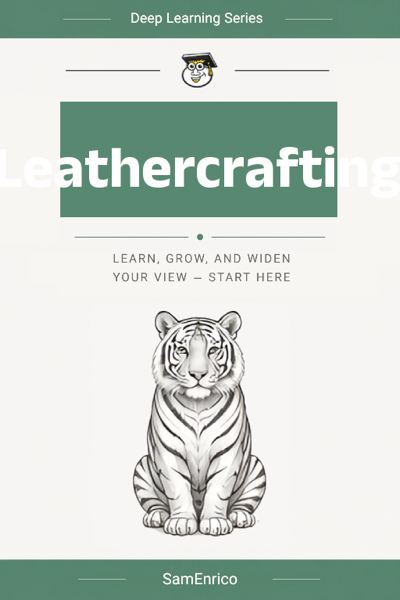
Non-FictionInformativeEducational
Leathercrafting eBook
A Coursebook on Leathercrafting
A Coursebook on Leathercrafting
Formats
Free sample
Chapter 1: The Living Material--–- Leather is not fabric. This is the single most important sentence in this entire book, and it is worth reading twice before you turn another page. Fabric is woven, knitted, or felted from fibers that begin as something other than skin. Leather begins as skin. It breathes, stretches, absorbs moisture, changes temperature with its environment, and – if you learn to work with its nature rather than against it – it will outlast you by decades.
A cotton shirt disintegrates in a landfill within months. A well-made leather bag, cared for properly, can be buried and dug up a century later, still supple, still holding its shape, still smelling faintly of the animal and the tannery and the hands that stitched it.This chapter exists to stop you from making the single most expensive mistake that new leathercrafters make: buying the wrong leather for your first project. That mistake costs beginners an average of forty to sixty dollars in wasted material, plus the soul-crushing experience of trying to tool a piece of chrome-tanned leather that refuses to hold a stamp, or stitching a belt from soft, stretchy leather that warps under its own weight. By the end of this chapter, you will know exactly what to buy for every project in this book, how to recognize quality with your own hands, and why a five-dollar scrap bin can teach you more than a fifty-dollar side of pristine hide.The Skin You Are Holding Before we talk about tannage, before we talk about grain or weight or color, you need to understand what leather actually is at the microscopic level. Leather is the preserved hide of an animal – most commonly cow, but also goat, pig, sheep, deer, horse, and dozens of exotic species.
That hide consists of three primary layers. The outermost is the epidermis, which is removed during the tanning process. Beneath that lies the grain layer – a dense, tight mesh of collagen fibers that gives leather its strength, its smooth surface, and its ability to take stamps and tooling. Beneath the grain lies the corium, a looser network of fibers that provides bulk and flexibility.When you run your fingers across a piece of full-grain leather, you are touching the original surface of the animal's skin. You might feel hair pores, scars from barbed wire, insect bites, or stretch marks from when the animal was alive.
These are not flaws. These are authenticity. The leather industry calls them "character marks," and they are the reason no two pieces of full-grain leather are exactly alike. Top-grain leather, by contrast, has had the uppermost layer sanded off to remove those marks, which also removes the tightest, strongest fibers. Genuine leather – the lowest grade – is not even a single layer.
It is a composite of shredded leather fibers bonded together with adhesives, then embossed with a fake grain pattern. You should never buy genuine leather for any project you intend to keep or sell.The Great Divide: Vegetable-Tanned vs. Chrome-Tanned Every piece of leather you will ever encounter falls into one of two categories, and understanding this distinction is the difference between a successful first project and a frustrating pile of ruined scraps. The category is determined by how the animal hide was preserved and stabilized – a process called tanning.Vegetable-tanned leather – often called "veg-tan" – is tanned using tannins found in tree bark, leaves, and other plant matter. The process takes anywhere from several weeks to several months.
The result is a firm, dense leather that can be carved, stamped, tooled, wet-formed, and burnished to a glassy shine. It starts as a pale pinkish-tan color (often called "natural" or "tooling leather") and darkens with age and sunlight. Veg-tan absorbs water readily, which makes it ideal for molding (Chapter 10) and casing for stamping (Chapter 7). It also cuts cleanly, holds a stitch hole without tearing, and develops a rich patina over years of use. The downsides?
It is stiffer than chrome-tan, takes more effort to work, and is generally more expensive.Chrome-tanned leather – often called "chrome-tan" – is tanned using chromium salts in a process that takes less than a day. The result is a soft, supple leather that comes in every color imaginable straight from the tannery. Chrome-tan is what most people think of when they imagine "leather" – soft bags, jackets, upholstery, car interiors. It is comfortable against the skin, drapes beautifully, and requires almost no break-in period. However, chrome-tan cannot be tooled or stamped – the fibers are too soft and springy to hold an impression.
It cannot be wet-formed into rigid shapes. It does not burnish to a shine; the edges remain fuzzy unless you paint them with edge paint. And it is more difficult to cut cleanly because the fibers stretch rather than sever.Here is the rule that will save you from ever buying the wrong leather again: If you want to carve, stamp, tool, wet-form, or burnish the edges, you must use vegetable-tanned leather. If you want a soft, supple bag or garment that will not hold decorative work, chrome-tanned leather is fine. This book's projects are designed around veg-tan because it is the leather that teaches you skills.
The Minimalist Wallet (Chapter 6), the Belt (Chapter 9A), the tooled projects (Chapters 7 and 8), and the wet-formed pouch (Chapter 10) all require veg-tan. The Tote Bag (Chapter 9B) is the only project where you have a choice – veg-tan for a structured, toolable bag, or chrome-tan for a soft, draping bag.Grain Quality: What the Labels Actually Mean Walk into any leather supplier, and you will see bins labeled "full-grain," "top-grain," "split," "bonded," and "genuine." These terms are not interchangeable, and they are not merely marketing jargon – they describe measurable differences in strength, durability, and workability.Full-grain leather is the highest quality. The grain layer is intact and un-sanded. The surface shows the natural texture of the animal – pores, scars, wrinkles. Full-grain is the strongest leather because the tightest fibers are preserved.
It will last decades with minimal care. It develops patina beautifully. It is the best choice for belts, wallets, sheaths, and any item that will see heavy use. The only downside is cosmetic: if you want a perfectly uniform, flawless surface, full-grain will disappoint you because animals are not manufactured.Top-grain leather has had the outermost layer of the grain sanded off to remove surface imperfections. This makes the leather more uniform in appearance but also weaker, because the sanding removes the densest fibers.
Top-grain is often embossed with an artificial grain pattern to disguise the fact that the original grain is gone. It is acceptable for items that will not bear heavy stress, like decorative covers or light-use bags, but it is never the best choice.Split leather is the fibrous underlayer that remains after the grain layer is split off. Splits are weak, fuzzy on both sides, and structurally inferior. They are often used for suede (where the fuzzy side becomes the surface) or for cheap linings. Splits have their place in the workshop – they make excellent practice material because they are inexpensive – but they should never be used for structural components or visible outer surfaces.Genuine leather and bonded leather are the lowest tier.
Genuine leather is a vague term that legally means only that the product contains some real leather. In practice, it…
This is the end of the free sample. Get the eBook to keep going. Buy now
About this book
Details
- Author
- Strauss Eilene
- Publisher
- SamEnrico
- Language
- English
- Genre
- Non-Fiction, Informative, Educational
- Released
- 2026-06-02
- Pages (approx.)
- 146
- Available as
- eBook, Audiobook

Read better in the ZLOADR app
Your eBooks on your phone or tablet. Sign in with your SamEnrico account and start reading.
More by Strauss Eilene
 Metta for ShameStrauss Eilene$11.99
 Mauritania Independence GuideStrauss Eilene$11.99
 Religious Affiliation Fitness PatternsStrauss Eilene$11.99
 Meadow Rest GuideStrauss Eilene$11.99
 The Imposter Syndrome Self Compassion GuideStrauss Eilene$11.99
 Whispers of the Vanished: The Last Speakers of SumerianStrauss Eilene$11.99
 Understanding Motor Neuron DiseaseStrauss Eilene$17.99
 Technical Writing Future TrendsStrauss Eilene$12.99
 Porsche GuideStrauss Eilene$12.99
 How to Become a Clothing-pattern PreparerStrauss Eilene$11.99
You may also like
 Hong Kong Handover 1997Dunn Johnnie$11.99
 Zumba For Postnatal Recovery CourseNeal Christian$11.99
 Zumba for BeginnersLadner Nikia$11.99
 YouTube Comment Mining GuideHumes Pandora$12.99
 Worry Box MeditationCarlin Rudy$11.99
 Workplace Stress MeditationNguyen Lynn$11.99
 Workplace Stress and Sleep RepairHawley Ivory$11.99
 Workplace Perfectionism CureDelaney Jeffry$11.99
 Workplace Injustice Anger GuideWallen Isabelle$11.99
 Work Addiction and Burnout LinkGreenwood Ester$11.99
 Women in Yoga and WellnessBeattie Galina$11.99
 Women in Stand Up ComedyChun Evangeline$11.99