
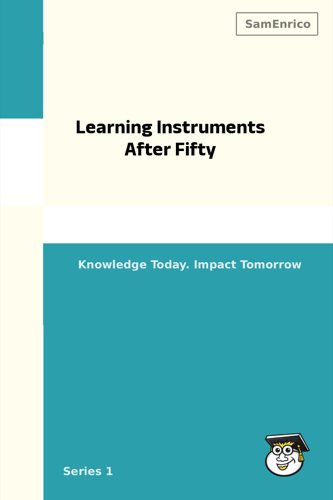
Learning Instruments After Fifty eBook
Stories of people who became musicians late in lif
Stories of people who became musicians late in life.
Formats
Free sample
Chapter 1: The Permission Note--The first thing you need to know is that you already have permission.You don’t need to earn it. You don’t need to prove you’re “serious enough.” You don’t need to wait until you retire, until the kids move out, until the basement is cleaned, until you’ve lost those fifteen pounds, until you’ve finally figured out what you want to be when you grow up—even though you’re fifty-three, fifty-seven, sixty-two, or seventy-one.You have permission right now.This entire chapter is designed to give you that permission in a way that sticks, that doesn’t dissolve the moment you sit down in front of a strange instrument and feel like a child again. Because the feeling of being a beginner at an age when you’re supposed to be competent—that feeling is the single greatest barrier between you and the music that’s been waiting for you, sometimes for decades.Let’s name that feeling. It has a name, and once you name it, you can start to dismantle it.The name is the prodigy myth.The Prodigy Myth and Its Long Shadow The prodigy myth is the belief that musical skill must be acquired in childhood or not at all. It’s the voice that says, “If I didn’t learn piano when I was seven, I’ve missed my window.” It’s the assumption that every adult beginner is competing—unfairly, hopelessly—against the ghost of a ten-year-old Mozart or a twelve-year-old Yo-Yo Ma.Here’s what the prodigy myth doesn’t tell you.It doesn’t tell you that most professional musicians were not child prodigies.
It doesn’t tell you that the vast majority of people who play instruments for pleasure—for the joy of it, for the community of it, for the sheer physical pleasure of making a sound that wasn’t there before—started as adults. It doesn’t tell you that the adult brain, while different from a child’s, has learning advantages that children would kill for.And it certainly doesn’t tell you about Peter Duchin.The Bandleader Who Had to Start Over at Seventy-Five Peter Duchin was one of the most famous bandleaders in America. He’d played for presidents, for royalty, for the New York elite at the Plaza Hotel. His fingers knew the keyboard the way your tongue knows the roof of your mouth—without thought, without effort, without the slightest hesitation.Then, at seventy-five, he had a stroke.When he woke up, he couldn’t read music. He couldn’t use his right hand.
He couldn’t remember the chord changes to songs he’d played ten thousand times. The part of his brain that had stored a lifetime of musical knowledge had been damaged.Here’s where the story gets interesting—not because of what Duchin lost, but because of what he did next.He didn’t hire a physical therapist to move his fingers for him. He didn’t stare at sheet music hoping the notes would rearrange themselves into meaning. Instead, he sat down at the piano and tried to play “Mary Had a Little Lamb” by ear. Then “Twinkle, Twinkle, Little Star.” Then the simplest versions of songs he’d played at the White House.He relearned by ear first—not because he wanted to, but because he had to.
His brain could no longer translate ink marks on a page into finger movements. But his ears still worked. His memory for melodies—the ones he’d heard as a child, the ones that were baked into his bones—those were still there.So he used what he had.Within two years, Peter Duchin was playing piano again. Not perfectly. Not the way he had before the stroke.
But well enough to perform, well enough to lead a band, well enough to prove something that the prodigy myth denies: a damaged brain can rewire itself, which means a healthy fifty-year-old brain is more than capable of learning a C major scale.What the Adult Brain Brings to the Party Let’s get specific about what your brain can do that a child’s cannot.Neuroscientists have studied this extensively, and the findings are consistent across dozens of studies. Children have one clear advantage: neuroplasticity for absolute tasks. That’s a fancy way of saying that kids can develop perfect pitch more easily than adults, and they can absorb new information without the filter of “But does this make sense?” They just absorb.But adults have advantages that matter far more for learning an instrument after fifty. Let’s call them the Four Adult Superpowers. You’ll see these referenced throughout the book because they’re your secret weapons.Superpower One: Focused Attention A seven-year-old can practice for twenty minutes—if you bribe them, if you sit next to them, if you turn off the TV, if they’re not hungry, if they’re not tired, if the dog isn’t barking.
A fifty-seven-year-old can practice for twenty minutes because they decide to. That’s not a small difference. That’s the difference between passive learning and active learning.Adults can sustain attention on a single task for longer periods without external reinforcement. This means that your twenty minutes of practice are more valuable than a child’s forty minutes of distracted noodling.Superpower Two: Emotional Regulation When a child plays a wrong note, they might cry, or laugh, or throw the instrument across the room. When an adult plays a wrong note, they can (with practice) say, “That was wrong.
Let me try that passage again slowly.” This ability to regulate frustration, to not interpret every mistake as a personal failure, is a superpower. It’s the difference between quitting after the first bad practice session and staying for the thousandth.Superpower Three: Pattern Recognition You’ve been listening to music for fifty years. You know what a major chord sounds like, even if you can’t name it. You know when a melody is going up or down. You know when a rhythm is syncopated or straight.
This isn’t nothing. This is a lifetime of unconscious learning that you can now make conscious. Children don’t have this. They’re hearing “Happy Birthday” for the thirtieth time, not the three-thousandth.Superpower Four: Metacognition This is the fancy word for “thinking about thinking.” Adults can ask themselves, “How am I learning this? Is this method working?
Should I try a different approach?” Children generally can’t. They just do what they’re told. Your ability to reflect on your own learning process means you can course-correct in real time. You can notice that you keep making the same mistake on the same transition, and you can decide to isolate just those two notes for five minutes. That’s metacognition in action.These four superpowers are why adults often learn faster than children in the first six months of instruction—not slower.
Yes, children who stick with an instrument for ten years will eventually surpass most adults. But you’re not competing with a child who practices for ten years. You’re learning…
This is the end of the free sample. Get the eBook to keep going. Buy now
About this book
Details
- Author
- Cervantes Celine
- Publisher
- SamEnrico
- Language
- English
- Genre
- Non-Fiction, Biography, Music
- Released
- 2026-06-07
- Pages (approx.)
- 115
- Available as
- eBook, Audiobook

Read better in the ZLOADR app
Your eBooks on your phone or tablet. Sign in with your SamEnrico account and start reading.
More by Cervantes Celine
 Digital Calendar Review GuideCervantes Celine$11.99
 Stress Reducing ConversationCervantes Celine$11.99
 Menopause And Alcohol GuideCervantes Celine$11.99
 The Personal Brand Voice GuideCervantes Celine$11.99
 Theme Day Scheduling StrategyCervantes Celine$11.99
 Meeting Parking Lot DigitalCervantes Celine$11.99
 Comparison Cease HypnosisCervantes Celine$11.99
 The Compound: Inside the Prison That Became a CultCervantes Celine$11.99
 Pizarro's Gambit: The Fall of the Inca Empire (1532)Cervantes Celine$11.99
 Exploring Egyptian Art: Hieroglyphs, Tombs & StatuaryCervantes Celine$11.99
 Mastering Subsidy: Government Payment SystemsCervantes Celine$11.99
 How to Produce a PlowshareCervantes Celine$11.99
You may also like
 Hong Kong Handover 1997Dunn Johnnie$11.99
 Zumba For Postnatal Recovery CourseNeal Christian$11.99
 Zumba for BeginnersLadner Nikia$11.99
 YouTube Comment Mining GuideHumes Pandora$12.99
 Worry Box MeditationCarlin Rudy$11.99
 Workplace Stress MeditationNguyen Lynn$11.99
 Workplace Stress and Sleep RepairHawley Ivory$11.99
 Workplace Perfectionism CureDelaney Jeffry$11.99
 Workplace Injustice Anger GuideWallen Isabelle$11.99
 Work Addiction and Burnout LinkGreenwood Ester$11.99
 Women in Yoga and WellnessBeattie Galina$11.99
 Women in Stand Up ComedyChun Evangeline$11.99