
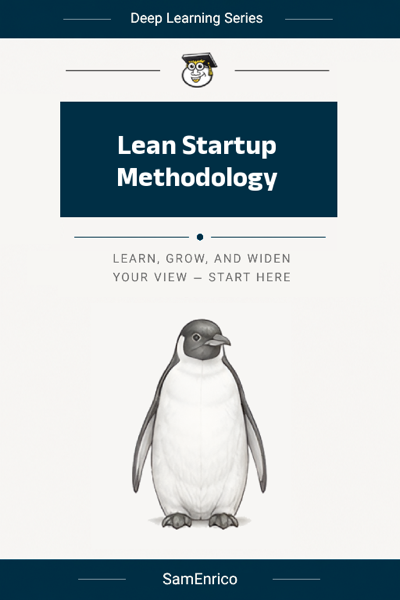
Lean Startup Methodology eBook
A Coursebook on Lean Startup Methodology
A Coursebook on Lean Startup Methodology
Formats
Free sample
Chapter 1: The Productivity Paradox--The most dangerous sentence in business is not “We’re going bankrupt” or “Our competitor just ate our lunch.” It is a sentence that sounds like progress, sounds like hard work, sounds like something a responsible leader should say. That sentence is: “Let’s make sure we get this right before we launch.”On its surface, this is wisdom. In practice, it is a slow-acting poison. It is the reason startups with millions of dollars in funding build products that exactly zero people want. It is the reason corporate innovation teams spend eighteen months on “research” only to discover that their target customer has already solved the problem without them.
It is the reason you have personally wasted months—maybe years—of your life on projects that felt productive at the time but ultimately went nowhere.This book is going to change that. But before we can fix the problem, we have to name it. And the problem has a name: the Productivity Paradox.Here is the paradox in its simplest form. In a traditional company, productivity means output. You measure productivity by how many features you ship, how many lines of code you write, how many tasks you check off your list.
The more you build, the more productive you are. This makes perfect sense in a factory. It makes perfect sense in an accounting department. It makes zero sense in a startup.Why? Because a startup is not a factory.
A factory already knows what to build—they have a blueprint, a supply chain, a predictable customer. A factory’s job is to execute efficiently. A startup’s job is to search for a business model. And in a search, efficiency is irrelevant if you are searching in the wrong place. You can build the wrong product perfectly.
You can ship a flawless version of something nobody wants. You can be maximally productive and maximally doomed at the same time.The Productivity Paradox, then, is this: the behaviors that make you look productive in a traditional organization—building fast, shipping features, hitting deadlines—are often the behaviors that guarantee failure in a startup. True productivity in a startup is not measured by what you build. It is measured by what you learn. And learning, unlike shipping, is invisible.
You cannot put “learned that customers hate our pricing model” on a quarterly report. You cannot brag about “discovered that our distribution channel is broken” at a board meeting. But those learnings are the only things that matter.This chapter will dismantle the Productivity Paradox piece by piece. We will explore why traditional management fails in conditions of extreme uncertainty, why “getting it right before launch” is a trap, and what the alternative looks like. By the end of this chapter, you will never measure your team’s progress by how much they built again.The Factory Mindset That Kills Startups Let us travel back in time to 1913.
Henry Ford has just installed the first moving assembly line at his Highland Park plant. Before the assembly line, building a Model T took over twelve hours per car. After the assembly line, it took ninety-three minutes. This was not just an improvement. It was a revolution.The principles that Ford pioneered—standardization, specialization, efficiency, quality control—became the bedrock of twentieth-century management.
Peter Drucker, Tom Peters, and generations of business school professors built careers on refining these ideas. And they worked. For factories. For predictable, repeatable processes. For businesses that already knew what their customers wanted.The problem is that we have spent the last hundred years applying factory logic to everything.
We apply it to software development. We apply it to marketing campaigns. We apply it to product design. And we apply it, disastrously, to startups.Here is how the factory mindset shows up in a startup environment. Someone has an idea for a new product.
The team writes a business plan—forty pages of spreadsheets and forecasts and market sizing. They present it to leadership. Leadership asks: “How long will it take?” The team estimates six months. Leadership approves a budget. The team disappears for six months.
They build. They test internally. They fix bugs. They polish. And then, on a carefully scheduled Tuesday, they launch.And nobody comes.The team is confused.
They did everything right. They followed the plan. They hit their deadlines. They built a high-quality product. How could this happen?The answer is uncomfortable: they were productive in exactly the wrong way.
They optimized for building when they should have been optimizing for learning. They treated the startup as a factory when it was actually a laboratory.The factory mindset assumes you know the answers before you start. It assumes the customer exists, the problem is well-defined, and the solution is a matter of execution. But in a startup, none of these things are true. The customer is a hypothesis.
The problem is a hypothesis. The solution is a hypothesis. Everything is a hypothesis until proven otherwise by real-world data.This is not a minor difference in philosophy. It is a complete inversion of how work should be organized. In a factory, you plan first, then execute.
In a startup, you hypothesize first, then test, then learn, then plan again. The factory moves from plan to product. The startup moves from idea to experiment to data to decision. These two sequences are opposites. And confusing them is the single most common cause of startup failure.Let me give you a concrete example.
In the late 1990s, a company called Webvan raised over eight hundred million dollars to build a grocery delivery service. They did everything a factory mindset would recommend. They wrote a detailed business plan. They built massive automated warehouses. They hired thousands of employees.
They launched in multiple cities simultaneously. And then they discovered, after spending nearly a billion dollars, that customers did not actually want groceries delivered that way. Webvan went bankrupt in 2001. It is now a case study in exactly what not to do.Now contrast Webvan with a startup called Zappos. In 1999, a young man named Nick Swinmurn had an idea: sell shoes online.
But instead of building warehouses, inventory systems, and a supply chain, Swinmurn did something that looked completely unproductive by factory standards. He drove to a local shoe store. He took photographs of their shoes. He posted the photos on a simple website. And when someone ordered a pair, he drove back to the store, bought the shoes at full price, and shipped them.This was not scalable.
This was not efficient. This was not a business. It was an experiment. And that experiment taught Swinmurn something invaluable: people would buy shoes online without trying them on. That single insight, which cost him almost nothing to obtain, justified building the real company.
Zappos eventually sold to Amazon for over one billion dollars.The difference between Webvan and Zappos is the difference between the factory mindset and the learning mindset. Webvan built first and asked questions later. Zappos asked questions first and built later. Webvan measured productivity by what they built. Zappos measured productivity by what they learned.
One approach burned nearly a billion dollars. The other built a billion-dollar company.The Vicious Cycle of “Just One More Feature”The…
This is the end of the free sample. Get the eBook to keep going. Buy now
About this book
Details
- Author
- Cambell Julianna
- Publisher
- SamEnrico
- Language
- English
- Genre
- Non-Fiction, Informative, Educational
- Released
- 2026-06-02
- Pages (approx.)
- 126
- Available as
- eBook, Audiobook

Read better in the ZLOADR app
Your eBooks on your phone or tablet. Sign in with your SamEnrico account and start reading.
More by Cambell Julianna
 Loving Kindness For ShameCambell Julianna$11.99
 Hybrid Memory SystemsCambell Julianna$11.99
 The Art Student Critique FearCambell Julianna$11.99
 Teen EQ Development CourseCambell Julianna$11.99
 Mindfulness for Restful SleepCambell Julianna$11.99
 Menopause Stress Relationship GuideCambell Julianna$11.99
 Lucid Dreaming for TraumaCambell Julianna$11.99
 Memory Palace TipsCambell Julianna$11.99Memory Palace TipsCambell Julianna$11.99
 Gates Of Arctic FrozenCambell Julianna$11.99
 The Siege of Barcelona: A City Held Hostage in the War of Spanish SuccessionCambell Julianna$11.99
 Titian and Charles V: The Emperor’s Portrait That Defined an EmpireCambell Julianna$11.99