
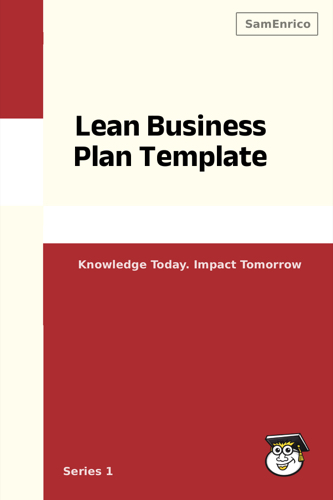
Non-FictionStartup GuideLean Methodology
Lean Business Plan Template eBook
Use one page canvas to map problem solution and ke
Use one page canvas to map problem solution and key metrics before writing full plan.
Formats
Free sample
Chapter 1: The 40-Page Lie--–- Every entrepreneur remembers the moment they first believed in the 40-page business plan. For me, it was in a coffee shop in Austin, Texas, surrounded by three-ring binders and the smell of burnt espresso. I had just raised $47,000 from friends and family for a meal-kit delivery service aimed at rock climbers. The name was "Cliffside Kitchen." The logo featured a carabiner holding a fork. The 47-page business plan—I was proud that it exceeded the mythical 40-page benchmark—included five-year financial projections, a SWOT analysis, a detailed organizational chart, and even a section on exit strategy.
The only thing it did not include was a single conversation with a rock climber.Eight months later, Cliffside Kitchen was dead. Not because we failed to execute. We executed perfectly. We built the kitchen, designed the packaging, hired climbers as delivery drivers, and launched with 15 carefully curated recipes. The problem was simple: rock climbers cook in parking lots with one-burner stoves.
They do not want meal kits that require refrigeration, chopping, and cleanup. They want dehydrated meals that fit in a backpack. They had been telling this to anyone who asked—but nobody at Cliffside Kitchen had asked. We had written a 47-page plan about a problem we invented, for customers we had never met, using solutions we had never tested.This chapter is about why that happened, why it happens to 42 percent of all startups, and why the Lean Canvas exists as the antidote. More importantly, this chapter introduces the Cascade Principle—the single most important framework in this book—which will govern every decision you make from Chapter 2 through Chapter 12.The Certainty Trap Every traditional business plan begins with an act of profound dishonesty.
Not intentional dishonesty, but structural dishonesty. The structure of a business plan forces you to write about your customer, your problem, your solution, your pricing, and your distribution as if you already know these things with certainty. A typical business plan template includes sections like "Market Analysis," "Competitive Landscape," "Financial Projections," and "Implementation Timeline." Each of these sections assumes that you have already done the work of discovery.But a startup, as Steve Blank famously observed, is not a small version of a large company. A startup is a "temporary organization designed to search for a repeatable business model." Large companies execute known business models. Startups search for unknown ones.
Writing a 40-page business plan for a startup is like drawing a detailed map of a city you have never visited. You are not documenting facts. You are documenting guesses.This is what I call the Certainty Trap. The business plan format demands certainty, so entrepreneurs manufacture it. They make up numbers for their financial projections.
They guess at customer acquisition costs. They assume their pricing is correct. They invent a five-year timeline. Then, having written these guesses down in a professional-looking document, they begin to believe their own guesses. The plan becomes a prison.
Any deviation from the plan feels like failure. So they march forward, building the product they planned, even as evidence mounts that the plan was wrong.At Cliffside Kitchen, our business plan projected that we would acquire 500 customers in month one through Facebook ads. We assumed a cost per acquisition of $12. We had never run a Facebook ad in our lives. When we actually launched, our cost per acquisition was $47—and those customers churned within 30 days.
But we had a plan. We had committed to the plan in front of investors. So we kept spending, kept acquiring expensive customers, kept losing money, because the plan said we were supposed to. The Certainty Trap had us.The Cost of Delay The most expensive word in entrepreneurship is "planning." Not because planning is inherently bad, but because planning often becomes a substitute for learning. I have watched founders spend six weeks writing a business plan for a product that could have been validated in six days with a landing page and $100 in Facebook ads.
I have watched founders build elaborate financial models for pricing strategies that could have been tested with a single "Buy Now" button. I have watched founders write 30-page market analyses when they could have simply interviewed ten customers.The cost of this delay is not just time. It is money, yes—the $47,000 I raised for Cliffside Kitchen could have been spent on 470 customer interviews at $100 each. But the real cost is opportunity. Every week you spend writing a plan is a week you are not learning whether your idea has merit.
Every feature you build based on an assumption is a feature you will have to rebuild when that assumption proves wrong. Every dollar spent on untested hypotheses is a dollar that could have been spent on validated learning.Consider the data. CB Insights analyzed 101 startup failures and found that 42 percent failed because there was "no market need." That is not a failure of execution. That is a failure of discovery. These founders built something that nobody wanted.
They could have discovered this in weeks with a Lean Canvas and customer interviews. Instead, they discovered it after months or years of building, after the money was gone, after the team had burned out.The Cliffside Kitchen story is embarrassing to tell, but it is also instructive. We spent eight months building a product for a market that did not exist. We could have discovered that market did not exist in eight days. The first rock climber we interviewed would have told us, "I cook with one burner in a parking lot." The second would have said, "I eat dehydrated meals." The third would have said, "Meal kits are for people with kitchens." But we never interviewed a single rock climber because we were too busy writing the plan.The Lean Alternative The alternative to the 40-page business plan is not chaos.
It is not "just build something and see what happens." The alternative is a systematic process of hypothesis testing that prioritizes learning over documentation. This is the Lean Startup methodology, developed by Eric Ries and inspired by the Customer Development work of Steve Blank.The Lean Startup replaces the question "Can I build this product?" with the question "Should I build this product?" And the only way to answer "should" is to test your riskiest assumptions as quickly and cheaply as possible. You do not need a 40-page plan to test whether customers have a problem. You need a conversation script and ten interviews. You do not need a five-year financial model to test whether customers will pay.
You need a landing page with a "Pre-order" button. You do not need a detailed channel strategy to test whether you can reach customers. You need a $100 experiment on one channel.This shift—from planning to experimenting, from documenting to learning, from certainty to curiosity—is the foundation of everything in this book. The Lean Canvas, which you will build in Chapter 2, is the tool that makes this shift practical. It forces you to surface your assumptions.
It forces you to prioritize which assumptions are riskiest. And it forces you to test those assumptions before you spend money building anything.But the Lean Canvas is just a…
This is the end of the free sample. Get the eBook to keep going. Buy now
About this book
Details
- Author
- Swart Jannette
- Publisher
- SamEnrico
- Language
- English
- Genre
- Non-Fiction, Startup Guide, Lean Methodology
- Released
- 2026-06-07
- Pages (approx.)
- 139
- Available as
- eBook, Audiobook

Read better in the ZLOADR app
Your eBooks on your phone or tablet. Sign in with your SamEnrico account and start reading.
More by Swart Jannette
 Stress Time Management HealthSwart Jannette$11.99
 Consistency Commitment TechniqueSwart Jannette$11.99
 Second Circle Third Circle BehaviorsSwart Jannette$11.99
 Quetzalcoatl’s Serpent Song: The Feathered Serpent’s RiseSwart Jannette$11.99
 Remote Presentation Setup GuideSwart Jannette$12.99
 Maintenance OutfitterSwart Jannette$11.99
 Learn to Play the HegelongSwart Jannette$11.99
 Ultimate Handbook Guide to Dengzhou : (China) Travel GuideSwart Jannette$11.99
You may also like
 Hong Kong Handover 1997Dunn Johnnie$11.99
 Zumba For Postnatal Recovery CourseNeal Christian$11.99
 Zumba for BeginnersLadner Nikia$11.99
 YouTube Comment Mining GuideHumes Pandora$12.99
 Worry Box MeditationCarlin Rudy$11.99
 Workplace Stress MeditationNguyen Lynn$11.99
 Workplace Stress and Sleep RepairHawley Ivory$11.99
 Workplace Perfectionism CureDelaney Jeffry$11.99
 Workplace Injustice Anger GuideWallen Isabelle$11.99
 Work Addiction and Burnout LinkGreenwood Ester$11.99
 Women in Yoga and WellnessBeattie Galina$11.99
 Women in Stand Up ComedyChun Evangeline$11.99