
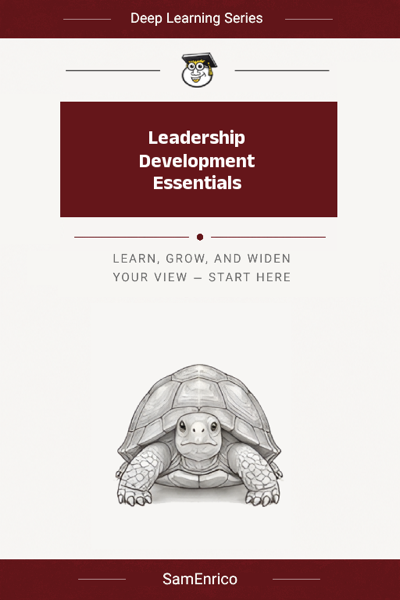
Non-FictionInformativeEducational
Leadership Development Essentials eBook
A Coursebook on Leadership Development Essentials
A Coursebook on Leadership Development Essentials
Formats
Free sample
Chapter 1: The Inner Scorecard--–- You are about to make a decision that will determine whether you become the leader you hoped you would be or the leader you fear you are becoming.It is not a decision about strategy, budget, or hiring. It is a decision about where you place your attention in the next 90 seconds. And right now, without knowing it, you are already making it.Every leader carries an invisible device. It is not a phone or a laptop. It is an internal scoreboard that runs constantly, updating in real time, tracking a single metric: How am I looking right now?This scoreboard is not new.
It evolved to protect you from rejection, from exclusion, from the ancient terror of being cast out of the tribe. In the savanna, that terror was a survival mechanism. In the boardroom, it is a leadership liability.Welcome to the inner critic.It has many names. Impostor syndrome. Self-doubt.
The voice that says "You don't belong here" right before you walk into a meeting. The voice that replays the one critical comment from a performance review while ignoring the nine positive ones. The voice that convinces you to overprepare, overexplain, and overcontrol because if you do not, someone might discover that you are, in fact, making it up as you go along.Everyone has this voice. The difference between leaders who struggle and leaders who thrive is not whether they hear it. It is whether they believe it.This chapter is about the most fundamental leadership shift you will ever make.
Not learning a new technique. Not memorizing a new framework. But dismantling the relationship between your attention and your inner critic so that you can lead from a place of authentic connection rather than anxious self-protection.Let us be clear about what is at stake.Without this shift, every other leadership skill you develop—communication, trust-building, decision-making, strategic thinking—will be performed through a distorted lens. You will be a technically competent leader who nobody truly follows. You will hit your numbers while losing your people.
You will climb the ladder only to discover that the view from the top is lonelier than you imagined.With this shift, you become someone different. Not more charismatic. Not more aggressive. More available—to the people who need you, to the problems that demand you, to the version of yourself that exists beneath the noise.The inner scoreboard is about to be revealed. The question is whether you are willing to look at it.The Weight of the Hidden Scoreboard Let us run a small experiment.Think about the last time you left a meeting feeling drained.
Not because the content was difficult but because something felt off. You replayed a comment you made. You wondered whether your boss thought you were prepared. You mentally calculated who spoke more than you and who spoke less.That feeling of drainage was not caused by the meeting. It was caused by the inner scoreboard running in the background, consuming cognitive bandwidth, burning emotional fuel, leaving less of you available for the actual work.Here is what researchers have discovered about this phenomenon.When leaders are asked to wear a device that measures physiological arousal during meetings, the highest spikes do not occur during difficult strategic debates.
They occur during moments of perceived social threat: being interrupted, having an idea dismissed without consideration, speaking and noticing that nobody looks up from their laptop.Your body does not know the difference between a saber-toothed tiger and a passive-aggressive comment from a peer. The same stress response activates. Cortisol floods your system. Your heart rate increases. Your field of vision narrows.
And your prefrontal cortex—the part of your brain responsible for strategic thinking, empathy, and impulse control—begins to shut down.This is the neuroscience of the inner scoreboard.You are not weak for experiencing it. You are human. But you are also a leader, and leadership requires that you recognize when your brain is reacting rather than responding.The inner scoreboard manifests in predictable patterns that most leaders recognize but few name aloud.The comparison trap. You scan the room and rank yourself against others. Who spoke more articulately?
Who got the laugh? Who had the better idea? This comparison is endless because there is always someone smarter, faster, more confident. And even when you "win" the comparison, the victory is temporary. By tomorrow, a new comparison will emerge.The approval hunt.
You monitor the facial expressions of authority figures. Did your boss nod? Did they look away? You leave the meeting and immediately scan for feedback signals—an email, a Slack message, a passing comment. Without external validation, you feel unmoored.The defensiveness reflex.
When someone challenges your idea, your first internal response is not curiosity but self-protection. You prepare your rebuttal before they finish speaking. You explain why they are wrong rather than asking what you might have missed.The perfectionism spiral. You delay decisions because the data is not complete. You rewrite the same email four times.
You avoid delegating because nobody else will do it "right." Underneath the perfectionism is a fear: if I am wrong, they will see that I am not enough.These patterns are not character flaws. They are adaptations. At some point in your past—likely early in your career or even in childhood—these behaviors protected you. They kept you safe. They helped you survive.But what protected you then is limiting you now.The inner scoreboard is not your enemy.
It is your former protector. And it is time to give it a new job description.The Credibility Equation: Why Your Inner Critic Destroys Trust Let us get mathematical for a moment.Researchers have studied trust across thousands of leader-follower relationships and have identified a clear formula for how trust is built and destroyed.It looks like this:Credibility = (Expertise + Reliability + Intimacy) ÷ Self-Orientation Let us break this down.Expertise is what you know. Your credentials, your experience, your technical competence. It matters, but less than most leaders think.Reliability is whether you do what you say you will do. Small promises kept—responding to emails, showing up on time, following through on commitments.
This is the bedrock of trust.Intimacy is psychological closeness. Do people feel safe sharing hard things with you? Do they believe you will handle their vulnerability with care?These three factors in the numerator are important. But the denominator is where the inner scoreboard does its damage.Self-Orientation is the degree to which you are focused on yourself—your image, your reputation, your needs, your advancement. High self-orientation divides the entire equation.
It multiplies the burden of proof that your expertise, reliability, and intimacy must overcome.Here is what this means in practice.Two leaders walk into the same meeting with identical expertise, reliability, and intimacy scores. Leader A has low self-orientation. They are genuinely curious, focused on the problem rather than their performance, and able to say "I do not know" without shame. Their credibility score is high.Leader B has high self-orientation. They are monitoring how they look, tracking who agrees with them, and mentally rehearsing their next point while others speak.…
This is the end of the free sample. Get the eBook to keep going. Buy now
About this book
Details
- Author
- Hutto Dominique
- Publisher
- SamEnrico
- Language
- English
- Genre
- Non-Fiction, Informative, Educational
- Released
- 2026-05-08
- Pages (approx.)
- 143
- Available as
- eBook, Audiobook

Read better in the ZLOADR app
Your eBooks on your phone or tablet. Sign in with your SamEnrico account and start reading.
More by Hutto Dominique
 The Assertiveness for Salespeople GuideHutto Dominique$11.99
 Infertility Couples Stress GuideHutto Dominique$11.99
 Mitch Kapor LotusHutto Dominique$11.99
 Informational Interview GuideHutto Dominique$12.99
 Teen Emotion DecodeHutto Dominique$11.99
 Belgian Congo CatastropheHutto Dominique$11.99
 Persuasive Website Redesign BriefHutto Dominique$11.99
 Peasant Participation GuideHutto Dominique$11.99
 Bias Blind Spot AwarenessHutto Dominique$11.99
 The Silent Bridge: How a Forgotten Diplomat Averted Nuclear WarHutto Dominique$11.99
 Harmony of the Spheres: Kepler’s Musical CosmosHutto Dominique$11.99
 The Feast of Genius: A Culinary Celebration of Black Nobel Laureates in ScienceHutto Dominique$11.99
You may also like
 Hong Kong Handover 1997Dunn Johnnie$11.99
 Zumba For Postnatal Recovery CourseNeal Christian$11.99
 Zumba for BeginnersLadner Nikia$11.99
 YouTube Comment Mining GuideHumes Pandora$12.99
 Worry Box MeditationCarlin Rudy$11.99
 Workplace Stress MeditationNguyen Lynn$11.99
 Workplace Stress and Sleep RepairHawley Ivory$11.99
 Workplace Perfectionism CureDelaney Jeffry$11.99
 Workplace Injustice Anger GuideWallen Isabelle$11.99
 Work Addiction and Burnout LinkGreenwood Ester$11.99
 Women in Yoga and WellnessBeattie Galina$11.99
 Women in Stand Up ComedyChun Evangeline$11.99