
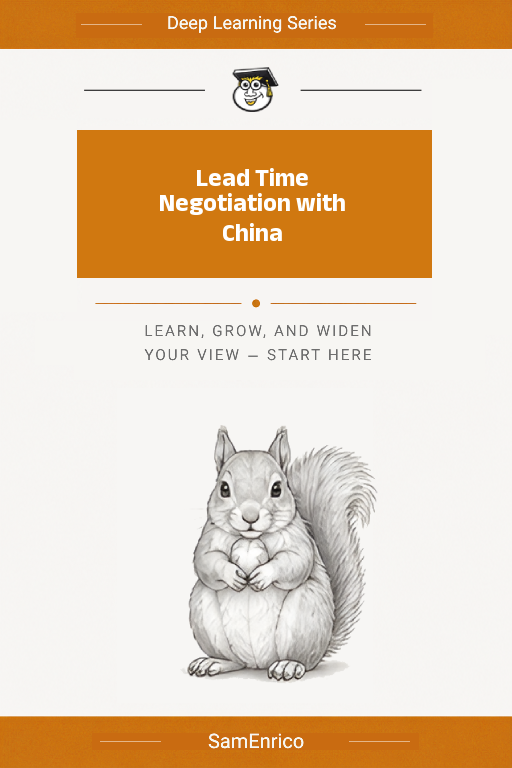
Non-FictionBusiness BriefLead Time
Lead Time Negotiation with China eBook
Balance faster production against cost increases a
by Lord Shante
Balance faster production against cost increases and negotiate realistic delivery schedules.
Formats
Free sample
Chapter 1: The Friction Tax--–- On a humid Tuesday morning in Shenzhen, a factory manager named Wei received an email from a buyer in Chicago. The email was 47 pages long. It contained technical specifications, legal disclaimers, quality checklists, and a request for a "detailed project plan with milestone deliverables." Wei read the first three pages, sighed, and forwarded the email to his assistant with a one-word note: "later."Four thousand miles away, that same buyer was congratulating himself on his thoroughness. He had spent six weeks in internal meetings – legal review, engineering sign-off, procurement committee approval, quality assurance alignment. He had covered every possible risk.
Now, finally, he was ready to source his product from China. He expected a reply within a week.The reply came in two hours. It was three sentences long: "We can make this. Tooling lead time 45 days. Production lead time 30 days.
Please send deposit."The buyer was furious. "They didn't even read my specifications!" he complained to his colleague. "How can they quote lead times without understanding the complexity?"What the buyer did not understand – what most Western buyers never understand – is that the factory had already started building his product. Not the final version. Not the certified, tested, approved version.
A rough, functional, imperfect version that would be tested, broken, fixed, and improved in the time it took the buyer to schedule his next alignment meeting.This is the first and most important lesson of lead time negotiation with China: The factory's clock started without you.The Great Misunderstanding For decades, Western supply chain professionals have operated under a shared assumption: Chinese manufacturing is cheap because labor costs are low, and it is fast because workers are willing to work longer hours. Both assumptions are wrong. Wages in Chinese manufacturing hubs have risen to parity with Eastern Europe and parts of Southern Europe. And working hours, while long, are not the source of the speed advantage that consistently allows Chinese factories to deliver prototypes in weeks while Western firms take months.The real source of "China Speed" is structural and cultural. It is not about working harder.
It is about eliminating the friction that Western buyers have come to accept as normal.Every time you schedule a meeting to "align on requirements," you add a week. Every time you wait for legal to approve a contract clause, you add three days. Every time you circulate a 50-page specification document for review by seven different departments, you add two weeks. These are not necessary steps. They are friction.
And friction is the single greatest enemy of lead time.Chinese manufacturers, particularly in the electronics and consumer goods sectors of the Pearl River Delta, have built an entire industrial culture around the elimination of friction. They do not wait for perfect information. They do not seek consensus before acting. They build, test, break, fix, and build again – sometimes in the same day. This is not recklessness.
It is a different philosophy of production, one that Western buyers consistently fail to understand and therefore fail to leverage.The V-Model vs. The Sprint To understand the friction gap, we must first understand two fundamentally different approaches to product development and production.The Western V-Model Most Western engineering and procurement organizations follow a version of what is known as the "V-Model." The name comes from the shape of the diagram: requirements start on the top left, cascade down through design, implementation, and testing, then rise back up to integration and validation. The model is sequential. Each phase must be completed and signed off before the next phase begins.In practice, this means:Phase 1: Concept. A product manager writes a brief.
(One week)Phase 2: Requirements. Engineering translates the brief into technical specifications. Legal reviews for intellectual property. Procurement reviews for supplier qualifications. (Two to four weeks)Phase 3: Design.
Engineers create detailed designs. Multiple rounds of internal review. (Four to eight weeks)Phase 4: Simulation and Analysis. Software models predict performance. Changes trigger design revisions.
(Two to four weeks)Phase 5: Committee Review. A cross-functional board reviews the design, asks questions, requests changes. (One to three weeks)Phase 6: Prototyping. Finally, a prototype is ordered. (Two to four weeks)Phase 7: Testing.
The prototype is evaluated. Failures trigger a return to Phase 3 or 4. (Two to six weeks)Phase 8: Production. Tooling begins.By the time a Western firm reaches Phase 6 – prototyping – twelve to twenty-five weeks have passed. The V-Model is designed to minimize risk.
It assumes that careful planning upfront prevents costly mistakes later. And for certain categories – medical devices, aerospace, anything where failure kills people – this is absolutely correct.But for the vast majority of consumer goods, industrial components, and electronics, the V-Model is not risk management. It is friction disguised as diligence.The Chinese Sprint Chinese manufacturers, particularly in Shenzhen, operate on a completely different model. Call it the "Sprint." The Sprint has only three phases, and they overlap continuously:Phase 1: Rough Build. The factory produces a functional but imperfect version of the product immediately, often within days.
They use available materials, standard components, and experienced judgment. They do not wait for complete specifications. They build to the spirit of the requirement, not the letter.Phase 2: Test and Break. The rough prototype is tested – not in a simulation, but in the real world. It fails.
This is expected. The failure is documented not as a problem but as data.Phase 3: Fix and Iterate. The factory modifies the design based on the test results. A new version is built, often within 24 hours. It is tested again.
The cycle repeats, daily.The Sprint compresses what the V-Model does in twenty weeks into three or four weeks. It does this by eliminating handoffs, approvals, and the illusion of perfect upfront information. The Chinese factory does not need your complete specifications to start. They need a functional direction. They will discover the problems by building, not by simulating.The critical insight: The Sprint is not a compromise on quality.
It is a different path to the same destination. The V-Model assumes you can think your way to a perfect design. The Sprint assumes you must build your way there. In practice, the Sprint often produces higher quality because real-world testing reveals problems that simulations miss.The Cost of Friction: A Benchmark You Cannot Afford to Ignore Here is a benchmark that appears in every serious analysis of China sourcing, from Roland Berger to Mc Kinsey to the academic literature on supply chain management: Six weeks of Western "alignment meetings" – defining requirements, negotiating legal terms, conducting design reviews – is enough time for a Shenzhen factory to produce a functional prototype and begin tooling.Read that again. Every week you spend in internal meetings, the factory could have spent building your product.
Every day you wait for legal approval, the factory could have been testing and iterating.The buyer in our opening story spent six weeks on alignment. In that same six weeks, the Shenzhen factory – the one he was furious with – could have delivered a working prototype. Not the final product, not the certified version, but something real and tangible that could be held, tested, and improved.This is the Friction Tax. It is the hidden cost of your…
This is the end of the free sample. Get the eBook to keep going. Buy now
About this book
Details
- Author
- Lord Shante
- Publisher
- SamEnrico
- Language
- English
- Genre
- Non-Fiction, Business Brief, Lead Time
- Released
- 2026-06-01
- Pages (approx.)
- 130
- Available as
- eBook, Audiobook

Read better in the ZLOADR app
Your eBooks on your phone or tablet. Sign in with your SamEnrico account and start reading.
More by Lord Shante
 Short Term Rental GuideLord Shante$11.99
 Quadrant Two Scheduling MasteryLord Shante$11.99
 Gurdjieff Fourth Way GuideLord Shante$11.99
 DBT For Emotional EatingLord Shante$11.99
 Breath Awareness For PerformersLord Shante$11.99
 Vulvodynia Pelvic ProtocolLord Shante$11.99
 Bellagio Bandit CrewLord Shante$11.99
 Pomodoro For PerfectionistsLord Shante$11.99
 Tangaroa's Fathomless Wrath: The God Who Swallowed the SunLord Shante$11.99
 Letters from the Dusty Pitch: The Forgotten Warriors of Ancient PersiaLord Shante$11.99
 Mastering The Art of KinomichiLord Shante$11.99
 How to Become a Grinding-mill OperatorLord Shante$11.99
You may also like
 Hong Kong Handover 1997Dunn Johnnie$11.99
 Zumba For Postnatal Recovery CourseNeal Christian$11.99
 Zumba for BeginnersLadner Nikia$11.99
 YouTube Comment Mining GuideHumes Pandora$12.99
 Worry Box MeditationCarlin Rudy$11.99
 Workplace Stress MeditationNguyen Lynn$11.99
 Workplace Stress and Sleep RepairHawley Ivory$11.99
 Workplace Perfectionism CureDelaney Jeffry$11.99
 Workplace Injustice Anger GuideWallen Isabelle$11.99
 Work Addiction and Burnout LinkGreenwood Ester$11.99
 Women in Yoga and WellnessBeattie Galina$11.99
 Women in Stand Up ComedyChun Evangeline$11.99