
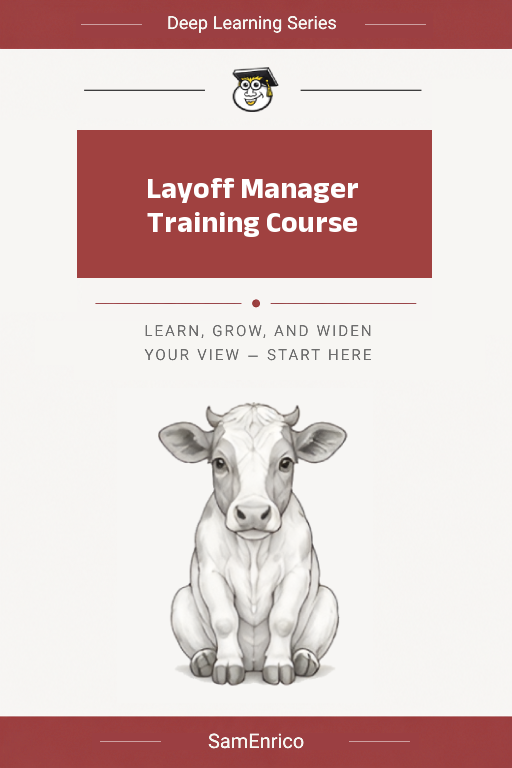
Non-FictionCrisis ManagementLeadership Development
Layoff Manager Training Course eBook
Train supervisors to conduct layoff conversations
by Rector Tiny
Train supervisors to conduct layoff conversations legally and compassionately without creating liability.
Formats
Free sample
Chapter 1: The Stay Interview--–- Most managers first think about layoffs the moment they receive the email from HR. The subject line reads "Workforce Reduction Planning" or "RIF Notification." Their stomach drops. They open the attachment. There is a column for employee names and an empty column next to it labeled "Selection Rationale." They have forty-eight hours to fill it in. And in that moment, they realize they have no idea how to make this decision fairly.
They know their people. They like most of them. They have vague feelings about who works hard and who coasts. But vague feelings are not defensible in court. Vague feelings are how good managers accidentally discriminate.
This chapter exists to ensure you never have to make a layoff decision based on memory and emotion. Because by the time you see that email from HR, it is already too late to prepare. The foundation of a defensible layoff is built months or years in advance, when no one is talking about layoffs at all. That foundation is called the Stay Interview.The Premise That Changes Everything Most managers are familiar with the Exit Interview. An employee resigns.
HR sits them down and asks why they are leaving. The information is useful, but it arrives after the talent has already walked out the door. The Stay Interview flips this model entirely. Instead of asking people why they leave after they have already decided to go, you ask them why they stay while they are still fully engaged. You ask them regularly, systematically, and with documentation.
You build a record of what matters to each employee long before you ever have to decide who stays and who goes during a reduction in force.The Stay Interview serves two masters. The first is retention. When you know what keeps your best people motivated, you can protect those conditions and reduce voluntary turnover. The second is legal defense. When you eventually face a layoff, your Stay Interview documentation proves that you understood each employee's role, their skills, their tenure, and their business value before any reduction was announced.
That documentation is your shield against claims that selection was based on age, race, gender, or any other protected characteristic.Here is the uncomfortable truth that most layoff training avoids. Discrimination claims rarely succeed because an employer intentionally targeted a protected group. They succeed because the employer could not prove otherwise. The plaintiff shows a pattern. The employer says "we selected based on business needs." The judge asks for documentation.
And the employer has nothing except a manager's memory of who seemed least essential. A Stay Interview creates paper. Paper creates proof. Proof creates defense.The Four Questions That Unlock Everything The Stay Interview is not a complex ritual. It does not require a two-hour meeting or a twenty-page form.
It requires four questions, asked in a private setting, with a notepad or a laptop open. The questions are designed to surface what the employee values, what might lure them away, and what would make their work more sustainable. You ask these questions once per quarter for your direct reports. Each interview takes fifteen minutes. Over the course of a year, you have invested one hour per employee in exchange for a complete picture of their motivations, their risks, and their business value.Question one: Why do you stay here?This question seems simple, but it is the most important one on the list.
You are asking the employee to articulate their positive reasons for remaining with your company. The answers will fall into predictable categories. Some will say the mission. Some will say their colleagues. Some will say the flexibility.
Some will say the compensation. Listen carefully because the answer tells you what you must protect if you want to keep this person. It also creates a baseline. Six months from now, when you ask the same question, a changed answer is a warning sign.Question two: What would tempt you away?This question is the risk assessment. You are asking the employee to name their vulnerabilities.
A competing offer with higher pay. A shorter commute. A promotion that your company cannot currently offer. A move to a different city. The answers are not confessions.
They are data points. If three people on your team all say that a forty-five minute commute is wearing them down, you have identified a collective risk that may require a conversation about remote work or adjusted hours. If your best engineer says that lack of mentorship is making them browse job listings, you have identified an intervention point. Document these answers. They become part of your retention risk matrix, which we will discuss later in this chapter.Question three: What would make your job better?This question is the improvement engine.
Employees rarely volunteer criticism unprompted. But when you ask directly and with genuine curiosity, they will tell you what is broken. Outdated software. A bottleneck in approvals. A colleague who is difficult to work with.
A process that adds no value. These answers are gold. They tell you exactly where to invest your limited improvement resources. They also create a record that you listened. When an employee later says "my manager never cared about my problems," you have quarterly documentation to the contrary.Question four: What do you need to grow here?This question is the future orientation.
Employees who see no path forward will eventually leave. That is not disloyalty. That is human nature. You are asking them to articulate what growth looks like from their perspective. A certification.
A stretch assignment. A mentor in another department. A promotion timeline. Their answers may be unrealistic or perfectly reasonable. Your job is not to promise everything.
Your job is to document what they asked for and what you committed to provide. When a layoff comes, this documentation proves that you understood each employee's trajectory and value to the organization.Documentation Standards That Hold Up in Court A Stay Interview that is not documented might as well not exist. You are creating a paper trail for two audiences. The first is your own memory. The second is a plaintiff's attorney or a state labor board.
Your documentation must serve both. Here are the five standards that every Stay Interview note must meet.First, date every entry. This seems obvious, but managers often backdate notes when they realize documentation is missing. Backdating is fraud. Do not do it.
Your credibility is your only asset in a legal proceeding. If you did not document something at the time, write "reconstructed from memory on [current date]" and explain why the original note is missing.Second, use objective language. Do not write "Sarah seems unhappy." Write "Sarah stated that her commute has increased from twenty minutes to forty-five minutes due to the office move. She said this is affecting her energy level by the end of the day." The first version is a feeling. The second version is a fact.
Feelings are not evidence. Facts are.Third, quote where possible. When an employee says something that reveals a retention risk or a business priority, write it down in their own words. Use quotation marks. A quoted statement like…
This is the end of the free sample. Get the eBook to keep going. Buy now
About this book
Details
- Author
- Rector Tiny
- Publisher
- SamEnrico
- Language
- English
- Genre
- Non-Fiction, Crisis Management, Leadership Development
- Released
- 2026-06-01
- Pages (approx.)
- 151
- Available as
- eBook, Audiobook

Read better in the ZLOADR app
Your eBooks on your phone or tablet. Sign in with your SamEnrico account and start reading.
More by Rector Tiny
 Parent Drug OverdoseRector Tiny$11.99
 Special Education Teacher BurnoutRector Tiny$11.99
 Foster Care Birthday MemoriesRector Tiny$11.99
 Housing Downsizing for CouplesRector Tiny$11.99
 Car Rental Small TalkRector Tiny$11.99
 Personal Branding for ArtistsRector Tiny$11.99
 Keto Desserts Without Sugar AlcoholsRector Tiny$11.99
 Battlecruiser Clash at JutlandRector Tiny$11.99
 The Raven’s Lament: How the Trickster Brought Light to the WorldRector Tiny$11.99
 The Last Lap: The Untold Story of the 1984 Olympic Marathon HeistRector Tiny$11.99
 Service Providers Guide to Long Distance TelecommunicationsRector Tiny$11.99
 How to Produce Lights and LightingRector Tiny$11.99
You may also like
 Hong Kong Handover 1997Dunn Johnnie$11.99
 Zumba For Postnatal Recovery CourseNeal Christian$11.99
 Zumba for BeginnersLadner Nikia$11.99
 YouTube Comment Mining GuideHumes Pandora$12.99
 Worry Box MeditationCarlin Rudy$11.99
 Workplace Stress MeditationNguyen Lynn$11.99
 Workplace Stress and Sleep RepairHawley Ivory$11.99
 Workplace Perfectionism CureDelaney Jeffry$11.99
 Workplace Injustice Anger GuideWallen Isabelle$11.99
 Work Addiction and Burnout LinkGreenwood Ester$11.99
 Women in Yoga and WellnessBeattie Galina$11.99
 Women in Stand Up ComedyChun Evangeline$11.99