
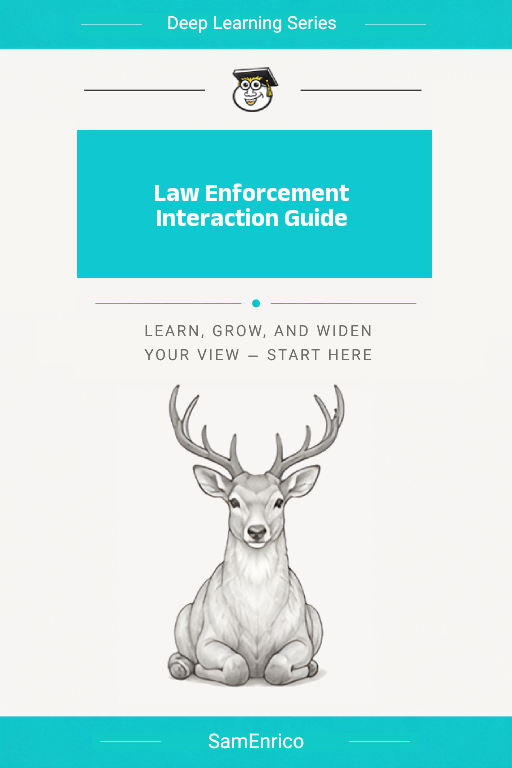
Non-FictionCrisis ManagementPolice Response
Law Enforcement Interaction Guide eBook
Train employees to obey law enforcement commands d
by Wild Lyla
Train employees to obey law enforcement commands during attacks. Keep hands visible, avoid sudden movements, and point to threats when directed.
Formats
Free sample
Chapter 1: The Frozen Second...--The average human being will experience approximately 22,000 days of life. On one of those days—perhaps a Tuesday, perhaps during a team meeting or a lunch break or a walk to the parking garage—the normal rules of reality will suspend themselves. The sound will arrive first. It will be loud, unexpected, and neurologically incomprehensible. And in the three seconds that follow, every decision you make will be written in permanent ink.This chapter is about those three seconds.
Not the minutes that follow. Not the police response, the evacuation, or the aftermath. The three seconds when your brain is lying to you and your body is trying to kill you with kindness by keeping you perfectly still.The term "active shooter" has become so common in American discourse that it has lost its power to shock. We say it in safety meetings. We see it in headlines.
We drill for it with the same bureaucratic resignation we apply to fire drills. But familiarity breeds a dangerous illusion: the illusion that you will recognize the threat when it arrives. The evidence suggests otherwise.Let us begin with a story you have never heard because the man who lived it rarely tells it. We will call him Marcus. He was a logistics manager at a distribution center in a medium-sized Midwestern city.
On a Thursday afternoon in autumn, a terminated employee re-entered the building through a loading dock door that had been propped open for a delivery. The man carried a 9mm pistol in his right hand, held flat against his thigh. He walked thirty feet into the warehouse before anyone noticed him. The first sound was not a gunshot. It was the click of the safety being disengaged.Marcus heard the click from sixty feet away, behind a stack of pallets.
He knew what the click was because he owned the same make of pistol. And yet, in the second between hearing the click and understanding the threat, his brain offered him three alternative explanations: (1) a stapler being dropped, (2) a pallet jack malfunctioning, (3) a forklift operator adjusting a metal bracket. He stood frozen for what felt like an eternity but was measured later at 4.7 seconds. In that time, the shooter fired five rounds. Two hit other employees.
Marcus survived not because he moved but because the shooter turned left instead of right.Marcus did nothing wrong. His brain performed exactly as evolution designed it to perform when confronted with a novel threat: it froze, searched for a familiar pattern, found none, and froze again. This is the "freeze response," and it is not cowardice. It is neurology. And it will kill you if you do not train past it.This chapter will teach you to break the freeze response in three seconds or less.
You will learn why your brain lies to you about gunfire. You will learn a three-step drill that rewires your threat response. You will learn the single most important transition rule in this entire book: the boundary between permitted shouting and required silence. And you will learn why speed is your friend until it becomes your enemy—and how to recognize the exact moment when fast becomes fatal.Let us begin with the neurology of the freeze response, because you cannot outsmart a mechanism you do not understand.The Three Brains: Why You Freeze When You Should Run The human brain is not a single organ but three, stacked atop one another like sedimentary rock. The deepest layer, the brainstem, manages heartbeat, breathing, and the startle reflex.
The middle layer, the limbic system, processes emotion and memory. The outermost layer, the neocortex, handles reasoning, planning, and conscious decision-making. Under normal conditions, these three layers communicate smoothly. Under extreme stress, the deepest layer seizes control and shuts down the others.This is called "cortical inhibition." When the brainstem perceives a life-threatening stimulus, it floods the body with cortisol and adrenaline. These hormones are designed for one purpose: to prepare you for fight or flight.
But they have a side effect. They suppress activity in the neocortex—the thinking brain—because thinking is slow and survival requires speed. The result is that you do not "decide" to freeze. Your thinking brain is literally, chemically, temporarily disabled. What remains is the primitive brain, which has only three responses: fight, flee, or freeze.
And freeze is the default.Why would evolution preserve a freeze response that seems so maladaptive? Because for most of human history, the most dangerous predators were not humans with guns but large animals with excellent motion-detection vision. A human who froze became invisible to a saber-toothed cat. A human who ran triggered the chase instinct. Freeze was the correct response for 99.9% of human evolutionary history.
The remaining 0.1%—the era of firearms—is too recent for our biology to have adapted.You are not broken if you freeze. You are working exactly as designed. But the design is obsolete. The only way to override it is to bypass the thinking brain entirely and train a new pathway directly from perception to action.Auditory Exclusion: Why Your Ears Lie First Before we train the override, we must understand the second neurological obstacle: auditory exclusion. This is the brain's tendency to mute sudden loud sounds as a protective measure.
The same mechanism that allows a parent to sleep through city noise but wake at a baby's cry works against you during an active threat. Your brain decides, without your consent, that the gunfire is not important enough to process in full fidelity.Auditory exclusion has been documented in every major law enforcement after-action report for the past thirty years. Officers in shootouts report hearing "pops" instead of gunshots, or hearing nothing at all until the shooting stops. Civilians report the same phenomenon. In the 2017 Las Vegas Route 91 Harvest festival shooting, survivors standing directly beneath the shooter's hotel window reported hearing "fireworks" or "construction noise" for several seconds before their brains recalibrated.
Those who recalibrated fastest survived. Those who did not remained stationary targets.The problem is not that your ears fail to detect the sound. The problem is that your brain mislabels it. The acoustic signature of a gunshot is distinct: a sharp initial crack (the muzzle blast) followed by a secondary sound (the sonic boom of the bullet if it passes nearby). But your brain does not process these characteristics under stress.
Instead, it reaches for the closest matching memory. If you have heard fireworks more often than gunfire, your brain will label the sound "fireworks." If you have heard construction noise more often, your brain will label it "construction." The label determines your response. "Fireworks" means curiosity. "Construction" means irritation. "Gunfire" means survival action.The gap between the sound and the correct label is where people die.Cognitive Dissonance: The Thought That Kills There is a third obstacle, and it is the most insidious.
Cognitive dissonance is the psychological discomfort of holding two contradictory beliefs simultaneously. During an active threat, the two beliefs are: "I am in a safe workplace" and "Someone is shooting at me." These cannot both be true. The brain resolves the dissonance not by accepting the threat but by…
This is the end of the free sample. Get the eBook to keep going. Buy now
About this book
Details
- Author
- Wild Lyla
- Publisher
- SamEnrico
- Language
- English
- Genre
- Non-Fiction, Crisis Management, Police Response
- Released
- 2026-05-29
- Pages (approx.)
- 132
- Available as
- eBook, Audiobook

Read better in the ZLOADR app
Your eBooks on your phone or tablet. Sign in with your SamEnrico account and start reading.
More by Wild Lyla
 LSE Online Alumni MentorshipWild Lyla$11.99
 Breathing Induction TechniqueWild Lyla$11.99
 The Open Skies NegotiatorWild Lyla$11.99
 OSS Spy Veterans MemoirWild Lyla$11.99
 The Gambler's Curse: How a Kenyan Football Fan Broke the OddsWild Lyla$11.99
 How to Start a Bottle Cleaning and or Drying Machinery Business (Beginners Guide)Wild Lyla$11.99
 Sphalerite MiningWild Lyla$11.99
 How to Produce Bicycle Tire Valve CapsWild Lyla$11.99
You may also like
 Hong Kong Handover 1997Dunn Johnnie$11.99
 Zumba For Postnatal Recovery CourseNeal Christian$11.99
 Zumba for BeginnersLadner Nikia$11.99
 YouTube Comment Mining GuideHumes Pandora$12.99
 Worry Box MeditationCarlin Rudy$11.99
 Workplace Stress MeditationNguyen Lynn$11.99
 Workplace Stress and Sleep RepairHawley Ivory$11.99
 Workplace Perfectionism CureDelaney Jeffry$11.99
 Workplace Injustice Anger GuideWallen Isabelle$11.99
 Work Addiction and Burnout LinkGreenwood Ester$11.99
 Women in Yoga and WellnessBeattie Galina$11.99
 Women in Stand Up ComedyChun Evangeline$11.99