
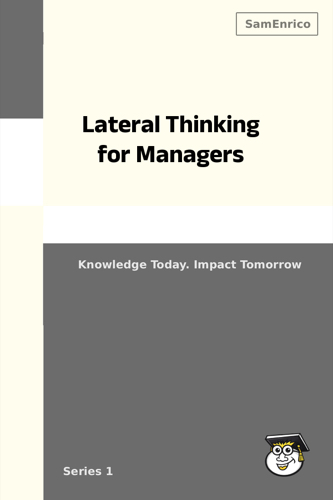
Lateral Thinking for Managers eBook
Break fixed patterns and escape mental ruts to sol
Break fixed patterns and escape mental ruts to solve stubborn business problems.
Formats
Free sample
Chapter 1: The High Ground Trap--–- Cliff had been a manager for eleven years, and by every external metric, he was succeeding. His team hit their quarterly numbers with mechanical regularity. His boss trusted him with the department's most difficult clients. He had never missed a deadline that mattered, and his performance reviews read like a eulogy written by someone who genuinely admired the deceased. But on a Tuesday afternoon in March, sitting in a conference room that smelled faintly of stale coffee and corporate despair, Cliff realized something that would take him two more years to fully understand: he had stopped being useful.The problem on the whiteboard was not new.
It was the same problem his team had "solved" six months ago, then again three months ago, and now, for the third time, they were solving it. The numbers were slightly different—this quarter it was supply chain delays instead of staffing shortages—but the shape of the conversation was identical. Someone would state the obvious solution. Someone else would explain why that solution had failed last time. A third person would propose a small variation.
And then, like a flock of birds all turning at once, the team would settle on the same compromise they had reached every time before.Cliff drove home that evening with his hands at ten and two on the steering wheel, a posture he had maintained since driver's education in high school. He was, he realized, a man who had perfected the art of driving perfectly straight on a road that was no longer going anywhere useful.This chapter is about why that happens to smart managers—and why it is not your fault.The Pattern-Making Machine The human brain is not a truth-seeking device. This is the first and most important fact that any manager must accept before they can escape the High Ground Trap. The brain is a pattern-making machine, designed for one purpose above all others: speed. Your ancestors did not survive because they found the optimal solution to every problem.
They survived because they found a good enough solution fast enough to outrun the tiger.This evolutionary heritage lives inside every decision you make. The brain operates on a principle called "first satisfactory fit." It does not search for the best answer. It searches for the first answer that is good enough, and then it stops. Then—and this is the cruel twist—it builds a neural road to that answer. The next time a similar problem appears, the brain does not re-search the entire landscape.
It takes the paved road. It is efficient. It is fast. And it is the reason your team is solving the same problem for the third time.Consider a simple experiment that cognitive scientists have run hundreds of times. A subject is shown a sequence of numbers: 2, 4, 8.
They are asked to guess the next number. Most people say 16. This is the pattern of doubling, and it is so obvious that it feels inevitable. But the actual rule could be "any number greater than the previous number," in which case 9 would be correct. Or "numbers that contain the letter 'e'," in which case 11 would be incorrect.
The subjects who guess 16 are not wrong in any absolute sense—but they have stopped looking for other patterns. Their brain took the first satisfactory fit and paved a road.In business, the cost of this paved road is invisible because the road usually works. The budget template from last year works. The meeting agenda from last month works. The hiring process from the previous manager works.
But "works" is a low bar. The question is not whether the pattern works. The question is whether it works better than the patterns you have stopped seeing.The High Ground: Where Success Becomes a Blind Spot There is a paradox at the heart of managerial careers that no one warns you about. The skills that get you promoted are not the skills that keep you effective. The solutions that solved your biggest crisis become the assumptions that create your next crisis.
This is the High Ground Trap: past success is the most dangerous blind spot you will ever have.Cliff had risen through the ranks by being decisive. In his first management role, he inherited a team that was paralyzed by analysis. He introduced a simple decision-making framework: pick three options, evaluate them in one hour, choose one, move on. It worked brilliantly. His team's output doubled.
His boss noticed. He was promoted.Five years later, Cliff was still using the same framework. But the problems had changed. They were no longer about choosing between clear options. They were about defining what the options even were.
His decisiveness, once a superpower, had become a straitjacket. He would force a decision when what the team needed was a provocation. He would choose when what they needed was to wander.The High Ground Trap has a specific anatomy. It begins with a genuine success. You solve a problem.
You are rewarded. Your brain builds a neural road. The next time a problem appears that looks similar—and the brain is very good at making dissimilar problems look similar—you drive down that same road. It works again, maybe not as well, but well enough. The road gets paved deeper.
Over time, the road becomes a canyon. You are not driving anymore. You are in a rut.Here is the cruelest part: the deeper the rut, the faster you can drive. Teams in deep ruts feel productive. They move quickly.
They check boxes. They produce outputs. But they are producing the same outputs, solving the same problems, and mistaking motion for progress. Cliff's team could solve their supply chain delay in ninety minutes flat. They had done it so many times that they had a Power Point template for the solution.
The problem was that the solution did not work anymore—it just felt like it did because they executed it so efficiently.A Taxonomy of Stuckness (Brief)Before we go further, we need a shared vocabulary for what it means to be stuck. The full diagnostic framework appears in Chapter 2, but for the purposes of this chapter, you need only two distinctions.The first distinction is between vertical and lateral thinking. Vertical thinking is what you were trained to do. It is logical, sequential, and selective. You take the most promising path and you dig deeper.
You gather more data. You refine your model. You execute more efficiently. Vertical thinking is excellent for execution. It is terrible for escaping ruts because it assumes the path is correct.Lateral thinking is what you will learn in this book.
It is disruptive, generative, and provocative. Instead of digging deeper, you dig elsewhere. Instead of asking "How do we do this better?" you ask "Why are we doing this at all?" Instead of refining the current solution, you restructure the problem itself. Lateral thinking feels inefficient because it abandons the paved road. But when the paved road is going nowhere, lateral thinking is the only way out.The second distinction is between tame problems and wicked problems.
Tame problems are defined, predictable, and have a clear stopping point. "We need to produce ten percent more units this…
This is the end of the free sample. Get the eBook to keep going. Buy now
About this book
Details
- Author
- Fournier Nubia
- Publisher
- SamEnrico
- Language
- English
- Genre
- Non-Fiction, Self-Help
- Released
- 2026-06-09
- Pages (approx.)
- 142
- Available as
- eBook, Audiobook

Read better in the ZLOADR app
Your eBooks on your phone or tablet. Sign in with your SamEnrico account and start reading.
More by Fournier Nubia
 US Remote Work UncertaintiesFournier Nubia$11.99
 Accounting Firm Multiples ManualFournier Nubia$11.99
 Phil Mickelson Lefty LegacyFournier Nubia$11.99
 PCSK9 Inhibitors GuideFournier Nubia$11.99
 OCD Symptom GuideFournier Nubia$11.99
 False Memory implantation by PoliceFournier Nubia$11.99
 Alcohol and Heart HealthFournier Nubia$11.99
 The Rolling Pioneers: How Skateboarding Ignited a Middle Eastern RevolutionFournier Nubia$11.99
 The Eagle and the Fox: Liman von Sanders and Mustafa Kemal at GallipoliFournier Nubia$11.99
 How to Produce ThermosesFournier Nubia$11.99
 How to Produce Hot Dog RollersFournier Nubia$11.99
 How to Become a Grader MarkerFournier Nubia$11.99
You may also like
 Hong Kong Handover 1997Dunn Johnnie$11.99
 Zumba For Postnatal Recovery CourseNeal Christian$11.99
 Zumba for BeginnersLadner Nikia$11.99
 YouTube Comment Mining GuideHumes Pandora$12.99
 Worry Box MeditationCarlin Rudy$11.99
 Workplace Stress MeditationNguyen Lynn$11.99
 Workplace Stress and Sleep RepairHawley Ivory$11.99
 Workplace Perfectionism CureDelaney Jeffry$11.99
 Workplace Injustice Anger GuideWallen Isabelle$11.99
 Work Addiction and Burnout LinkGreenwood Ester$11.99
 Women in Yoga and WellnessBeattie Galina$11.99
 Women in Stand Up ComedyChun Evangeline$11.99