
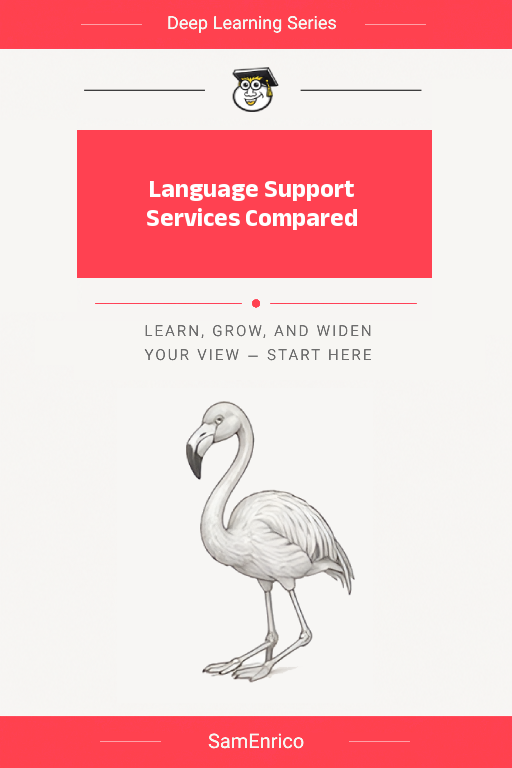
Language Support Services Compared eBook
Access English academic writing centers, ESL suppo
by Sowell Leif
Access English academic writing centers, ESL support, and conversation partners at UK, US, and Australian universities for international students.
Formats
Free sample
Chapter 1: The Silent A+...--–- Mina arrived at Penn State with an IELTS score of 7.5, a suitcase full of ambition, and a secret she told no one. Three weeks into her master's program in data science, she sat in the back row of a seminar, heart pounding, as the professor called on students one by one for their opinions on a case study. She knew the answer. She had prepared for hours. But when her turn came, her throat closed.
The words “I think the model fails because…” lodged somewhere between her brain and her tongue. She mumbled, “I agree with what everyone said,” and sank into her chair. The professor noted a “needs to participate more” on her mid-semester feedback. That note – seemingly small – would haunt her for the rest of the semester.What Mina didn’t know was that her experience was not a personal failing. It was a predictable, almost scripted outcome of a system that actively penalizes quiet international students while offering free, underutilized resources that could have saved her.
She also didn’t know that a university 5,000 miles away – Ulster University in Northern Ireland – had solved this problem by making language support a mandatory, credit-bearing requirement. And another, Griffith University in Australia, had embedded English consultants directly into career centers, turning anxious speakers into job-ready graduates.This book is the map Mina wished she had. It is not about how to get into a university. It is about how to survive – and thrive – once you arrive. Because the single greatest predictor of whether you will drop out, transfer, or struggle silently is not your entrance exam score.
It is whether you use language support services in your first thirty days.The $60,000 Question Nobody Asks Every year, over six million international students enroll in universities across the United States, the United Kingdom, and Australia. Collectively, they pay more than $200 billion in tuition. The vast majority arrive with IELTS scores between 6.5 and 7.5 – scores that theoretically indicate “competent” to “good” English proficiency. And yet, within the first semester, a staggering 30 to 40 percent of these students report feeling “academically at risk” due to language barriers. Fifteen percent seriously consider dropping out.Why?
Because the IELTS does not test what university requires. The IELTS tests scripted speaking, controlled reading, and predictable writing prompts. University requires spontaneous participation, rapid-fire group work, and the ability to argue with a professor who uses sarcasm, cultural references, and discipline-specific jargon. The gap between “test English” and “classroom English” is a chasm. And the bridge is language support services – writing centers, conversation partners, and ESL modules that are almost always free and almost never used.Here is the paradox that drives international student attrition: Over 70 percent of eligible students never book a single writing center appointment.
Fewer than 20 percent attend more than one conversation partner session. Yet universities that mandate an initial consultation – such as Ulster University in the UK and Penn State in the US – see retention improvements of 15 to 20 percent among international students. The data is unambiguous. The solution is not more tutoring. The solution is getting students through the door.This chapter reveals why the door is so hard to walk through.The Hidden Curriculum: What Your University Didn't Tell You Every academic system has a hidden curriculum – the unspoken rules about what counts as “good” student behavior.
These rules vary dramatically between the US, the UK, and Australia. And they are almost never explained to international students.The United States: Participation as Performance In American universities, participation typically accounts for 10 to 20 percent of your final grade. This does not mean simply showing up. It means speaking – offering opinions, asking questions, challenging the professor, and engaging in debate. Silence is interpreted as disengagement, unpreparedness, or even disrespect.For international students, this creates an impossible bind.
You are told to participate, but you are also acutely aware that your accent marks you as an outsider. You fear being perceived as “the international student who can’t speak properly.” So you stay quiet. Your grade drops. You feel like a failure. This is not a character flaw.
It is a structural feature of a system that rewards verbal fluency over thoughtful reflection.Consider Raj, a computer science student from India at a large US public university. He is brilliant – top of his class in mathematics, flawless on coding assignments. But in his software engineering seminar, the professor uses a Socratic method, cold-calling students to defend their design choices. Raj freezes. His English, perfectly adequate for technical writing, crumbles under pressure.
He stammers. The professor moves on. Raj receives a C+ for participation. He considers transferring to a UK university where, he has heard, participation is not graded. He is right – but he does not yet know the UK has its own hidden traps.The United Kingdom: Independence as a Weapon British universities pride themselves on producing independent thinkers.
In practice, this means you are expected to develop original arguments with minimal scaffolding. Lectures are often formal and non-interactive. Tutorials (small-group sessions) require you to arrive with prepared questions. Professors rarely chase you down if you are struggling.The hidden curriculum in the UK is that asking for help is acceptable – but only if you do it in the right way. You do not drop by a lecturer’s office unannounced.
You email the administrator. You use formal titles (Dr., Prof.) until explicitly invited otherwise. You phrase requests as polite inquiries (“I would be grateful if you could advise me on…”) rather than direct demands (“I need help with…”).International students who violate these norms – who email “I need help with my essay” without proper salutations – may be perceived as rude or demanding. Their requests go unanswered. They conclude that UK professors are cold or uncaring.
In reality, they have simply triggered a cultural mismatch. The UK system is not cold. It is formal. And the difference matters deeply.Australia: The Group Work Gauntlet Australian universities emphasize collaborative, practical learning. Many programs – particularly in business, engineering, and health sciences – require substantial group work and workplace-integrated learning (internships).
The hidden curriculum in Australia is that you must negotiate meaning in real-time, often with native speakers who speak quickly, use slang, and assume shared cultural knowledge.For international students, group work is a double-edged sword. On one hand, it provides natural opportunities for speaking practice. On the other hand, it exposes every linguistic weakness in front of peers who will grade you (peer assessment is common in Australian universities). Students report feeling “exposed,” “ashamed,” and “resentful” when their group members correct their grammar or redo their slides.But Australia also offers an advantage that neither the US nor the UK can match: a direct pipeline from language support to job outcomes. Australian universities have invested heavily in career-integrated English programs because they know that 80 percent of their international students intend to stay and work post-graduation.
The “fair go” ethos means you are expected to struggle, ask for help, and improve – not hide your weaknesses.The Psychology of Avoidance: Why Free Help Goes Unused If language support services are free and effective, why do 70 percent of students never use them? The answer is not laziness or…
This is the end of the free sample. Get the eBook to keep going. Buy now
About this book
Details
- Author
- Sowell Leif
- Publisher
- SamEnrico
- Language
- English
- Genre
- Non-Fiction, Student's Shortcut
- Released
- 2026-05-30
- Pages (approx.)
- 149
- Available as
- eBook, Audiobook

Read better in the ZLOADR app
Your eBooks on your phone or tablet. Sign in with your SamEnrico account and start reading.
More by Sowell Leif
 Eulogy Writing ExerciseSowell Leif$11.99
 IBS And Migraine ConnectionSowell Leif$11.99
 The ABC Please GuideSowell Leif$11.99
 Nicotine Anonymous ExplainedSowell Leif$11.99
 Single Parent Shift SleepSowell Leif$11.99
 Opioid Dependency Recovery GuideSowell Leif$11.99
 Parent of College StudentSowell Leif$11.99
 Cleopatra Linguistic PowerSowell Leif$11.99
 The Last Stand of the Kanga CupSowell Leif$11.99
 The 1924 Paris Olympics: The Birth of Modern Sports BroadcastingSowell Leif$11.99
 How to Produce Track HurdlesSowell Leif$11.99
 US Salary Benchmark ResourcesSowell Leif$12.99
You may also like
 LSE Online Program LengthAgee Letisha$11.99
 Harvard Extension School for Working AdultsRoush Yer$11.99
 LSE Online Reading ListAshford Ludivina$11.99
 LSE Online Language RequirementsWhitten Daphine$11.99
 LSE Online Class SizeHughey Garret$11.99
 LSE Online Alumni MentorshipWild Lyla$11.99
 London School of Economics Alumni NetworkDutton Chantal$11.99
 Harvard Extension School Student SupportCantrell Christene$11.99
 Harvard Extension School Library AccessSantana Adah$11.99
 Harvard Extension School Degree CompletionBray Wyatt$11.99
 Harvard Extension School Course AuditingAbbott Craig$11.99
 Harvard Extension School Extension DiplomaNew Joane$11.99