
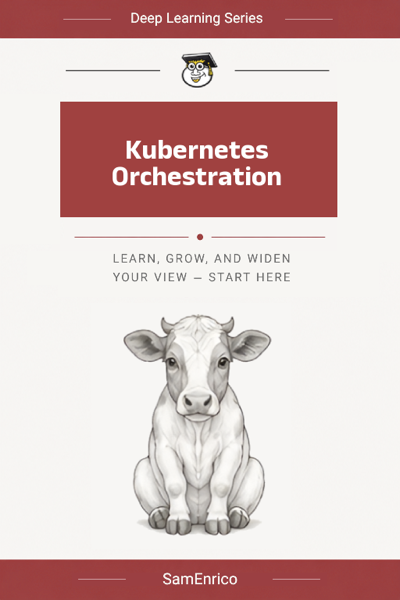
Non-FictionInformativeEducational
Kubernetes Orchestration eBook
A Coursebook on Kubernetes Orchestration
by Ammons Jina
A Coursebook on Kubernetes Orchestration
Formats
Free sample
Chapter 1: From Chaos to Cluster--–- In the summer of 2018, a senior engineer at a mid-sized e-commerce company did something that would haunt him for years. He manually restarted two hundred containers across forty virtual machines because the load balancer kept routing traffic to dead instances. It took four hours. During the company’s biggest sale day. The post-mortem revealed that the team had “orchestration” written on their roadmap for next quarter.
They were six months too late.That engineer was me. And this book exists so you never have to live that nightmare.Welcome to Kubernetes Orchestration: A Coursebook. This is not a reference manual you’ll shelve next to your dusty certification guides. This is a working book—one you’ll keep open on your desk, smudged with coffee stains and filled with margin notes. By the time you finish these twelve chapters, you won’t just know what Kubernetes is.
You’ll understand why your first cluster crashed, how to fix it at 2 AM when the pager won’t stop screaming, and which patterns separate production-grade engineers from those who learn the hard way.Let’s start at the beginning: not with YAML or kubectl, but with a question that most books gloss over. Why does orchestration exist at all? And why did we let things get so messy before fixing them?The Way We Deployed Before We Knew Better If you’ve been in software for more than a few years, you remember the old ways. Maybe you still carry the scars.Bare metal was the original sin. You bought a physical server—a loud, hot, expensive machine that lived in a data center you probably never visited.
You installed an operating system, configured network interfaces by hand, and deployed your application directly onto that single point of failure. When the server died (not if—when), you drove to the data center at midnight and swapped hard drives. High availability meant having two servers and a load balancer that cost more than your car.Then came virtual machines. VMware and its ilk let you slice one physical server into many isolated units. Each VM had its own operating system, its own kernel, its own memory footprint measured in gigabytes.
Virtualization was a revolution—until you realized that running ten VMs meant running ten copies of an operating system, each consuming CPU and memory just to stay alive. Deployment times improved from hours to minutes, but you still waited for VMs to boot, SSH keys to propagate, and configuration management tools like Puppet or Chef to converge. The phrase “configuration drift” became a four-letter word.Containers arrived like a fire extinguisher in a burning building. Docker made it possible to package an application and its dependencies into a lightweight, portable unit that shared the host’s operating system kernel. A container started in milliseconds, not minutes.
You could run dozens on a single server without breaking a sweat. Developers loved containers because “it works on my machine” finally meant something—if it ran in a container locally, it would run the same way in production.But containers solved only half the problem. They gave you a better way to package and run applications, but they didn’t tell you where to run them, how to restart them when they failed, or how to connect them to each other. You still needed to decide which server got which container. You still needed to notice when a container crashed and manually start a new one.
You still needed to update a configuration file in forty places when your database moved to a new IP address.That’s where orchestration enters the story. And it enters because we learned something painful: running containers without orchestration is like owning a thousand taxis with no dispatch system. You have the vehicles, but no one knows where they’re going, which ones are broken, or how to get a passenger to their destination.What Orchestration Actually Means (And Why Most People Get It Wrong)Let me ask you a question. If you hear the word “orchestration,” what comes to mind? A conductor waving a baton, probably.
Violins and cellos playing in harmony. It’s a pleasant image, but it’s misleading.Container orchestration isn’t about controlling every note. It’s about ensuring that when a musician leaves the stage, another one takes their place without missing a beat. It’s about knowing that the brass section can get louder during the crescendo without drowning out the strings. And it’s about recovering gracefully when someone drops their sheet music.In technical terms, orchestration is the automated management of containerized applications across a cluster of machines.
That management includes four essential responsibilities:Scheduling decides which container runs on which machine. A good scheduler considers available resources (CPU, memory, storage), constraints (this container must run on a machine with a GPU), and policies (spread these containers across availability zones). The opposite of scheduling is what we did in 2018—manually assigning containers to machines, praying the math worked out, and waking up when a machine ran out of memory.Scaling adjusts the number of running containers based on demand. When Black Friday traffic hits, you want more containers. When the clock strikes 3 AM and traffic dives, you want fewer.
Manual scaling means waking up an engineer to click buttons. Automated scaling means the system watches metrics and adjusts itself while you sleep.Self-healing detects failed containers and replaces them without human intervention. Your application will crash. Your node will lose network connectivity. Your cloud provider will have an outage.
Self-healing doesn’t prevent these failures—it mitigates them. The system continuously compares what’s running to what should be running, and it reconciles the difference.Service discovery and load balancing ensure that containers can find each other (service discovery) and that traffic spreads evenly across healthy instances (load balancing). Containers come and go. Their IP addresses change constantly. Service discovery gives them a consistent name to use, and load balancing ensures that a request goes to a container that’s actually ready to handle it.If this sounds like a lot, that’s because it is.
Before Kubernetes, companies built their own orchestration systems. Google had Borg. Twitter built Mesos. Netflix architected their own stack. These systems took years to develop and required teams of Ph Ds to operate.
Kubernetes democratized orchestration by taking the lessons from Google’s internal systems and packaging them into an open-source platform that anyone could use.The Problems Kubernetes Solves (And the Ones It Doesn’t)Kubernetes has a reputation for solving everything. It doesn’t. Understanding its boundaries is as important as understanding its capabilities. Let me draw a clear line.What Kubernetes solves beautifully:Declarative configuration. You tell Kubernetes what you want—three replicas of your web server, port 8080 exposed, a database password stored as a secret—and Kubernetes makes it happen.
You don’t write scripts that say, “create this, then wait, then create that.” You write a description of the desired state, and the system works continuously to achieve and maintain it.Infrastructure abstraction. Your application doesn’t need to know whether it’s running on AWS, Google Cloud…
This is the end of the free sample. Get the eBook to keep going. Buy now
About this book
Details
- Author
- Ammons Jina
- Publisher
- SamEnrico
- Language
- English
- Genre
- Non-Fiction, Informative, Educational
- Released
- 2026-05-06
- Pages (approx.)
- 133
- Available as
- eBook, Audiobook

Read better in the ZLOADR app
Your eBooks on your phone or tablet. Sign in with your SamEnrico account and start reading.
More by Ammons Jina
 EQ For Workplace Success GuideAmmons Jina$11.99
 Micro Cheating Stress ResponseAmmons Jina$11.99
 Self Worth For Only ChildrenAmmons Jina$11.99
 Loci for Music MemorizationAmmons Jina$11.99
 Drug Dependency MythsAmmons Jina$11.99
 The Medical Student StressAmmons Jina$11.99
 Metta For LonelinessAmmons Jina$11.99
 Memory Palace MistakesAmmons Jina$11.99
 Accident Trauma DreamsAmmons Jina$11.99
 The Sultan's Swiftness: The Untold Story of the First Middle Eastern Marathon ChampionAmmons Jina$11.99
 The Whistleblower's Dilemma: The Truth Behind the Pentagon PapersAmmons Jina$11.99
 Suleiman the Magnificent: Love and Siege in Rhodes (1522)Ammons Jina$11.99
You may also like
 Hong Kong Handover 1997Dunn Johnnie$11.99
 Zumba For Postnatal Recovery CourseNeal Christian$11.99
 Zumba for BeginnersLadner Nikia$11.99
 YouTube Comment Mining GuideHumes Pandora$12.99
 Worry Box MeditationCarlin Rudy$11.99
 Workplace Stress MeditationNguyen Lynn$11.99
 Workplace Stress and Sleep RepairHawley Ivory$11.99
 Workplace Perfectionism CureDelaney Jeffry$11.99
 Workplace Injustice Anger GuideWallen Isabelle$11.99
 Work Addiction and Burnout LinkGreenwood Ester$11.99
 Women in Yoga and WellnessBeattie Galina$11.99
 Women in Stand Up ComedyChun Evangeline$11.99