
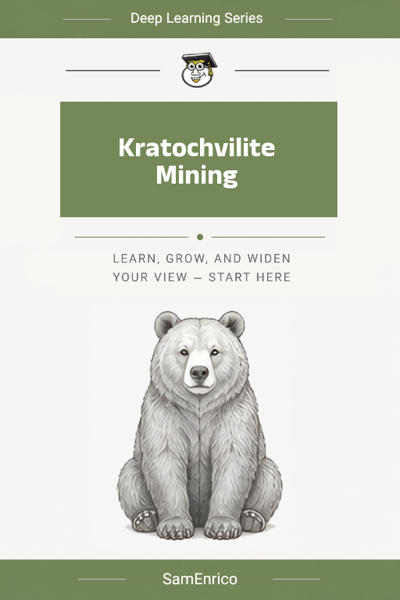
Non-FictionInformativeEducational
Kratochvilite Mining eBook
A Coursebook on Kratochvilite Mining
A Coursebook on Kratochvilite Mining
Formats
Free sample
Chapter 1: The Burning Question...--–- It begins not with a pickaxe or a drill, but with a wisp of acrid smoke curling from a crack in the earth. The ground beneath your feet feels warm, even hot, through the soles of your boots. The air smells of sulfur and coal tar, a chemical bouquet that stings the back of your throat. You are standing on top of a geological contradiction: a place where the deep past meets an accidental present, where a fire that started decades ago—perhaps even a century ago—burns silently, patiently, without flame, without notice, without any intention of ever going out. This is the coal fire.
And somewhere within this pyrometamorphic labyrinth, hidden among white and yellow efflorescences that look like frost on a summer day, lies one of the rarest and most misunderstood substances on Earth: Kratochvilite.You have never heard of it. That is not your fault. Kratochvilite occupies an awkward corner of the mineralogical world, too obscure for most geology textbooks, too recent for the classical canon, and too easily dismissed as mere "burned coal gunk" by the few miners who ever stumble upon it. Yet this unassuming organic mineral—this pale, waxy, feather-light crystal that floats on water and scratches like a fingernail—holds a mirror to one of the most violent and chemically creative processes in near-surface geology. To understand Kratochvilite is to understand coal fires.
To understand coal fires is to confront a global phenomenon that releases more carbon dioxide each year than many small nations, that poisons groundwater, that swallows towns, and that has been burning beneath our feet for centuries without anyone truly paying attention.This book is not a conventional mining manual. There are no veins to follow, no ore grades to calculate, no smelting temperatures to optimize. The "mining" in our title is a deliberate provocation, a reframing of scientific investigation as an act of extraction—not of profit, but of knowledge. We will mine coal-fire dumps for samples the size of a grain of rice. We will mine the literature for clues buried in obscure Czech and Polish journals.
We will mine the crystal structure of a hydrocarbon molecule for insights into how carbon moves, transforms, and occasionally freezes into mineral form under conditions that would destroy almost any other organic compound. And along the way, we will confront a deeper question that has haunted geochemists for nearly a century: when you set fire to ancient swamps, do you simply release what was already there, or do you create something entirely new?This chapter begins that journey. We will establish the foundational concepts that underpin everything that follows: what organic minerals are and why they challenge our traditional definitions of "mineral"; who Josef Kratochvíl was and how a Czech geologist stumbled upon a substance that would not be properly understood for another eighty years; why Kratochvilite matters to both geologists and chemists; and finally, a clear, consistent definition of what we mean by "mining" in this book—a definition we will honor across every subsequent chapter, from the thermodynamic modeling of Chapter 8 to the safety protocols of Chapter 9. By the end of this opening chapter, you will never look at a burning coal dump the same way again. More importantly, you will understand why something as trivial as a pale yellow crystal, weighing less than a paperclip, deserves an entire book of its own.What Is an Organic Mineral?
Rethinking the Boundaries of Geology To appreciate Kratochvilite, we must first challenge a hidden assumption buried in most mineralogy textbooks: the assumption that minerals are, by definition, inorganic. Walk into any university geology department, flip open a standard mineralogy reference, and you will read something like this: "A mineral is a naturally occurring, homogeneous solid with a definite chemical composition and an ordered atomic arrangement, formed by inorganic processes." That final phrase—"formed by inorganic processes"—has excluded an entire class of natural crystalline compounds from the official canon for generations. And yet, nature does not respect textbook definitions.Organic minerals are exactly what they sound like: naturally occurring crystalline solids whose chemical structures are built around carbon-hydrogen bonds, typically derived from biological source materials but transformed by geological processes into ordered atomic arrangements. The International Mineralogical Association (IMA), the governing body that decides what is and is not a mineral, currently recognizes approximately sixty organic minerals. Sixty.
In a universe of more than 5,800 officially approved mineral species, organic minerals represent barely one percent. They are the geological equivalent of rare stamps or misprinted currency—technically valid, scientifically significant, but so seldom encountered that most practicing geologists will never see one in the field.This rarity is not accidental. Organic molecules are fragile. They burn. They melt.
They sublimate. They react with oxygen. They are devoured by microorganisms. For an organic compound to survive the twin gauntlets of diagenesis and metamorphism, and then to arrange itself into a repeating three-dimensional crystal lattice rather than remaining as an amorphous tar or wax, requires exceptional conditions. Kratochvilite's exceptional condition is fire—specifically, the low-temperature, reducing, hydrocarbon-rich gas phase that migrates through fractures in a burning coal waste dump.
But we are getting ahead of ourselves.The most famous organic mineral is whewellite (calcium oxalate monohydrate, Ca C₂O₄·H₂O), which forms in coal seams and occasionally in kidney stones. The most abundant is mellite (aluminum benzenehexacarboxylate, Al₂C₆(COO)₆·16H₂O), found in lignite deposits. And then there is Kratochvilite, a mineral so obscure that even many mineralogists have to pause and sound out the name: kra-TOKH-vi-lite. It belongs to a subclass of organic minerals known as the hydrocarbon minerals—compounds composed almost entirely of carbon and hydrogen, with no oxygen, no nitrogen, no metals. This subclass is tiny.
At the time of this writing, fewer than ten hydrocarbon minerals have been officially approved. Kratochvilite is one of them.Why "Mining" Is the Wrong Word—And Why We Use It Anyway Before we go any further, we must address an elephant in the room the size of a bulldozer. Traditional mining is an economic activity. You mine iron ore to make steel. You mine copper to wire the world.
You mine gold to store value, gild cathedrals, and fill dental cavities. Kratochvilite has no economic value. You cannot smelt it. You cannot sell it. You cannot build anything with it.
A kilogram of Kratochvilite—if you could somehow gather that much, which no one has—would be worth less than a kilogram of the coal it came from. So why use the word "mining" in the title of this book?We use it because the act of extracting knowledge from a coal-fire environment requires the same skills, the same caution, the same systematic methodology, and the same respect for hazard as extracting ore from a commercial mine. You will not use a continuous miner or a longwall shearer. You will use a rock hammer, a chisel, a set of fine tweezers, and perhaps a folded piece of aluminum foil to catch falling crystals. But you will also use gas monitors, heat-reflective clothing, supplied-air respirators, and thermal imaging cameras.
You will map zones, record temperatures, log paragenetic sequences, and label samples with the same obsessive precision as any exploration…
This is the end of the free sample. Get the eBook to keep going. Buy now
About this book
Details
- Author
- Ginn Lorriane
- Publisher
- SamEnrico
- Language
- English
- Genre
- Non-Fiction, Informative, Educational
- Released
- 2026-06-02
- Pages (approx.)
- 158
- Available as
- eBook, Audiobook

Read better in the ZLOADR app
Your eBooks on your phone or tablet. Sign in with your SamEnrico account and start reading.
More by Ginn Lorriane
 Dumbbell Only Strength GuideGinn Lorriane$11.99
 Genetic Testing for SchizophreniaGinn Lorriane$11.99
 Workplace Esteem HandbookGinn Lorriane$11.99
 Self Worth Adoption Origins GuideGinn Lorriane$11.99
 Meiji Annexation of Korea GuideGinn Lorriane$11.99
 The Moonlit Vow: A Yokai’s Forbidden LoveGinn Lorriane$11.99
 The Lost Fleet of the Chola Dynasty: Surviving the Bay of BengalGinn Lorriane$11.99
 How to Become a Seconds HandlerGinn Lorriane$11.99
 Non Compete Trap PrimerGinn Lorriane$12.99
 Data Cleaning for EconGinn Lorriane$12.99
 Understanding Glossopalatine Ankylosis Micrognathia Ear AnomaliesGinn Lorriane$17.99
You may also like
 Hong Kong Handover 1997Dunn Johnnie$11.99
 Zumba For Postnatal Recovery CourseNeal Christian$11.99
 Zumba for BeginnersLadner Nikia$11.99
 YouTube Comment Mining GuideHumes Pandora$12.99
 Worry Box MeditationCarlin Rudy$11.99
 Workplace Stress MeditationNguyen Lynn$11.99
 Workplace Stress and Sleep RepairHawley Ivory$11.99
 Workplace Perfectionism CureDelaney Jeffry$11.99
 Workplace Injustice Anger GuideWallen Isabelle$11.99
 Work Addiction and Burnout LinkGreenwood Ester$11.99
 Women in Yoga and WellnessBeattie Galina$11.99
 Women in Stand Up ComedyChun Evangeline$11.99