
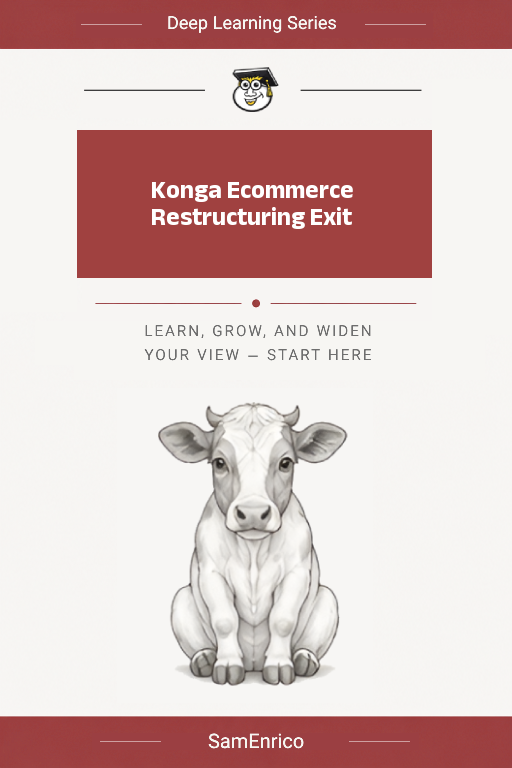
Konga Ecommerce Restructuring Exit eBook
Plan distressed exits using Nigerian Konga's restr
Plan distressed exits using Nigerian Konga's restructuring and acquisition by Zinox for turnaround value.
Formats
Free sample
Chapter 1: The Vanishing Unicorn--The boardroom on the sixth floor of Konga’s Lagos headquarters had gone silent. It was November 2017, and the executive team was staring at a spreadsheet that told a story no one wanted to hear. The numbers cascaded down the screen in crimson: cash reserves sufficient for approximately eleven more weeks, pay-on-delivery return rates hovering at 25 percent, and a valuation that had evaporated faster than morning harmattan mist. The unicorn was bleeding out.Three years earlier, this same room had hosted celebration dinners. In 2014, Konga was Nigeria’s most visited website, a crown jewel of African technology, a company that had raised nearly 80millionfromthemostsophisticatedinvestorsontheplanet[citation:2].Naspers—the South Africanmediagiantthathadturneda80 million from the most sophisticated investors on the planet[citation:2].
Naspers—the South African media giant that had turned a 80millionfromthemostsophisticatedinvestorsontheplanet[citation:2].Naspers—the South Africanmediagiantthathadturneda34 million bet on Tencent into a $100 billion fortune—had placed its chips on Konga. Kinnevik, the Swedish investment firm that had backed Zalando and Delivery Hero, had done the same. Together, they had poured money into Sim Shagaya’s vision of an Amazon for Africa, believing that Nigeria’s 170 million people represented the next great e-commerce frontier-3.They had been wrong. Or rather, they had been right about the opportunity and catastrophically wrong about the timing, the infrastructure, and the economics of selling goods online in a country where the roads were crumbling, the currency was collapsing, and the customers refused to pay for products before they touched them.This chapter dissects the collapse of Konga between 2015 and 2018—a fall from grace that wiped out 82 percent of the company’s value and transformed a 200millionunicornintoadistressedassetsoldforpartsatarumoredpriceof200 million unicorn into a distressed asset sold for parts at a rumored price of 200millionunicornintoadistressedassetsoldforpartsatarumoredpriceof10 million to $15 million-1-5. It examines the three fatal flaws that brought Konga to its knees: the currency crisis that decimated its balance sheet, the logistics nightmare that made every delivery a gamble, and the pay-on-delivery trap that turned revenue into an illusion.
Most importantly, it extracts the warning signs that every investor, founder, and turnaround specialist must recognize before a distressed asset becomes a corpse.The Rise and Sudden Stop To understand the collapse, one must first appreciate the scale of the ambition. Konga launched in July 2012 with $3.5 million in seed funding and a twenty-person team working out of a modest office in Lagos-5. Within weeks of launch, the company faced its first existential crisis: the Lagos State government banned its delivery motorcycles, a bureaucratic hiccup that foreshadowed the operational chaos to come-7. But Shagaya, a Harvard-trained former Google executive, was undeterred. He had seen e-commerce transform retail in the United States and India, and he believed Nigeria was ready.The investors agreed.
In 2013, Kinnevik injected 17.5millionfora46percentequitystake,valuing Kongaatapproximately17.5 million for a 46 percent equity stake, valuing Konga at approximately 17.5millionfora46percentequitystake,valuing Kongaatapproximately38 million. Naspers followed with 9.7millionfor25.5percent[citation:5].By2014,ase−commercemomentumbuiltacross Nigeria,bothinvestorsdoubleddown.Thecompanyraiseda Series Croundof9.7 million for 25.5 percent[citation:5]. By 2014, as e-commerce momentum built across Nigeria, both investors doubled down. The company raised a Series C round of 9.7millionfor25.5percent[citation:5].By2014,ase−commercemomentumbuiltacross Nigeria,bothinvestorsdoubleddown.Thecompanyraiseda Series Croundof40 million from Naspers, pushing Konga’s valuation to an eye-watering $200 million-1-10. The messaging was triumphant: Konga was Nigeria’s e-commerce king, having overtaken Jumia in website traffic and brand recognition.But beneath the headlines, the foundation was cracking.The first fissure appeared in the form of foreign exchange risk—a threat that every frontier market investor acknowledges in theory but rarely prices correctly in practice.
Nigeria’s economy was almost entirely dependent on oil exports, and when crude prices collapsed from over 100perbarrelinmid−2014tobelow100 per barrel in mid-2014 to below 100perbarrelinmid−2014tobelow30 per barrel by early 2016, the country was thrown into a severe currency crisis. The Central Bank of Nigeria, desperate to defend the naira, imposed capital controls and rationed dollars. The official exchange rate, which had held steady at approximately N199 to the dollar for years, began a controlled devaluation that eventually saw the naira trade at over N360 to the dollar on the parallel market—an 81 percent decline-5-10.For Konga, this was catastrophic. The company imported a significant portion of its inventory—electronics, appliances, mobile phones, and other high-value items that made up the bulk of its sales. When the naira lost 81 percent of its value against the dollar, the cost of replacing that inventory skyrocketed.
A laptop that had cost Konga 500toimport—soldfor N100,000attheoldexchangerate—nowcost500 to import—sold for N100,000 at the old exchange rate—now cost 500toimport—soldfor N100,000attheoldexchangerate—nowcost500 to import at N360 to the dollar, or N180,000. The company faced an impossible choice: raise prices and lose customers, or absorb the loss and bleed cash.Konga absorbed the loss. And it bled.The investors, watching from London and Stockholm, did the math. In 2015, Kinnevik wrote down the value of its Konga stake from 48millionto48 million to 48millionto12 million—a 75 percent reduction implemented just eight months after the Series C round had closed-10. The official explanation cited “developments relative to Nigeria’s currency and market environment,” which was corporate-speak for “the naira cratered and took our investment with it.”Naspers followed suit in 2016, announcing that it had “recognized impairment losses of $53 million relating to Konga”-5-10.
The company that had turned a single bet on Tencent into the most successful venture capital investment in history had just admitted defeat on its African e-commerce gamble. The unicorn was no longer magical. It was a financial albatross.The Pay-on-Delivery Trap If the currency crisis was the external shock that wounded Konga, pay-on-delivery was the internal contradiction that kept it from healing.In mature e-commerce markets—the United States, China, Western Europe—customers pay for goods online at the time of purchase. Credit cards, digital wallets, and bank transfers have created a trust infrastructure that allows money to flow before products ship. Nigeria in the mid-2010s had none of this.
A 2015 survey found that 53 percent of Nigerian online shoppers cited “faster delivery” as their primary concern, while 40 percent highlighted “safer payment options”-3. The underlying issue was trust: Nigerians were deeply skeptical of paying for something they had not seen, touched, and verified.The industry’s solution was pay-on-delivery (POD). The model was simple: customers placed orders online, and delivery drivers carried point-of-sale terminals and cash boxes. When the package arrived, the customer inspected the product, swiped a card or handed over cash, and only then completed the transaction. For consumers, this was ideal—they bore no risk.
For e-commerce companies, it was a nightmare dressed in the clothing of customer convenience.The numbers were brutal. By late 2017, Konga’s pay-on-delivery return rate had reached 25 percent-4. One out of every four packages loaded onto a delivery truck came back to the warehouse. The reasons were as varied as they were frustrating: customers changed their minds, customers were not home when the driver arrived, customers claimed the product did not match the online description, customers simply refused delivery because they had spent the cash they had set aside for the purchase. One source close to the Zinox deal later revealed that Fed Ex and UPS had “pulled the plug on delivery”…
This is the end of the free sample. Get the eBook to keep going. Buy now
About this book
Details
- Author
- Wingfield Ara
- Publisher
- SamEnrico
- Language
- English
- Genre
- Non-Fiction, Business Brief
- Released
- 2026-06-01
- Pages (approx.)
- 155
- Available as
- eBook, Audiobook

Read better in the ZLOADR app
Your eBooks on your phone or tablet. Sign in with your SamEnrico account and start reading.
More by Wingfield Ara
 Twelve Step Prayer and MeditationWingfield Ara$11.99
 Digital Note Taking GuideWingfield Ara$11.99
 Oppenheimer’s Los Alamos AssemblersWingfield Ara$11.99
 Esports Betting CompulsionWingfield Ara$11.99
 Cuban Camp To Miami LifeWingfield Ara$11.99
 The Study Space SanctuaryWingfield Ara$11.99
 Rumination Cessation GuideWingfield Ara$11.99
 Disappointment In GrandchildrenWingfield Ara$11.99
 Advanced Sleep Phase Syndrome HelpWingfield Ara$11.99
 Boxer Uprising: China's Last Imperial RebellionWingfield Ara$11.99
 Whispers of the Forbidden LibraryWingfield Ara$11.99
 The Composer’s Redemption: How a Fallen Star Reclaimed His SymphonyWingfield Ara$11.99
You may also like
 Franchising Your Local Brand Across Borders Child Labor LawsWilson Ida$11.99
 Franchising Your Local Brand Across Borders Beneficial OwnershipGordon Debbie$11.99
 Franchising Your Local Brand Across Borders Trade SecretsKeener Tatum$11.99
 Franchising Your Local Brand Across Borders Performance DashboardsCota Lisette$11.99
 Franchising Your Local Brand Across Borders Parallel ImportsBailey Wallace$11.99
 Franchising Your Local Brand Across Borders Packaging RegulationsRandle Adaline$11.99
 Franchising Your Local Brand Across Borders Know Your CustomerMyers Adam$11.99
 Franchising Your Local Brand Across Borders Human TraffickingFranklin Lee$11.99
 Franchising Your Local Brand Across Borders Government IncentivesLogsdon Beckie$11.99
 Franchising Your Local Brand Across Borders Carbon FootprintMcfarlane Margot$11.99
 Franchising Your Local Brand Across Borders Bribery LawsStarr Cortney$11.99
 Franchising Your Local Brand Across Borders Best Practice SharingBryson Vernia$11.99