
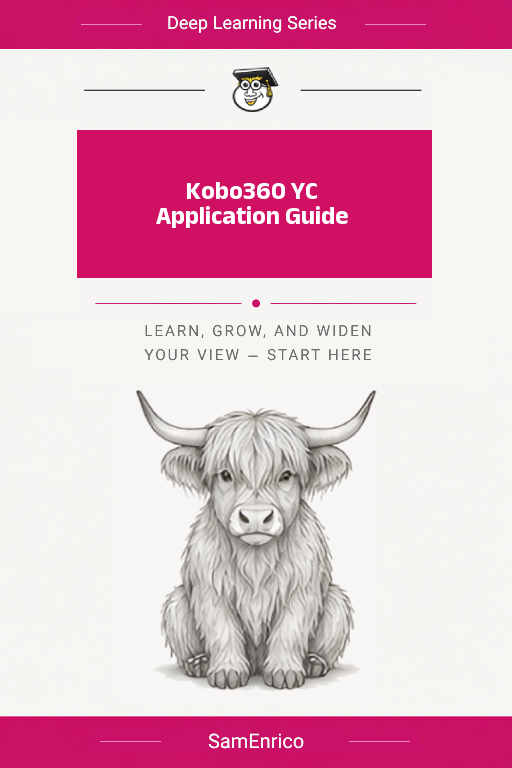
Kobo360 YC Application Guide eBook
Study Kobo360 Y Combinator logistics platform appl
by Mcdonald Ed
Study Kobo360 Y Combinator logistics platform application and apply their asset light model to your startup.
Formats
Free sample
Chapter 1: The Asset Trap--–- In 2016, a young Nigerian founder named Obi Ozor stood in a dusty warehouse in Lagos, watching six of his company’s trucks sit idle. The drivers were playing cards in the shade of the trucks, their salaries burning a hole in his bank account. He had done everything right, according to the traditional playbook. He had raised money. He had bought assets.
He had signed contracts with e-commerce giants Jumia and Konga. And yet, his company was dying. Not slowly, the way a mature business fades, but rapidly, the way a startup with a twelve-month runway and ten months of losses spirals toward oblivion. He was learning a brutal lesson that would later become the foundation of a Y Combinator-backed logistics platform: owning physical assets is the fastest way to kill a startup.This chapter is not a history lesson. It is an autopsy of a near-death experience, and a strategic blueprint for every founder who believes that control over trucks, warehouses, inventory, or equipment equals competitive advantage.
The truth is the opposite. In the age of platform economics, assets are anchors. They create fixed costs, depreciation, and operational drag. They turn your balance sheet into a boat anchor and your runway into a countdown timer. Kobo360 almost died learning this lesson.
Your startup does not have to.The fallacy of asset ownership runs deep in logistics. Founders look at industry incumbents – the DHLs, the Maersks, the TSLs – and see fleets of trucks, sprawling warehouses, and decades of accumulated capital. They assume that to compete, they must own those things too. This is the same mistake that blockbuster made with video stores, that taxi medallion owners made with Uber, and that hotel chains made with Airbnb. Incumbents own assets because they had to.
The internet changed that. Platforms aggregate assets without owning them. Kobo360’s insight was not that trucks are useless. It is that owning them is.Before Y Combinator, before the pivot to long-haul trucking for multinationals, before the Kobo WIN financing platform that would lock in twenty thousand drivers, Kobo360 was a failed last-mile delivery startup. They had trucks.
They had drivers on payroll. They had contracts. And they were hemorrhaging cash because the volume of e-commerce deliveries in Nigeria could not keep those trucks moving. The problem was not a lack of demand. The problem was the mismatch between fixed asset costs and variable revenue.
Every hour a truck sat idle, it cost money. Every maintenance repair came out of the same pocket. Every driver who was not driving was still being paid. This is the hidden math of asset-heavy startups, and it kills more companies than competition ever will.This chapter introduces the first and most important diagnostic tool in this book: the Burn Rate versus Asset Matrix. You will learn to plot your startup on four quadrants, diagnose your risk of implosion, and identify the path to the asset-light promised land.
You will also learn a critical distinction that most founders miss: the difference between operational asset-light (owning no assets) and balance sheet asset-light (offloading ownership while retaining risk). Kobo360 achieved the former but inadvertently took on the latter through their financing arm – a nuance that would later become both their greatest strength and their biggest exposure. By the end of this chapter, you will never look at a physical asset the same way again.The Near-Death Experience That Built a Unicorn In 2016, Nigeria’s e-commerce market was the great hope of African tech. Jumia was raising hundreds of millions of dollars. Konga was burning through venture capital.
Every logistics startup wanted a piece of the action, and Kobo360 was no exception. Obi Ozor and his co-founder Ife Oyodeli believed that the key to winning last-mile delivery was owning the last mile – the trucks, the drivers, the warehouses. They raised a small seed round and bought a fleet of vehicles. They hired drivers as employees, not contractors. They signed exclusive delivery agreements with e-commerce platforms.
On paper, it looked like a classic logistics company. In practice, it was a cash incinerator.The problem was not execution. Kobo360 delivered packages on time, with tracking, and with reasonable prices. The problem was volume. Nigeria’s e-commerce penetration in 2016 was less than one percent of retail sales.
There simply were not enough packages to keep a fleet of trucks moving eight hours a day. Trucks sat idle for days. Drivers were paid to play cards. Maintenance costs continued regardless of utilization. And the revenue per delivery – often less than two dollars – could never cover the fixed costs of asset ownership.This is the trap that asset-heavy startups fall into.
They confuse ownership with control. They believe that owning the means of production gives them an advantage over competitors who rent. But in a low-volume market, the opposite is true. The competitor who owns nothing but aggregates everything has no fixed costs. They can survive on thin margins because their only costs are variable.
When volume drops, they simply stop matching trips. They do not have to lay off drivers or sell trucks at a loss.Kobo360’s near-death experience lasted eighteen months. They burned through their seed round. They took bridge loans at punishing interest rates. They had conversations with investors that went nowhere because their unit economics did not work.
And then they made a decision that would define their future: they stopped trying to be a logistics provider and started trying to be a logistics enabler. They sold most of their trucks to the drivers who had been operating them. They stopped hiring drivers as employees and turned them into independent contractors. They pivoted from last-mile e-commerce delivery to long-haul B2B trucking. And they built a software platform to match shippers to trucks instead of owning the trucks themselves.The pivot was not clean.
It was not instantaneous. As we will see in Chapter 12, Kobo360 ran a hybrid model for over a year, losing money on e-commerce while breaking even on long-haul B2B. But the direction was clear: toward less ownership, more aggregation, and lower fixed costs. The company that emerged from that pivot was not the same company that had started. It was leaner, meaner, and capable of scaling without raising endless rounds of capital.The Two Definitions of Asset-Light (And Why Most Founders Get Them Wrong)Before we go further, we need to resolve a confusion that appears in almost every conversation about asset-light business models.
The term is used to mean two different things, and conflating them leads to strategic mistakes.Operational Asset-Light means that your company does not own the physical assets required to deliver its service. You lease, rent, or aggregate assets owned by others. Uber is operationally asset-light: it does not own the cars. Airbnb is operationally asset-light: it does not own the homes. Kobo360, after its pivot, was operationally asset-light: it did not own the trucks.
This is the definition that most founders aspire to, and it is the definition that appears in Chapter 1 of every lean startup book.Balance Sheet Asset-Light means that your company has minimal capital invested in physical assets on its balance sheet. This sounds like the…
This is the end of the free sample. Get the eBook to keep going. Buy now
About this book
Details
- Author
- Mcdonald Ed
- Publisher
- SamEnrico
- Language
- English
- Genre
- Non-Fiction, Startup Guide, Accelerator Prep, Logistics Tech
- Released
- 2026-06-01
- Pages (approx.)
- 154
- Available as
- eBook, Audiobook

Read better in the ZLOADR app
Your eBooks on your phone or tablet. Sign in with your SamEnrico account and start reading.
More by Mcdonald Ed
 Remote Status ReportingMcdonald Ed$11.99
 Email Subscription Cleanse GuideMcdonald Ed$11.99
 Mayor of the College TownMcdonald Ed$11.99
 IBS Pelvic Floor DysfunctionMcdonald Ed$11.99
 Data Leak Apology Letter TemplatesMcdonald Ed$11.99
 Firestorm: The Scientists Who Deciphered Yellowstone's SupervolcanoMcdonald Ed$11.99
 Windows System EngineerMcdonald Ed$11.99
 Production Schedule SimulationMcdonald Ed$12.99
 Understanding Cloacal ExstrophyMcdonald Ed$17.99
 Ultimate Handbook Guide to Shijiazhuang : (China) Travel GuideMcdonald Ed$11.99