
Non-FictionSelf-HelpInterruption Management
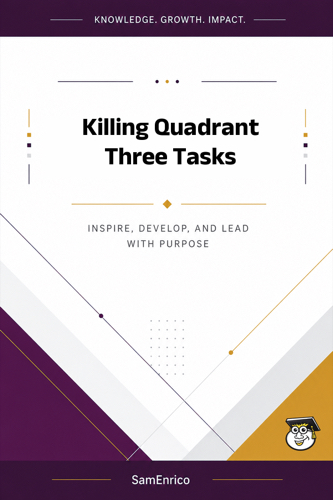
Killing Quadrant Three Tasks eBook
Eliminate urgent but unimportant interruptions tha
Eliminate urgent but unimportant interruptions that waste your day.
Formats
Free sample
Chapter 1: The Twenty-Three Minute Hole--–- You are about to lose twenty-three minutes of your life. Not later today. Not next week. Right now, as you read this sentence, the clock is ticking on a loss you did not agree to and probably did not know existed.That number—twenty-three minutes—is not a guess. It is the average time required for a human being to fully refocus on a complex task after a single interruption.
Not to return to the task. Not to glance at it again. To return to the same depth of concentration, the same fluid mental state, the same quality of output that existed before the interruption occurred. The research comes from multiple studies synthesized in The Time Bandit Solution and confirmed by Gloria Mark at the University of California, Irvine, who spent years tracking knowledge workers in their natural environments. What she found should terrify you.Most people do not experience one interruption per day.
They experience ten. Or fifteen. Or, in open-plan offices and Slack-heavy cultures, twenty or more. Do the math. Ten interruptions at twenty-three minutes each is nearly four hours.
Four hours of every single workday spent not working—not in the sense of taking a break or checking out, but in the more insidious state of recovering. You are at your desk. Your hands are on the keyboard. Your eyes are on the screen. But your brain is a rescue helicopter trying to land on a pitching deck, circling, recalibrating, unable to set down and do the work that actually matters.This is the hidden architecture of burnout.
It is not the big projects that break us. It is the death by a thousand paper cuts, each one arriving with a ping, a buzz, a tap on the shoulder, a subject line that says "Quick question" or "Following up" or "URGENT: Thoughts?" You answer. You switch contexts. You lose your place. You find your place.
You lose it again. By five o'clock, you have no idea what you accomplished, but you are exhausted. That exhaustion is real. The accomplishment is not.Welcome to the world of Quadrant Three.The Matrix You Have Never Been Taught The Eisenhower Matrix—named for President Dwight D. Eisenhower, who famously said, "I have two kinds of problems: the urgent and the important.
The urgent are not important, and the important are never urgent"—divides every task into four boxes. Quadrant One is urgent and important: crises, deadlines, fires. Quadrant Two is not urgent but important: strategy, relationship-building, exercise, deep work. Quadrant Four is neither urgent nor important: the black hole of social media scrolling and reality television. And then there is Quadrant Three.Urgent but not important.This is the quadrant that does not get named in most productivity books.
The authors race past it, eager to talk about prioritizing Quadrant Two or managing Quadrant One crises. Quadrant Three is the awkward relative at the family dinner. It is the task that screams for attention but delivers nothing of value. It is the meeting invite sent "just for visibility." The email chain that includes seventeen people who have no decision rights. The colleague who failed to plan and now presents their emergency as your emergency.
The notification that feels like a fire drill but is actually just a squirrel running across a lawn.Quadrant Three tasks are the single largest drain on modern productivity, and they are almost entirely invisible to the people suffering from them. You cannot kill what you cannot see. So the first job of this book is to make you see.The Autopsy of an Average Day Let us perform an autopsy on a typical information worker's day. Not a bad day. Not a day when everything went wrong.
A perfectly average Tuesday.You arrive at your desk at 8:45 AM with a clear intention: finish the proposal draft by noon. You open your laptop. Before you can open the document, an email notification pops up. It is from a colleague in another department. The subject line reads: "Quick question about the Q3 numbers?" You open it.
The question is not quick. It requires you to look up three separate spreadsheets and cross-reference a meeting note from two weeks ago. You spend eleven minutes on it. You close the email. Where were you?
The proposal draft. Right. You open it.Three minutes later, a Slack message arrives. Your manager: "Can you hop on a quick call?" You hop. The call is not quick.
It is twenty-two minutes of your manager thinking out loud about a project that does not start for another month. You contribute nothing except "uh-huh" and "interesting." You hang up. The proposal draft. What was the third paragraph going to say? You read it again to remind yourself.Another notification.
This time it is a calendar reminder: a meeting in fifteen minutes. The meeting has no agenda. It never does. You attend anyway because you are a good team player. The meeting lasts forty-five minutes.
Three decisions were supposed to be made. None were made. A follow-up meeting is scheduled. You return to your desk. It is now 11:30 AM.
The proposal draft is still at the same three paragraphs you wrote before you arrived.You work in a panic for thirty minutes. You produce something mediocre. You send it. You feel bad about it. At 2:00 PM, a "URGENT" email arrives from a client.
You drop everything. By 5:00 PM, you have answered forty-seven emails, attended three meetings, and completed exactly zero hours of deep work. You stay late to "catch up." You leave at 6:45 PM, exhausted, guilty, and vaguely resentful.This is not a failure of character. It is a failure of design. You were not lazy.
You were not disorganized. You were simply standing in the path of a flood with no umbrella, no boots, and no warning. Quadrant Three did this to you.The Restart Fee: Why Twenty-Three Minutes Matters The twenty-three-minute figure deserves a closer look because it defies intuition. Most people assume that an interruption costs only the time of the interruption itself. A two-minute email?
That costs two minutes. A five-minute chat? Five minutes. This assumption is catastrophically wrong.The cost of an interruption is the interruption time plus the recovery time. And the recovery time is almost always longer than the interruption itself.
Gloria Mark's research found that after a brief interruption, it takes an average of twenty-three minutes and fifteen seconds to return to the same level of focus. For complex or creative work—writing, coding, designing, analyzing—the recovery time can exceed thirty minutes.Here is what happens in your brain during those twenty-three minutes. When you are deeply focused, your prefrontal cortex enters a state of fluid reasoning. Connections between disparate ideas become easier. Patterns emerge.
Solutions that were invisible ten minutes ago suddenly appear. This state is biologically expensive; it requires sustained attention and metabolic energy. An interruption shatters it. Your brain does not simply pause and resume like a Netflix show. It reboots.
The neural networks that were firing together disperse. The context you had built—the mental scaffolding of the problem you were solving—collapses.When you return to the task…
This is the end of the free sample. Get the eBook to keep going. Buy now
About this book
Details
- Author
- Dennison Donovan
- Publisher
- SamEnrico
- Language
- English
- Genre
- Non-Fiction, Self-Help, Interruption Management
- Released
- 2026-06-11
- Pages (approx.)
- 135
- Available as
- eBook, Audiobook

Read better in the ZLOADR app
Your eBooks on your phone or tablet. Sign in with your SamEnrico account and start reading.
More by Dennison Donovan
 BPD Emotional RegulationDennison Donovan$11.99
 Step Six Willingness MeditationDennison Donovan$11.99
 Stress Headache Migraine GuideDennison Donovan$11.99
 The Star Charts of the Dogon: Africa's Celestial MathematiciansDennison Donovan$11.99
 AI for HR Document ClassificationDennison Donovan$12.99
 Hydroxylapatite MiningDennison Donovan$11.99
 Learn to Play the Electric CymbalumDennison Donovan$11.99
 How to Become a Steam-distribution SupervisorDennison Donovan$11.99
You may also like
 Hong Kong Handover 1997Dunn Johnnie$11.99
 Zumba For Postnatal Recovery CourseNeal Christian$11.99
 Zumba for BeginnersLadner Nikia$11.99
 YouTube Comment Mining GuideHumes Pandora$12.99
 Worry Box MeditationCarlin Rudy$11.99
 Workplace Stress MeditationNguyen Lynn$11.99
 Workplace Stress and Sleep RepairHawley Ivory$11.99
 Workplace Perfectionism CureDelaney Jeffry$11.99
 Workplace Injustice Anger GuideWallen Isabelle$11.99
 Work Addiction and Burnout LinkGreenwood Ester$11.99
 Women in Yoga and WellnessBeattie Galina$11.99
 Women in Stand Up ComedyChun Evangeline$11.99