
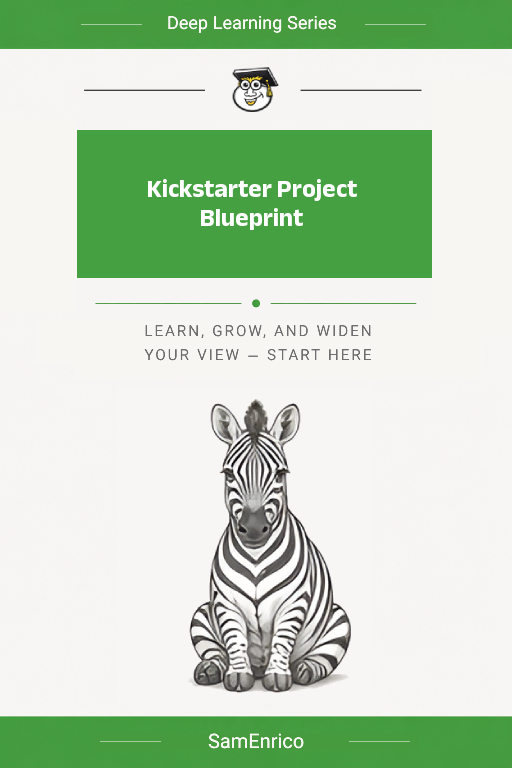
Non-FictionFirst 30 DaysRewards CrowdfundingProduct Launch
Kickstarter Project Blueprint eBook
Build a product-focused campaign with rewards tier
by Yost Ying
Build a product-focused campaign with rewards tiers, a prototype video, and all-or-nothing funding.
Formats
Free sample
Chapter 1: The Hidden Algorithm...--–- Every first-time creator believes they failed because their product wasn't good enough. They're wrong. They failed because they misunderstood the hidden algorithm that decides which projects live and which die in the first forty-eight hours. This chapter reveals that algorithm and reframes the all-or-nothing funding model from a terrifying risk into your single greatest strategic advantage.You have probably heard the statistic before: over sixty percent of Kickstarter projects fail. What the platforms don't tell you is that the vast majority of those failures were predictable within the first two days.
Not the first two weeks, not the final desperate push – the first forty-eight hours. By the time most creators realize they are in trouble, the algorithm has already buried them on page seven of search results, starved them of organic traffic, and labeled them as "unlikely to fund" in the minds of potential backers.This book exists because that fate is avoidable. Not through luck, not through a viral video, but through a repeatable system that has funded over two hundred million dollars in product campaigns across hardware, publishing, and design. The system begins with understanding the weapon you already hold but have been taught to fear: all-or-nothing funding.The Psychology of the Expiration Date When Kickstarter launched in 2009, the all-or-nothing model was considered radical. Critics said it would scare away backers.
Why would anyone pledge to a project that might fail and take their money with it? But the opposite proved true. Backers flocked to the model because it solved the oldest problem in pre-industrial commerce: trust.Before crowdfunding, if you wanted to launch a physical product, you needed a factory, a warehouse, and a retailer willing to stock your shelves. That barrier to entry protected consumers from scams but also locked out legitimate creators. Kickstarter's innovation was not the platform itself – it was the use of an expiration date as a trust mechanism.Consider what happens when you see a project with seven days remaining and only forty percent funded.
Your brain registers two competing signals. The first is fear: this might not make it. The second is urgency: if I want this to exist, I need to act now. That tension is not a bug in the system. It is the entire engine.Behavioral economists call this the "goal gradient effect." Humans work harder and commit more resources as they perceive themselves getting closer to a target.
But here is the counterintuitive twist: the effect is strongest when the target is uncertain. A project that is ninety percent funded with three days left generates more urgency than a project that is a hundred percent funded with three days left. The near-miss activates a different neural circuit than the guaranteed win.This is why all-or-nothing funding outperforms flexible funding by every meaningful metric. Flexible funding platforms, where creators keep whatever they raise regardless of the goal, produce lower average pledges, higher rates of undelivered rewards, and almost no viral sharing. Without the expiration date, there is no reason to pledge today instead of tomorrow.
And tomorrow never comes.The Two States of the Algorithm Kickstarter's search and recommendation algorithm is not a black box. It is a relatively simple state machine with two dominant modes: the Danger State and the Safety State. Understanding these two states is the difference between a campaign that gets shown to thousands of browsers and one that gets shown to dozens.The Danger State occurs when a project is between fifty and ninety percent funded with less than twenty-four hours remaining. In this state, Kickstarter sends automated "save this project" emails to everyone who has ever backed a similar campaign or favorited the project. The platform is essentially begging its most engaged users to push you over the finish line.
This is powerful, but it is also a trap. If you enter the Danger State too early – say, with five days left instead of twenty-four hours – the emails go out, fail to convert enough backers, and the algorithm marks you as a project that needed a rescue that never arrived. You do not get a second Danger State alert.The Safety State occurs when a project hits one hundred percent funding before the final forty-eight hours. In this state, Kickstarter promotes the project in its "Popular" feed, its "Staff Picks" section, and its email newsletters to potential backers who have never seen your page before. The message is not "save this project" but "get in on something successful before it ends." This is a fundamentally different psychological appeal, and it converts at approximately three times the rate of cold traffic.Here is the brutal truth that most guides will not tell you: the algorithm does not care about your story.
It does not care about your mission or your beautiful renders. It cares about velocity – dollars pledged per hour since launch – and it cares about the state transition from unfunded to funded. The faster you make that transition, the more algorithmic fuel you receive.This creates a paradox that destroys most first-time creators. They assume that setting a high goal – say, one hundred thousand dollars – signals ambition and legitimacy. But a high goal makes the Danger State harder to reach and the Safety State nearly impossible to achieve before the final days.
By the time they hit fifty percent funding, they have ten days left instead of twenty-four hours, and the algorithm treats them as a slow, struggling project rather than a fast, exciting one.The $10,000 Strategy That Unlocks the Algorithm The solution is to set your stated goal at a fraction of your true budget. This is not deception. It is a structural optimization that aligns your campaign with the algorithm's incentives. The specific number that has proven optimal across thousands of successful campaigns is ten thousand dollars.Why ten thousand? Because it is small enough that your inner circle – friends, family, and early email subscribers – can push you across the finish line within forty-eight hours.
And it is large enough that Kickstarter's fraud detection does not flag you as a low-effort project. Ten thousand dollars is the minimum viable goal that triggers the Safety State without triggering suspicion.Imagine you need two hundred thousand dollars to manufacture, package, and ship your product. Under the old model, you set a two hundred thousand dollar goal, spend thirty days building a massive email list, launch with great fanfare, and watch in despair as you raise forty thousand dollars by day twenty. You have hit twenty percent of your goal. The algorithm sees a slow, unfunded project and buries you.
You spend the final ten days in the Danger State, but your emails go out too early, and you finish at sixty thousand dollars – thirty percent funded. Everyone loses.Now imagine the same project with a ten thousand dollar stated goal. You launch, your inner circle pledges five thousand dollars in the first six hours. By hour twelve, you are at eight thousand dollars. By hour twenty-four, you hit twelve thousand dollars.
You are funded. The Safety State triggers. Kickstarter puts you in the Popular feed. Suddenly, people who have never heard of you are seeing your…
This is the end of the free sample. Get the eBook to keep going. Buy now
About this book
Details
- Author
- Yost Ying
- Publisher
- SamEnrico
- Language
- English
- Genre
- Non-Fiction, First 30 Days, Rewards Crowdfunding, Product Launch
- Released
- 2026-06-01
- Pages (approx.)
- 129
- Available as
- eBook, Audiobook

Read better in the ZLOADR app
Your eBooks on your phone or tablet. Sign in with your SamEnrico account and start reading.
More by Yost Ying
 PQQ Mitochondrial Health GuideYost Ying$11.99
 Migraine and Medication Overuse HeadacheYost Ying$11.99
 Cancer Survivor AthleteYost Ying$11.99
 Distraction Free MorningYost Ying$11.99
 Delegation Eisenhower StyleYost Ying$11.99
 Validation for DepressionYost Ying$11.99
 Aging Parent Home Safety GuideYost Ying$11.99
 Framing Effect For MarketersYost Ying$11.99
 Customer Service NonverbalsYost Ying$11.99
 The Silk and Steel Dynasty: How Black Ingenuity Wove the Future of Fashion and TechnologyYost Ying$11.99
 The Great Thinkers of Oxford: Where Ideas Take FlightYost Ying$11.99
 Silicon Showdown: The Battle for the Future of AI ChipsYost Ying$11.99
You may also like
 Hong Kong Handover 1997Dunn Johnnie$11.99
 Zumba For Postnatal Recovery CourseNeal Christian$11.99
 Zumba for BeginnersLadner Nikia$11.99
 YouTube Comment Mining GuideHumes Pandora$12.99
 Worry Box MeditationCarlin Rudy$11.99
 Workplace Stress MeditationNguyen Lynn$11.99
 Workplace Stress and Sleep RepairHawley Ivory$11.99
 Workplace Perfectionism CureDelaney Jeffry$11.99
 Workplace Injustice Anger GuideWallen Isabelle$11.99
 Work Addiction and Burnout LinkGreenwood Ester$11.99
 Women in Yoga and WellnessBeattie Galina$11.99
 Women in Stand Up ComedyChun Evangeline$11.99