
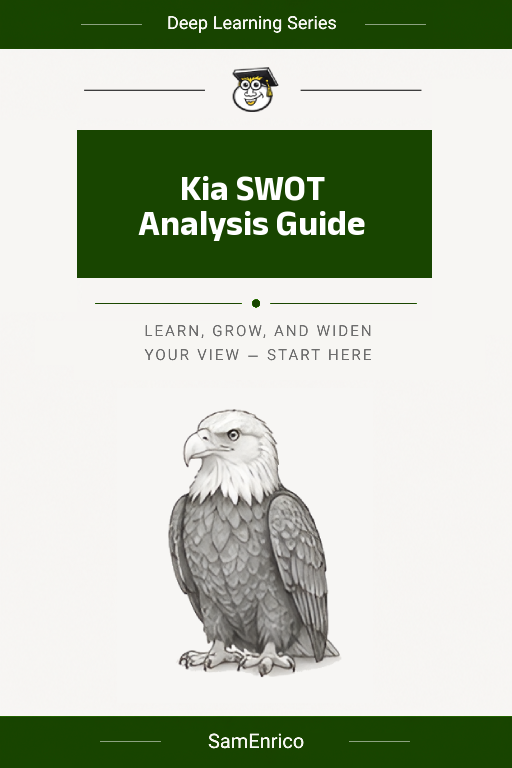
Non-FictionStrategic AtlasAuto Analysis
Kia SWOT Analysis Guide
Evaluate value positioning, EV9 success, supply ch
by Layne Ja
Evaluate value positioning, EV9 success, supply chain agility, and brand perception vs Hyundai.
Formats
About this book
Free sample
Chapter 1: The Telluride Effect...--–- In the winter of 2019, a strange thing happened in the driveways of suburban Atlanta, Dallas, and Phoenix. Families who had spent the previous decade writing off Kia as a rental-fleet special began arriving at Kia dealerships with trade-ins still bearing the badges of Volvo, Acura, and even entry-level BMWs. They weren't looking for the cheapest option. They were looking for a $50,000 eight-passenger SUV with quilted Nappa leather, a towing capacity that embarrassed the Ford Explorer, and a design that made neighbors ask, "Wait, that's a Kia?" The vehicle was the Telluride, and it did something that no single product had done for the brand in its three-decade history: it rewired the demographic DNA of the Kia buyer. This chapter dissects how Kia solved the impossible equation—looking expensive without being unattainable—and why that achievement, now called the "value-premium paradox," remains the single most important strategic asset the company holds as it navigates the turbulent 2026 landscape of tariff wars, expiring tax credits, and an electrified future.The Birth of the Paradox To understand Kia's current position, one must first understand where it came from.
As recently as 2010, Kia was synonymous with the "cash for clunkers" program—a brand you bought only if you couldn't afford a Honda or Toyota. Resale values were abysmal. A three-year-old Kia Rio retained barely 35 percent of its original price, while a comparable Civic held over 55 percent. Interior plastics were hard and shiny. The brand's signature feature was a 10-year/100,000-mile warranty, which dealers marketed less as a sign of confidence and more as a necessity: you would need it.
Then something shifted. Kia hired Peter Schreyer, the legendary Audi designer who had penned the original TT, and gave him permission to break every rule in the budget-brand playbook. The 2011 Optima arrived with a tiger-nose grille, sweeping body lines, and an interior that looked like it belonged in a car twice its price. Critics were stunned. Motor Trend named it Car of the Year, the first time the award had gone to a brand synonymous with econoboxes.
But the Optima was just the appetizer. The main course arrived in 2019 with the Telluride, and with it, the…
This is the end of the free sample. Get the eBook to keep going. Buy now
Contents
- Chapter 1
- Chapter 2
- Chapter 3
- Chapter 4
- Chapter 5
- Chapter 6
- Chapter 7
- Chapter 8
- Chapter 9
- Chapter 10
- Chapter 11
- Chapter 12
Details
- Author
- Layne Ja
- Publisher
- SamEnrico
- Language
- English
- Genre
- Non-Fiction, Strategic Atlas, Auto Analysis
- Released
- 2026-05-28
- Pages (approx.)
- 135
- Available as
- eBook, Audiobook

Read better in the ZLOADR app
Your eBooks on your phone or tablet. Sign in with your SamEnrico account and start reading.
More by Layne Ja
 TM Maintenance Over Decades GuideLayne Ja$11.99
 Social Work EQ Skills GuideLayne Ja$11.99
 Treasure Chest CalmLayne Ja$11.99
 The Joy of Small ThingsLayne Ja$11.99
 Self Esteem for Partner With Chronic IllnessLayne Ja$11.99
 The Lioness of Dahomey: The Warrior Queens Who Ruled the BattlefieldLayne Ja$11.99
 Understanding MyelitisLayne Ja$17.99
 Accounting Formula Crash CourseLayne Ja$12.99
 The Space Race: 42 Days to the MoonLayne Ja$11.99
 How to Become a SpotterLayne Ja$11.99
You may also like
 Hong Kong Handover 1997Dunn Johnnie$11.99
 Zumba For Postnatal Recovery CourseNeal Christian$11.99
 Zumba for BeginnersLadner Nikia$11.99
 YouTube Comment Mining GuideHumes Pandora$12.99
 Worry Box MeditationCarlin Rudy$11.99
 Workplace Stress MeditationNguyen Lynn$11.99
 Workplace Stress and Sleep RepairHawley Ivory$11.99
 Workplace Perfectionism CureDelaney Jeffry$11.99
 Workplace Injustice Anger GuideWallen Isabelle$11.99
 Work Addiction and Burnout LinkGreenwood Ester$11.99
 Women in Yoga and WellnessBeattie Galina$11.99
 Women in Stand Up ComedyChun Evangeline$11.99