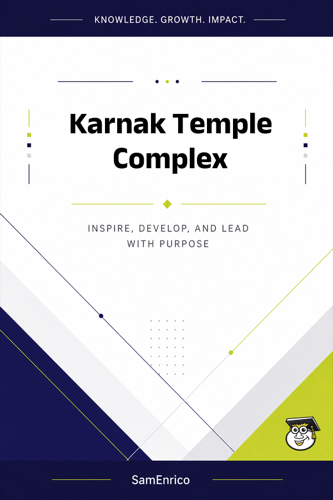
Karnak Temple Complex Audiobook
undefined
by Ferrer John
undefined
Formats
Free sample
Chapter 1: The Sacred Sand...--The first time you stand before the ruins of Karnak, the instinct is not to marvel but to disbelieve. Your eyes send signals to your brain that say this cannot be right — because no human civilization, no matter how powerful, should have been able to stack stone that high, that densely, that deliberately, and then walk away from it for two thousand years. The Great Hypostyle Hall alone, with its one hundred and thirty-four columns rising like a petrified forest, covers an area large enough to swallow Notre Dame Cathedral whole and still have room for the Roman Forum as a courtyard. And yet the Hypostyle Hall is only one room in a complex that stretched, at its peak, across nearly two hundred acres — larger than some ancient cities. Larger, in fact, than many modern cities if you measure by footprint alone.But size is not what makes Karnak astonishing.
What makes Karnak astonishing is that it was never finished. It was never even planned as a single structure. For over two thousand years — from the mud-brick chapels of the Middle Kingdom around 2000 BCE to the last Ptolemaic gates erected in the first century BCE — every pharaoh who held the crook and flail added something. Some added whole temples. Some added obelisks.
Some added only a single wall or a carved inscription. But they all added. The result is not a building in any conventional sense. It is a palimpsest of Egyptian history written in stone, where a Ramesside pylon stands in front of a Hatshepsutine chapel, which itself was built on the foundations of a Middle Kingdom shrine that replaced an Old Kingdom altar. To walk through Karnak is to walk through three thousand years of human ambition, piety, politics, and vandalism — often simultaneously.This book is the story of that place.
But before we can understand what Karnak became, we must understand the land on which it was built, the god for whom it was raised, and the strange, persistent belief that drove Egyptians for millennia to carry stones across rivers and drag them up ramps, all so that a statue hidden in a dark room could be woken each morning with incense and song.The River and the Floodplain The Nile does not merely flow through Egypt. It is Egypt. Without the Nile, the entire country would be indistinguishable from the Sahara that presses…
This is the end of the free sample. Get the Audiobook to keep going. Buy now
About this book
Details
- Author
- Ferrer John
- Publisher
- SamEnrico
- Language
- English
- Genre
- Non-Fiction, History / Archaeology
- Released
- 2026-06-08
- Pages (approx.)
- 144
- Available as
- eBook, Audiobook

Listen in the VoxFlicks app
Audiobooks and audio dramas wherever you go. Sign in with your SamEnrico account and press play.
More by Ferrer John
 Self Esteem for Dads at WorkFerrer John$11.99
 Emotion Regulation HandoutsFerrer John$11.99
 Paramedic PTSD Prevention HandbookFerrer John$11.99
 Multiple Language PalacesFerrer John$11.99
 The Breath Sensations WorkbookFerrer John$11.99
 Anger Management for Neurodivergent WorkersFerrer John$11.99
 Midnight Zone Diver's LogFerrer John$11.99
 Vacation Without BurnoutFerrer John$11.99
 The Fox of the Desert: Erwin Rommel's North African CampaignFerrer John$11.99
 Bloodlines of Power: The Bush Dynasty’s Shadow WarsFerrer John$11.99
 The Bone Whisperers of Timbuktu: Unlocking the Secrets of the Human Body in the Age of DiscoveryFerrer John$11.99
 Facebook Ad Audience InsightsFerrer John$12.99