
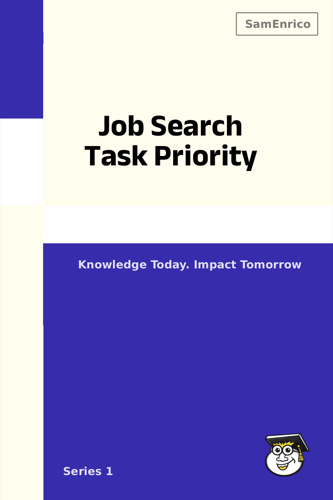
Non-FictionSelf-HelpJob SearchCareer
Job Search Task Priority eBook
Sort applications, networking, and skill building
Sort applications, networking, and skill building using Eisenhower matrix.
Formats
Free sample
Chapter 1: The Panic Loop--–- Maria had submitted eighty-seven job applications in eleven days. She had tailored zero of them. She had spoken to exactly one human being—a recruiter who ghosted her after a thirty-second phone screen. On the morning of day twelve, she sat in her home office, still in her pajamas at 11:47 AM, refreshing her email inbox every forty-five seconds. Her right hand hovered over the mouse.
Her left hand held a cold cup of coffee. Her brain felt like a browser with forty-seven tabs open, none of them loading.Maria is not lazy. Maria is not stupid. Maria is not unemployable. Maria is trapped in what this book calls the Panic Loop, and if you are reading this chapter, there is a very high probability that you are trapped in it too.The Panic Loop is a behavioral and neurochemical pattern that looks like hard work, feels like desperate effort, and produces almost nothing except burnout.
It works like this: You lose your job, or you decide to leave, or you graduate into a brutal market. Fear activates your sympathetic nervous system. Your brain, seeking to reduce that fear, latches onto the easiest, most repetitive, most immediately available action—submitting an application. Each click of the "Submit" button releases a small pulse of dopamine, the neurotransmitter associated with reward and anticipation. You feel, for a moment, as though you have done something.
You have advanced. You are in control.But you are not in control. You are in a slot machine.The Dopamine Trap of Easy Apply Behavioral psychologists have known for decades that variable ratio reinforcement schedules—rewarding an action after an unpredictable number of tries—produce the most compulsive behavior. This is why slot machines are more addictive than vending machines. With a vending machine, you insert money, you press a button, and you receive a snack.
Predictable. Boring. With a slot machine, you pull the lever, and sometimes nothing happens, sometimes you get a small reward, and very rarely you get a jackpot. The unpredictability keeps you pulling.Linked In Easy Apply, Indeed Quick Apply, and similar one-click submission tools are slot machines for job seekers. You click.
Most of the time, nothing happens. Occasionally, you get a form rejection ("After careful review..."). Very rarely, you get a phone screen. The unpredictability—the maybe this time—keeps you clicking. You are not conducting a job search.
You are feeding a behavioral addiction.This is not a metaphor. Functional magnetic resonance imaging studies of reward processing show that the same neural circuits activated by gambling are activated by checking email and waiting for job application responses. The anticipation of a possible reward—an interview request, a call from a recruiter—releases more dopamine than the reward itself. This means that the act of waiting for a response can feel more compelling than actually receiving one. And what is the easiest way to generate that anticipation?
Submit another application. And another. And another.Maria submitted eighty-seven applications in eleven days. She received six automated acknowledgments, three form rejections, one phone screen that led nowhere, and seventy-seven messages that never came. But she kept clicking, because every click generated a small spike of maybe.The Myth of Volume: Why More Is Less Let us be very clear about something that will sound counterintuitive but is supported by every major hiring study of the past decade: Applying to more jobs reduces your chances of getting a job.Not relative to doing nothing.
Relative to applying to fewer, better-targeted jobs with customization and human connection.A 2020 analysis of over two million applications by the talent platform Ideal found that candidates who applied to more than fifteen jobs per week had a lower interview rate per application than those who applied to five to ten. Why? Because speed destroys quality. When you are rushing to hit an arbitrary application count, you skip company research, you skip tailoring your resume, you skip writing a cover letter that mentions a specific project or leader, and you skip the single most important step: finding a human being to refer you.Recruiters can spot a generic application in under seven seconds. Seven seconds.
That is not an exaggeration. The average time a recruiter spends reviewing a resume before making an initial decision is between six and eight seconds. In that time, they are looking for three things: (1) a clear match between your most recent role and the job description, (2) recognizable company names or brands, and (3) something specific—a project, a metric, a tool—that signals you actually read the job posting.A generic application has none of these. A generic application is the resume equivalent of a robocall. You are not being rejected because you are unqualified.
You are being rejected because you are invisible.The author once worked with a client named James, a product manager who had been laid off from a midsize tech company. James had submitted 214 applications over eight weeks. He had received two first-round interviews. He was despondent. He believed the job market was broken.
The author asked James to show him his last ten applications. Every single one used the exact same resume file. Not a single one mentioned the company name, the role, or a specific requirement from the job description. James was not applying to jobs. He was spamming the universe and hoping for a miracle.After three weeks of applying to no more than four jobs per week—each with a tailored resume, a specific cover letter, and a Linked In message to a current employee—James received five interview requests.
The volume went down. The results went up.The Cost of Context Switching: Why Your Brain Is Fried Even if volume did not hurt quality, there is another reason the Panic Loop fails: context switching destroys cognitive function.Every time you switch between tasks—from a job board to your email to a resume template to a company website—you incur a "switching cost." Psychologists have measured this cost at between fifteen and twenty minutes of lost focus per switch. This is not the time it takes to physically move your attention. This is the time it takes for your brain to fully re-engage with the new task, to reload the relevant information, and to reach the same depth of concentration you had before the switch.Consider a typical hour in the Panic Loop: You open Linked In Jobs (five seconds). You scan ten postings (two minutes).
You see one that looks promising. You click "Easy Apply." You upload your resume (thirty seconds). You check your email while the upload completes (one minute). You receive a notification that a different job has been reposted. You open that tab (three seconds).
You realize you have not customized anything. You open your resume file to add a keyword (forty-five seconds). Your phone buzzes with a text message. You look at it (ten seconds). You return to the application, but you cannot remember where you were.
You start over.In that one hour, you have context-switched at least a dozen times. Your effective deep work time is zero minutes. You have not learned anything about any company.…
This is the end of the free sample. Get the eBook to keep going. Buy now
About this book
Details
- Author
- Mcguire Timmy
- Publisher
- SamEnrico
- Language
- English
- Genre
- Non-Fiction, Self-Help, Job Search, Career
- Released
- 2026-06-09
- Pages (approx.)
- 154
- Available as
- eBook, Audiobook

Read better in the ZLOADR app
Your eBooks on your phone or tablet. Sign in with your SamEnrico account and start reading.
More by Mcguire Timmy
 Roblox Microtransaction TrapMcguire Timmy$11.99
 Early Career ConnectorMcguire Timmy$11.99
 DHT Blocker Natural GuideMcguire Timmy$11.99
 Upwork Hourly Versus Fixed Price GuideMcguire Timmy$11.99
 The Ballot Box Rebellion: How a College Dropout Almost Toppled a Political GiantMcguire Timmy$11.99
 Notion Advanced Database GuideMcguire Timmy$12.99
 Nanotechnology Skills GuideMcguire Timmy$12.99
 Ultimate Handbook Guide to Yantai : (China) Travel GuideMcguire Timmy$11.99
 Understanding Mengel–konigsmark SyndromeMcguire Timmy$17.99
 Research Project ManagerMcguire Timmy$11.99
You may also like
 Hong Kong Handover 1997Dunn Johnnie$11.99
 Zumba For Postnatal Recovery CourseNeal Christian$11.99
 Zumba for BeginnersLadner Nikia$11.99
 YouTube Comment Mining GuideHumes Pandora$12.99
 Worry Box MeditationCarlin Rudy$11.99
 Workplace Stress MeditationNguyen Lynn$11.99
 Workplace Stress and Sleep RepairHawley Ivory$11.99
 Workplace Perfectionism CureDelaney Jeffry$11.99
 Workplace Injustice Anger GuideWallen Isabelle$11.99
 Work Addiction and Burnout LinkGreenwood Ester$11.99
 Women in Yoga and WellnessBeattie Galina$11.99
 Women in Stand Up ComedyChun Evangeline$11.99