
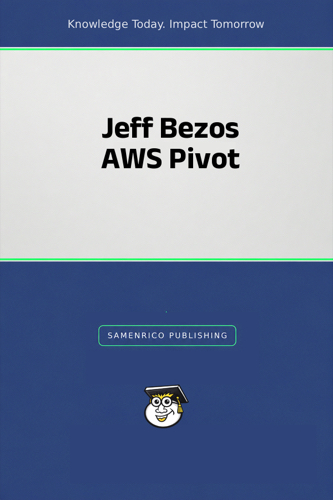
Non-FictionBiographyPlatform Strategy
Jeff Bezos AWS Pivot eBook
Turn internal infrastructure into a multi-billion
Turn internal infrastructure into a multi-billion dollar cloud computing service.
Formats
Free sample
Chapter 1: The Christmas Crush--December 1999. The dot-com bubble had not yet burst. Pets.com was still spending millions on a sock puppet. And Amazon.com, the "Earth's Biggest Bookstore," was about to discover that its own success had become a weapon aimed at its throat.The holiday shopping season was supposed to be a celebration. Amazon had spent the previous four years growing at a breakneck pace, doubling revenue every few months.
Wall Street loved the story. Customers loved the convenience. But inside the company's cramped offices in Seattle's Pioneer Square neighborhood, a different story was unfolding—one of rising panic, sleepless engineers, and a website that was beginning to crack under its own weight.It started slowly. A few dropped shopping carts here. A search that took ten seconds instead of one.
Then, during the peak shopping hour on December 12, 1999, the site simply stopped working. Not a slowdown. Not a partial outage. A complete, total, humiliating failure. The homepage loaded as a blank white screen.
The checkout cart returned an error message that might as well have been written in Latin. For forty-five minutes—an eternity in e-commerce time—Amazon.com was a bookstore that could not sell books.Jeff Bezos, then thirty-five years old, was not known for his patience. He paced the floor of the engineering bullpen, asking a question that no one could answer: "Why?"The engineers could not tell him. Not because they were incompetent, but because the system had become too complex for any single human to understand.The Big Ball of Mud To understand what happened that December night, you have to understand how Amazon built software in the late 1990s. The answer is simple and terrifying: they built it like everyone else did at the time, which is to say, they built it wrong.The Amazon website was what software engineers now call a monolith.
Imagine a single, sprawling codebase containing everything—the product catalog, the shopping cart, the payment processor, the inventory system, the customer reviews, the recommendation engine, the order tracker, the shipping calculator, and a hundred other features. Every piece of code lived in the same repository. Every feature shared the same database tables. Every team pulled from the same codebase and deployed to the same servers.On paper, this seemed efficient. In practice, it was a nightmare.The metaphor that engineers use for such systems is "the big ball of mud." It is not a technical term, though it might as well be.
A big ball of mud is a system that has grown organically, without central planning, as different teams added features on top of features, patching bugs on top of patches, until the original architecture—if there ever was one—became unrecognizable.Here is how one early Amazon engineer described it years later: "Imagine you have a bowl of spaghetti. Now imagine that every noodle is connected to every other noodle, and someone keeps adding new noodles while you are trying to eat. Now imagine that you are not allowed to see the bowl. You just have to guess where the noodles are. That was Amazon in 1999."The consequences were predictable and brutal.A small change to the book recommendations feature—something as simple as tweaking the algorithm to show more thrillers—could accidentally break the checkout cart.
Why? Because somewhere deep in the code, the recommendations module and the payments module shared a database table they should not have shared. No one remembered adding that connection. It had been there for years, written by an engineer who had long since left the company.Deploying new code was a surgical operation performed under extreme duress. The release process involved dozens of engineers huddled around a conference room, projecting their screens onto a wall, manually coordinating who would push which changes in which order.
A single deployment could take an entire weekend. And even then, something almost always broke.The fragility of the monolith created a culture of fear. Engineers stopped making improvements because they were terrified of breaking something else. Technical debt—the cost of choosing a quick solution today over a correct solution tomorrow—accumulated like credit card interest on a maxed-out account. The team knew they needed to fix the architecture.
But every time they discussed it, the same objection arose: "We cannot stop shipping features. The business depends on us."So they kept adding noodles to the bowl.The Growth Paradox The Christmas 1999 outage was not an anomaly. It was a warning shot. And it revealed what engineers now call the Growth Paradox—one of the most important and least understood dynamics in the technology industry.Here is the paradox: The very software that enables rapid growth eventually becomes the bottleneck to further growth.Think of it like a highway. When a city is small, two-lane roads are plenty.
As the city grows, the roads fill up, so you add more lanes. But adding lanes is expensive and disruptive. And eventually, you realize that no number of lanes can fix the underlying problem: the roads were designed for a town, not a metropolis. You need a fundamentally different system—trains, subways, buses—not just wider roads.Amazon had built a two-lane highway for what was becoming a metropolis. And the highway was collapsing.The Growth Paradox is not unique to Amazon.
It happens to every successful software company. The problem is that success comes with a hidden cost. Each new feature, each new integration, each new team adds complexity. And complexity, unlike code, does not stay neatly contained. It spreads.
It tangles. It creates dependencies that no one maps and no one understands.The cruelest part of the paradox is that the people who could fix it are usually the same people who are too busy fighting fires to fix it. The engineers who understand the system best are the ones paged at 2 AM to restart a crashed server. They are exhausted. They are not thinking about architecture.
They are thinking about survival.By 2000, Amazon was deep in the survival phase. The dot-com bubble had burst. Pets.com was dead. Webvan was dead. Boo.com was dead.
Amazon was losing money, and Wall Street was asking hard questions. The company had survived the crash, but barely. And inside the engineering organization, morale was crumbling.Something had to change.The Man Who Hated Meetings That something arrived in the form of a memo.Jeff Bezos had many quirks, but two are relevant to this story. First, he hated meetings. Not in the casual "meetings are a waste of time" way that every executive claims.
Bezos hated meetings with a burning, almost religious intensity. He believed that most meetings existed to hide the fact that no one had done the hard work of thinking through a problem.Second, Bezos worshipped the written word. He believed that a well-crafted six-page narrative memo was superior to any Power Point presentation. Power Point, he argued, allowed the presenter to hide weak arguments behind bullet points and pretty formatting. A narrative memo forced the writer to think clearly, to build a logical argument, to anticipate objections.
At Amazon, Power Point was banned from executive meetings. The six-page memo was sacred.In 2002, Bezos combined these two obsessions…
This is the end of the free sample. Get the eBook to keep going. Buy now
About this book
Details
- Author
- Becnel Alisia
- Publisher
- SamEnrico
- Language
- English
- Genre
- Non-Fiction, Biography, Platform Strategy
- Released
- 2026-06-09
- Pages (approx.)
- 140
- Available as
- eBook, Audiobook

Read better in the ZLOADR app
Your eBooks on your phone or tablet. Sign in with your SamEnrico account and start reading.
More by Becnel Alisia
 Broadway Child Star JourneyBecnel Alisia$11.99
 Passive Aggressive To Direct GuideBecnel Alisia$11.99
 Pain Neuroscience Self TalkBecnel Alisia$11.99
 The Couples Stress Management WorkbookBecnel Alisia$11.99
 Blood and Bandages: The Unseen Heroes of PharsalusBecnel Alisia$11.99
 Understanding Lipid Storage MyopathyBecnel Alisia$17.99
 SEA Pet Care Market GuideBecnel Alisia$12.99
 Payment Automation For ExportersBecnel Alisia$12.99
 How to Start a Chartered Rail Travel Business (Beginners Guide)Becnel Alisia$11.99
 Electric Pallet JackBecnel Alisia$11.99
You may also like
 Hong Kong Handover 1997Dunn Johnnie$11.99
 Zumba For Postnatal Recovery CourseNeal Christian$11.99
 Zumba for BeginnersLadner Nikia$11.99
 YouTube Comment Mining GuideHumes Pandora$12.99
 Worry Box MeditationCarlin Rudy$11.99
 Workplace Stress MeditationNguyen Lynn$11.99
 Workplace Stress and Sleep RepairHawley Ivory$11.99
 Workplace Perfectionism CureDelaney Jeffry$11.99
 Workplace Injustice Anger GuideWallen Isabelle$11.99
 Work Addiction and Burnout LinkGreenwood Ester$11.99
 Women in Yoga and WellnessBeattie Galina$11.99
 Women in Stand Up ComedyChun Evangeline$11.99