
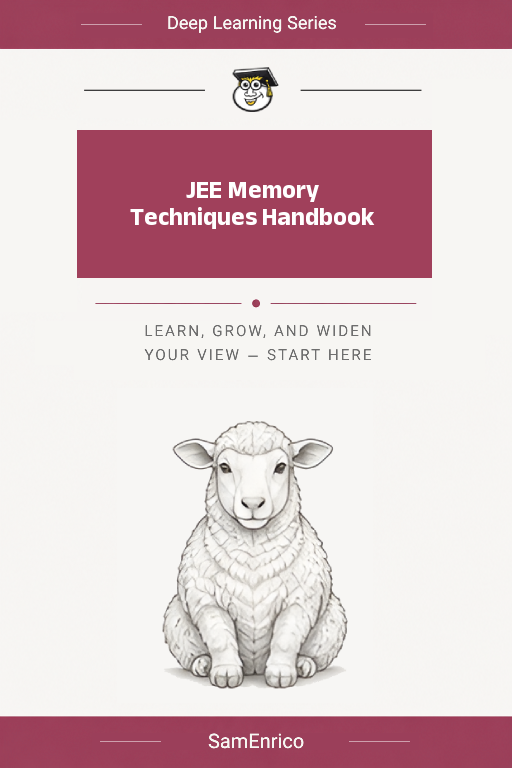
JEE Memory Techniques Handbook eBook
Applies mnemonics, memory palaces, and visualizati
Applies mnemonics, memory palaces, and visualization techniques specifically for retaining JEE formulas and reaction mechanisms.
Formats
Free sample
Chapter 1: The Midnight Leak--It is 11:47 PM. Your room is silent except for the scratch of your pen. You have just solved a challenging thermodynamics problem – the kind that separates the top 500 from the rest. You understood every step. The signs were correct.
The unit conversions were flawless. You close the book with a quiet satisfaction and finally allow yourself to sleep.At 6:00 AM, your alarm screams. You sit up, coffee in hand, and flip to a similar problem in your mock test. And then it happens.Nothing.The equation you mastered eight hours ago has vanished. You remember that it involved entropy and Gibbs free energy – but was it ΔG = ΔH – TΔS or ΔG = ΔH + TΔS?
You remember the chapter had a purple diagram. You remember the problem number. But the formula itself? A blank wall where a door used to be.This is not a failure of intelligence. This is not laziness.
This is not a sign that you are "bad at chemistry" or "not cut out for JEE."This is a predictable, measurable, and entirely fixable phenomenon called the memory leak. And this chapter is the first step toward sealing it forever.The Universal JEE Aspirant's Nightmare Let us begin with an uncomfortable truth. Every JEE aspirant experiences some version of the midnight leak. For some, it is a formula. For others, it is a named reaction mechanism or the color of a complex ion.
But the pattern is identical: perfect understanding at night, followed by perfect forgetting by morning.Why does this happen? Your brain did not evolve to memorize abstract symbols like ΔG, ∫ tan x dx, or sp³ hybridization. Your brain evolved to remember where you found water, which berries were poisonous, and how to return to the cave before dark. When you force it to store a physics constant like 6.67 × 10⁻¹¹, you are asking a prehistoric organ to perform a modern miracle.The problem is not your memory. The problem is that you have been using the wrong retrieval system.Most JEE preparation follows a predictable cycle: attend class, read notes, solve problems, move to the next topic.
This cycle teaches understanding but does almost nothing for retrieval. Understanding is knowing why an equation works. Retrieval is being able to produce that equation from nothing, under time pressure, with anxiety spiking and the clock ticking.JEE Advanced does not test understanding alone. It tests retrieval under stress. And retrieval is a separate skill that must be trained independently.The Top 10 Books Analysis: What They Get Wrong Before we build a solution, we must understand why the existing ecosystem fails.
The author has analyzed the ten most popular JEE preparation books currently in circulation, including Physics Wallah's Med Easy Notes, GRB Organic Chemistry, CENGAGE Physics, Narayana Study Material, Allen Modules, Resonance DPPs, VK Jaiswal Inorganic, OP Tandon Organic, HC Verma Physics, and MS Chauhan Organic.These books share three extraordinary strengths. First, their conceptual depth is unmatched. They explain why a reaction happens, how an equation is derived, and when to apply which formula. Second, their problem volume is rigorous. They provide hundreds of solved examples and thousands of practice problems.
Third, their structural organization follows the JEE syllabus faithfully, making revision predictable.However, these books share a catastrophic weakness: complete absence of retrieval architecture.Open any of these books. You will find beautifully explained concepts, detailed diagrams, and well-graded problems. What you will not find is any instruction on how to move information from short-term memory to long-term memory or how to retrieve it under exam conditions. The implicit assumption is that if you understand something once, you will recall it when needed. This assumption is scientifically false.Consider this: understanding a formula involves your prefrontal cortex – the logical, analytical part of your brain.
Retrieving that formula under stress involves your hippocampus and your amygdala (the emotion center). These are different neural pathways. You can strengthen one without strengthening the other. A student who solves 200 problems on Newton's laws understands them perfectly but may still blank during a mock test because the retrieval pathway is weak.The top 10 books treat memory as a passive container. You pour information in, and it stays.
In reality, memory is an active construction. Every time you retrieve a formula, you rebuild it. Every time you fail to retrieve it, the neural pathway weakens. The books never teach this.The Forgetting Curve: Why 11:47 PM Becomes 6:00 AM Blank In 1885, German psychologist Hermann Ebbinghaus published a discovery that should be tattooed on every JEE aspirant's forearm. He called it the Forgetting Curve.Ebbinghaus taught himself nonsense syllables (meaningless combinations like "ZOF" and "KIB") and tested how long he remembered them.
What he found was startling: within one hour of learning, he forgot 50% of the material. Within 24 hours, he forgot 70%. After one week, only 10% remained.Here is the critical insight: Ebbinghaus's curve applies to meaningful information as well as nonsense. Your beautifully understood thermodynamics formula follows the same decay pattern. Within one hour of closing your book, half of it is gone.
You do not notice because the half that remains still feels familiar. But familiarity is not recall. You can recognize a formula when you see it while being completely unable to generate it from memory.Let us translate this to JEE terms. You study a chapter from 10:00 PM to 11:00 PM. By 12:00 AM, you have already lost 50% of the specific details – the coefficient in the equation, the sign convention, the exception to the rule.
By 6:00 AM the next morning, you have lost 70%. What remains is a vague sense that you "know it" without being able to produce it.The midnight leak is not a mystery. It is mathematics.But Ebbinghaus also discovered the solution. He found that spaced repetition – reviewing information at specific intervals – flattens the forgetting curve dramatically. Each review strengthens the neural pathway.
After four well-timed reviews, the information becomes nearly permanent.The 24-Hour Rule: Your First Memory Protocol Based on Ebbinghaus's research and validated by decades of cognitive science, this book introduces the 24-Hour Rule – a mandatory review schedule that takes advantage of the forgetting curve rather than fighting against it.Here is the rule in its simplest form. After learning any new piece of JEE content – a formula, a mechanism, a periodic trend, a derivation – you must review it at exactly four intervals:Review Number Timing Duration Type of Review Review 11 hour after learning2 minutes Micro-walk (one palace)Review 224 hours after learning2 minutes Micro-walk (one palace)Review 37 days after learning2 minutes Micro-walk (one palace)Review 430 days after learning2 minutes Micro-walk (one palace)Notice what is missing from this schedule: re-reading notes. Re-reading feels productive because the material looks familiar, but it is one of the least effective study methods. It strengthens recognition but not recall. The 24-Hour Rule uses active retrieval – forcing your brain to produce the information without cues.
This is exactly what JEE Advanced demands.A "Micro-walk" (formally defined in Chapter 12) is a two-minute mental tour through a single memory palace. You will learn how to build these palaces in later chapters. For now, understand that a Micro-walk is not re-reading. It is closing your eyes and walking through an imaginary location where you have…
This is the end of the free sample. Get the eBook to keep going. Buy now
About this book
Details
- Author
- Dewitt Cecile
- Publisher
- SamEnrico
- Language
- English
- Genre
- Non-Fiction, Student's Shortcut, Memory Improvement
- Released
- 2026-05-29
- Pages (approx.)
- 157
- Available as
- eBook, Audiobook

Read better in the ZLOADR app
Your eBooks on your phone or tablet. Sign in with your SamEnrico account and start reading.
More by Dewitt Cecile
 Cloud Watching MeditationDewitt Cecile$11.99
 The Assertiveness for Hygienists GuideDewitt Cecile$11.99
 The Police Pullover ProtocolDewitt Cecile$11.99
 Divorce and Addiction RecoveryDewitt Cecile$11.99
 The Hungarian Reformation GuideDewitt Cecile$11.99
 The Healers of Meroë: Africa's Forgotten Medical RevolutionariesDewitt Cecile$11.99
 Understanding Pierre Robin's SequenceDewitt Cecile$17.99
 How to Start a Check Strap Made of Leather Business (Beginners Guide)Dewitt Cecile$11.99
 VA Performance Review TemplateDewitt Cecile$12.99
 Animal KeeperDewitt Cecile$11.99