
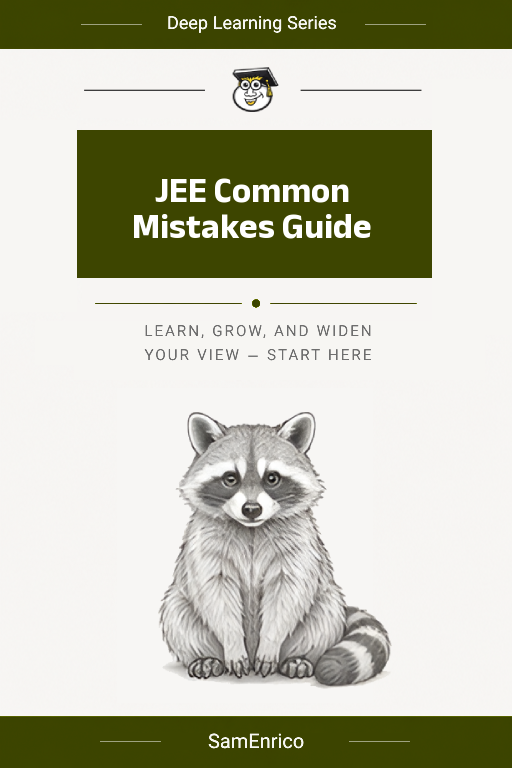
JEE Common Mistakes Guide eBook
Avoid calculation errors and misreading traps that
Avoid calculation errors and misreading traps that cost thousands of ranks.
Formats
Free sample
Chapter 1: The 90% Lie--–- Aakash had solved more than 2,000 physics problems in two years. He had worked through Irodov’s legendary collection twice. He could derive Schrödinger’s equation from first principles and had memorized every formula in the HC Verma appendix. His teachers called him brilliant. His parents called him a future IITian.
The JEE Main answer key called him wrong.In his third mock test before the actual exam, Aakash scored 142 out of 300. Not 250. Not 200. One hundred and forty-two.When he reviewed his answers with a mentor, something strange emerged. Out of the 158 marks he lost, only 31 were due to concepts he genuinely did not understand.
The remaining 127 marks—127 marks—were lost on problems where he later looked at the solution and said, “But I knew that. I knew exactly how to solve this.”He was telling the truth. He did know the concepts. Every single formula was in his head. Every method was practiced.
And yet, he lost 127 marks on material he had mastered.This is not a story about Aakash. This is a story about you.Every year, 1.2 million students take the JEE Main. Roughly 900,000 of them walk out believing they have performed well. Then the answer keys are released, and a strange silence falls over Whats App groups. Conversations that were once full of confidence become full of explanations: “I knew that one… I just made a silly mistake… I misread the sign… I forgot to convert units… I panicked at the last minute.”These are not excuses.
They are accurate descriptions of a hidden epidemic. The average JEE aspirant loses between 40 and 60 marks per exam not because of what they do not know, but because of how they execute what they already know.This book exists to close that gap. And Chapter 1 exists to convince you of one uncomfortable truth: knowing the formula is only 10 percent of the battle. The other 90 percent is training your hand, your eye, and your emotional brain to execute without distortion.Most students never recover those 60 marks because they are looking for the wrong enemy. They think the enemy is a difficult concept they have not yet learned.
They think if they just study one more chapter, solve one more book, watch one more video, the marks will come. Meanwhile, the real enemy is sitting quietly in their habits, stealing 4 marks at a time, disguised as “carelessness.”There is no such thing as carelessness. There is only predictable failure of attention, procedure, or emotional regulation. And predictable failures have predictable fixes.The Illusion of Competence Close your eyes for a moment. Imagine a physics problem: a block of mass 2 kg slides down a frictionless incline of 30 degrees.
Calculate the acceleration.You can see the solution in your mind, can’t you? a=gsinθ=9.8×0.5=4.9 m/s2a = g \sin \theta = 9.8 \times 0.5 = 4.9 \, \text{m/s}^2a=gsinθ=9.8×0.5=4.9m/s2. Easy.Now imagine you are sitting in the exam hall. Your watch says 45 minutes remaining. You have three unsolved problems in mathematics waiting for you.
Your mouth is dry. The person next to you is typing furiously. You read the incline problem. You know the formula. You write a=9.8×sin30a = 9.8 \times \sin 30a=9.8×sin30.
You write 9.8×0.5=4.99.8 \times 0.5 = 4.99.8×0.5=4.9. You bubble 4.9. You move on.Three weeks later, the answer key shows the correct answer was 4.9 m/s24.9 \, \text{m/s}^24.9m/s2. You got it right. But what if the incline had a coefficient of friction of 0.2?
What if the problem asked for velocity after 3 seconds instead of acceleration? What if the mass was given in grams instead of kilograms?In your calm, untimed, low-pressure imagination, you would catch those twists. In the actual exam, under the actual conditions, research shows that students miss an average of 2.3 qualifying conditions per problem when they are rushing. The illusion of competence—the feeling that you know something because you recognize it—is the single most dangerous cognitive bias in test-taking.The term “illusion of competence” was coined by cognitive psychologists Henry Roediger and Jeffrey Karpicke in their 2006 study on learning and memory. They found that students who repeatedly studied a text without testing themselves dramatically overestimated how well they would perform on an exam.
Recognition felt like recall. Reading felt like knowing. The same phenomenon happens in JEE preparation: students watch a video solution, nod along, and think “I could have solved that.” Then they sit for a mock test and cannot produce the solution from scratch under time pressure.This is not a character flaw. It is a feature of human memory. Your brain is wired to confuse fluency with mastery.
When information feels easy to process—because you have seen it before, because it is presented clearly, because you are relaxed—your brain tags it as “learned.” But processing fluency is not the same as retrieval ability. Being able to follow a solution is not the same as being able to generate it.The gap between recognition and recall is where JEE dreams die.The Case of the Irodov Prodigy Let me tell you about Aakash in more detail, because his case study appears in hundreds of coaching institute files under different names. Aakash was not a weak student. He was, by every conventional measure, a strong student. He joined a prestigious coaching program in Kota after scoring 92 percent in his Class 10 boards.
He attended every lecture. He solved every assignment. His Irodov problem notebook—the gold standard for advanced physics—was filled with detailed, correct solutions. His teachers praised his conceptual clarity.In his first mock test, he scored 156. He was disappointed but not alarmed.
“I made silly mistakes,” he told himself. “I’ll be more careful next time.”His second mock: 148. His third: 142. By his seventh mock, his scores had stabilized around 150, never crossing 170. He was studying 10 hours a day.
He was solving hundreds of problems. But his scores would not move.His mentor sat with him for an error analysis. They took his last three mock tests—48 pages of questions, rough work, and answer sheets—and categorized every single error. The results were devastating:Conceptual errors (Type A): 31 marks total across three tests. These were problems where Aakash genuinely did not know the formula or method.Procedural errors (Type B): 127 marks total.
These were problems where Aakash knew the concept but made an execution error: misreading the question (42 marks), sign errors in algebra (38 marks), unit conversion failures (24 marks), calculation slips (15 marks), and time-pressure rushing (8 marks).One hundred and twenty-seven marks. Almost four times his conceptual gap. On a 300-mark exam, Aakash was losing more than 40 percent of the paper to errors he later called “silly.”Here is the painful truth that Aakash learned: his Irodov-level problem-solving ability was almost irrelevant to his JEE Main score. Irodov problems are hard. They require deep thinking, multiple steps, and sophisticated physics reasoning.
JEE Main problems are, by comparison, straightforward. But Irodov problems do not punish a single sign error with a 4-mark loss. Irodov problems do not require you to solve 90 problems in 180 minutes. Irodov problems do not have an on-screen timer ticking down while your heart rate climbs.Aakash had trained for the wrong sport. He had trained to be…
This is the end of the free sample. Get the eBook to keep going. Buy now
About this book
Details
- Author
- Gonzalez Dale
- Publisher
- SamEnrico
- Language
- English
- Genre
- Non-Fiction, Student's Shortcut
- Released
- 2026-05-29
- Pages (approx.)
- 125
- Available as
- eBook, Audiobook

Read better in the ZLOADR app
Your eBooks on your phone or tablet. Sign in with your SamEnrico account and start reading.
More by Gonzalez Dale
 Mentorship in Creative IndustriesGonzalez Dale$11.99
 Bid Rigging Enforcement LogGonzalez Dale$11.99
 Assertiveness For WritersGonzalez Dale$11.99
 Mindful Stress Reduction for NursesGonzalez Dale$11.99
 Self Worth After Job LossGonzalez Dale$11.99
 Barrymore DynastyGonzalez Dale$11.99
 Thumb Sprain RehabilitationGonzalez Dale$11.99
 The Crying CornerGonzalez Dale$11.99
 Trace Evidence Contamination PreventionGonzalez Dale$11.99
 The Silent Ward: The Forgotten Patients of St. Mary'sGonzalez Dale$11.99
 The Forgotten Clash of the Adriatic: Otranto Barrage and the Silent War Beneath the WavesGonzalez Dale$11.99
 Lancelot’s Last Waltz: The Knight Who Danced with ShadowsGonzalez Dale$11.99
You may also like
 Hong Kong Handover 1997Dunn Johnnie$11.99
 Zumba For Postnatal Recovery CourseNeal Christian$11.99
 Zumba for BeginnersLadner Nikia$11.99
 YouTube Comment Mining GuideHumes Pandora$12.99
 Worry Box MeditationCarlin Rudy$11.99
 Workplace Stress MeditationNguyen Lynn$11.99
 Workplace Stress and Sleep RepairHawley Ivory$11.99
 Workplace Perfectionism CureDelaney Jeffry$11.99
 Workplace Injustice Anger GuideWallen Isabelle$11.99
 Work Addiction and Burnout LinkGreenwood Ester$11.99
 Women in Yoga and WellnessBeattie Galina$11.99
 Women in Stand Up ComedyChun Evangeline$11.99