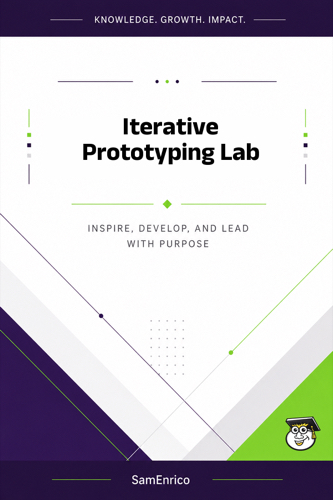
Iterative Prototyping Lab eBook
Test, learn, and refine solutions through rapid bu
Test, learn, and refine solutions through rapid build cycles.
Formats
Free sample
Chapter 1: The Ego Trap--–- You have a brilliant idea. It arrived in the shower, or during a restless night, or while staring out a window avoiding real work. It feels complete. It feels correct. It feels like the solution to a problem that has been bothering you for months.
So you do what most people do: you hide it. You polish it. You perfect it. You wait until every pixel is aligned, every word is crafted, and every feature is accounted for. And then, finally, when you are certain no one can laugh at you, you show it to the world.And the world, predictably, finds it wrong.Not because your idea was bad.
Not because you lacked intelligence or skill. But because you committed the single most expensive error in creation: you fell into the Ego Trap.This chapter is not about prototyping techniques. You will learn those in later chapters. This chapter is about something far more difficult to acquire than a new tool or a faster workflow. It is about rewiring your relationship with your own ideas.
Because before you can build anything worth building, you must understand why your brain actively works against the very process that leads to great solutions.Let us begin with a confession from one of the most celebrated innovators of the twenty-first century.The Fried Mayonnaise Epiphany In 2003, a chef named Wylie Dufresne opened a restaurant called wd~50 on the lower east side of Manhattan. He was not trying to open a normal restaurant. He was trying to invent a new cuisine. His method was not elegant. It was not safe.
It was, by any conventional measure, a festival of failure.One of his most famous dishes was something called fried mayonnaise. If you have ever left a jar of mayonnaise on a hot counter, you know that mayonnaise melts. It is an emulsion of oil and egg yolk held together by tension and hope. Heating it typically produces a greasy puddle. Frying it should be impossible.
And for the first thirty-seven attempts, it was.Dufresne and his team tried different oils. Different temperatures. Different binders. They tried freezing the mayonnaise first. They tried breading it.
They tried double-breading it. They tried adding starches, gums, and things that sound like they belong in a chemistry lab. Thirty-seven times, the mayonnaise collapsed into a sad, oily slick on the bottom of the fryer.On the thirty-eighth attempt, something worked. The exact formula is still a restaurant secret, but the principle is not. Dufresne did not succeed because he was brilliant.
He succeeded because he was willing to be wrong thirty-seven times in public, in front of a kitchen staff that watched him fail repeatedly, and then to serve the thirty-eighth version to paying customers who had no idea how many puddles preceded their plate.In an interview years later, Dufresne was asked about his creative process. He said something that should be printed on the desk of every product manager, designer, and entrepreneur: "The failure is the secret ingredient. You can't get to the thing that works without going through the things that don't."This is the opposite of how most of us operate.Why Your Brain Hates Prototyping You have a biological handicap. Your brain evolved to avoid danger, not to iterate rapidly. Ten thousand years ago, if you tried something new and it failed, the consequence might have been starvation or predation.
The brain that said "let me try that berry again after it killed my neighbor" did not pass on its genes. We are the descendants of people who learned from a single mistake and never repeated it.This survival mechanism is useless in product development.Modern problems are not saber-toothed tigers. A failed prototype will not eat you. But your brain does not know the difference. When you show someone a rough, unfinished, ugly version of your idea, your amygdala fires the same warning signals as if you had stumbled into a predator's den.
Your heart rate increases. Your palms sweat. Your cognitive processing narrows to a defensive crouch.This is the Ego Trap: you confuse the quality of your prototype with the quality of your self.When someone criticizes your low-fidelity sketch, you hear criticism of your intelligence. When a user struggles with your paper prototype, you feel personal embarrassment. When a stakeholder asks a hard question about your assumption, you experience it as an attack.
And so you do the one thing that guarantees failure: you retreat to perfectionism. You polish. You hide. You wait until everything is finished before showing anyone.By then, you have invested so much time and ego that you cannot afford to be wrong. So you launch anyway.
And the market, which is not burdened by your emotional investment, tells you exactly what your early prototypes would have told you for free.The Four Goals of Prototyping (And Why Most People Miss the First Two)Professional prototypers understand something that amateurs do not: prototyping serves four distinct goals, and only two of them have anything to do with testing. The four goals are:1. To Understand Before you can solve a problem, you must understand its shape. You cannot think your way into understanding. You must build your way in.
A prototype built for understanding is not meant to be shown to anyone. It is a private conversation with the problem. You might sketch five versions of a user flow and realize on the third sketch that you did not understand the starting condition. That is not a failure of the prototype. That is the prototype doing its job.2.
To Communicate Teams fail not because people are stupid, but because words are imprecise. You can say "a fast checkout process" and imagine one thing while your developer imagines another. A rough prototype—even stick figures on a napkin—collapses that ambiguity. When you communicate with a prototype, you are not demonstrating a solution. You are aligning a shared understanding of the problem.3.
To Test This is the goal everyone knows. You build something, you put it in front of a user, you measure what happens. But testing is only effective if you have already used prototyping for understanding and communication. Testing a prototype that answers the wrong question is a waste of time. Testing a prototype that your team interprets differently is worse than useless—it actively misleads.4.
To Advocate Sometimes you need to sell an idea. A prototype for advocacy is not the same as a prototype for testing. Testing prototypes should be low-fidelity and ugly so users feel comfortable criticizing them. Advocacy prototypes should be polished enough to communicate vision without misleading about feasibility. Knowing the difference is a superpower.Most beginners skip directly to goal three.
They build a testable prototype before they understand the problem or align their team. Then they wonder why the feedback is confusing or contradictory. They have put the cart so far ahead of the horse that the horse has forgotten what a cart is for.The Failure Resume Exercise Stop reading for a moment. Take out a piece of paper or open a blank document. Write the heading "My Most Productive Failures." Then…
This is the end of the free sample. Get the eBook to keep going. Buy now
About this book
Details
- Author
- Noyes Assunta
- Publisher
- SamEnrico
- Language
- English
- Genre
- Non-Fiction, Self-Help, Iteration
- Released
- 2026-06-11
- Pages (approx.)
- 137
- Available as
- eBook, Audiobook

Read better in the ZLOADR app
Your eBooks on your phone or tablet. Sign in with your SamEnrico account and start reading.
More by Noyes Assunta
 Gambling Addiction And The LawNoyes Assunta$11.99
 Dysthymia and AnhedoniaNoyes Assunta$11.99
 Date Night RoutineNoyes Assunta$11.99
 Alcoholism Recovery for Night Shift WorkersNoyes Assunta$11.99
 Border Crossing to FamilyNoyes Assunta$11.99
 Kidney Disease and FoodNoyes Assunta$11.99
 Burn Rate Calculation HandbookNoyes Assunta$11.99
 The Diamond Heist of the Dutch Masters: A Colonial Crime in AmsterdamNoyes Assunta$11.99
 Eleanor of Aquitaine: The Lioness Who Shaped KingdomsNoyes Assunta$11.99
 A Collector's Handbook to the Delahaye T135msNoyes Assunta$11.99
 Mastering The Art of GermanyNoyes Assunta$11.99
 How to Produce Gun Cleaning Cloths and SwabsNoyes Assunta$11.99