
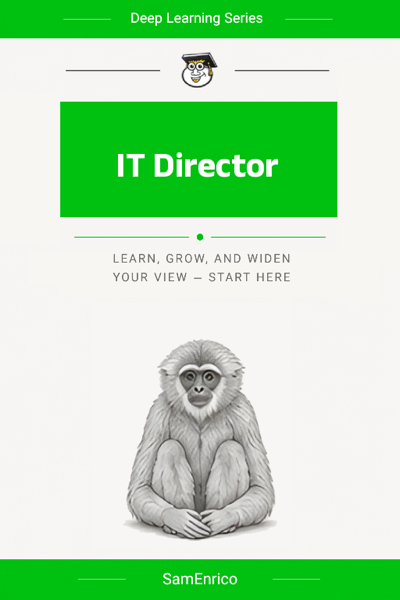
Non-FictionInformativeEducational
IT Director eBook
A Coursebook on IT Director
by Crosby Daysi
A Coursebook on IT Director
Formats
Free sample
Chapter 1: The Phoenix Wakes...--–- The phone buzzed at 2:17 AM on a Tuesday. Not the gentle tap of a text message, but the violent, sustained vibration of a critical alert. On the screen: “P1 Incident – Payment Gateway – 100% Failure Rate – Estimated Revenue Loss: $48,000 per minute.”For most people, this is a nightmare. For an IT Director, it is Tuesday.The call came from the on-call engineer, voice tight with panic. “The entire payment stack is down.
We tried rolling back the last deployment, but the database is corrupted. We don’t have a clean backup from before 6 PM. I’ve got six people on the bridge, but nobody knows the root cause.”You take a breath. You open your laptop. And in that moment, you face the fundamental question that defines every IT Director’s existence: Are you running the business, or is the business running you?This chapter is not about uptime percentages or disaster recovery runbooks.
It is about a single, dangerous, and nearly universal delusion: the belief that IT is a cost center—a utility to be minimized, like electricity or water. As long as you and your leadership team hold this belief, you will always be firefighting, always be underfunded, and always be one corrupted database away from bankruptcy.This is the story of how to wake the Phoenix—to transform your IT organization from a reactive cost center into the strategic engine of your business.The Parts Unlimited Disaster: A Case Study in Slow-Motion Collapse In 2013, Gene Kim published The Phoenix Project, a novel that has since become required reading for every serious IT leader. The book follows a fictional company, Parts Unlimited, a once-dominant auto parts manufacturer that is bleeding market share to nimbler competitors. The IT department is a disaster: projects are years late, deployments break production, and the business sees IT as a black hole of money and delays.The protagonist, Bill, is promoted to IT Director not because he is the best candidate, but because everyone else quit. On his first day, he discovers that the company’s flagship “Phoenix Project”—a new e-commerce platform—is two years behind schedule and over budget by $20 million.
The CEO demands answers. The CFO demands cuts. And the IT team is exhausted, demoralized, and drowning in unplanned work.What makes The Phoenix Project so powerful is not its drama but its diagnosis. The company’s real problem is not technical. It is systemic.
The IT department is structured as a collection of functional silos—Development, QA, Operations, Security, Database Administration—each with its own backlog, its own priorities, and its own incentives. A simple feature request from sales must travel through six handoffs, each adding delay, each introducing friction. When something breaks (and it always breaks), the same teams are pulled off project work to fight fires, which delays projects further, which creates more pressure to skip testing, which creates more fires.It is a death spiral. And it happens every day in companies of every size.The climax of the novel is not a heroic coding session. It is a realization: IT is not about uptime or features.
IT is about flow—the speed and reliability with which work moves from concept to customer. When flow is blocked, the entire business suffers.The Three Ways: Your New Operating System The Phoenix Project introduces a framework called The Three Ways. These are not theoretical concepts. They are the operating principles of every high-performing IT organization, from Google to Amazon to Netflix. If you only internalize three things from this book, internalize these.The First Way: Flow Flow is the principle of accelerating the movement of work from left to right—from development to operations to the customer.
The enemy of flow is batch processing: large releases, long-lived feature branches, manual testing cycles, and approval gates.The goal of the First Way is to create a continuous, high-velocity pipeline. This means deploying small changes frequently, automating testing and deployment, and removing any handoff that does not add value. When flow works, a developer can push a change to production in minutes, not months.But here is the counterintuitive insight: flow is not about speed. It is about feedback. Small, frequent deployments mean that when something breaks, you know exactly which change caused it.
You can fix it fast. You learn faster. And learning is the ultimate competitive advantage.The Second Way: Feedback Feedback is the principle of shortening and amplifying the loops that return information from the right side (operations, customers, production) back to the left side (development, planning).In most IT organizations, feedback is slow, filtered, and ignored. A customer reports a bug. The ticket sits in a queue for two weeks.
It gets assigned to a developer who has never seen that part of the code. They spend three days reproducing the issue. By the time the fix is deployed, the customer has already churned.The Second Way demands that feedback loops be tight, transparent, and actionable. This means real-time monitoring, on-call rotations that include developers, blameless post-mortems, and direct customer telemetry. When a payment fails, the engineer who wrote that code gets an alert within seconds, not days.The Third Way: Continuous Learning Continuous learning is the principle of creating a culture that systematically embeds improvements into daily work.
This is the hardest of the Three Ways because it requires psychological safety. You cannot learn if you are punished for mistakes.The Third Way means conducting blameless post-mortems after every incident, where the question is not “who caused this?” but “how did our system allow this to happen?” It means dedicating time to technical debt reduction, not as a “someday” project but as a line item in every sprint. It means celebrating learning, not just delivery.When the Three Ways work together, something magical happens. IT stops being a source of delays and becomes a source of competitive advantage. You deploy faster, break less often, and recover more quickly.
Your team stops hating their jobs. Your business partners start trusting you.The Four Types of Work: Seeing the Invisible Before you can improve flow, you need to see what is actually flowing. Most IT Directors manage by intuition, which is another way of saying they manage by blindness. You need a framework for categorizing every single thing your team does.The Phoenix Project provides one: the Four Types of Work.Type 1: Business Projects These are the visible, strategic initiatives that the business cares about. The new e-commerce platform.
The CRM migration. The mobile app redesign. Business projects have budgets, deadlines, and executive sponsors. They are what you talk about in quarterly reviews.Type 2: Internal Projects These are technical improvements that the business does not see and usually does not want to fund. Upgrading the database.
Refactoring the authentication service. Replacing the legacy monitoring system. Internal projects are the invisible infrastructure that makes everything else possible. When they are underfunded, they become technical debt.Type 3: Changes These are the day-to-day deployments, configuration updates, and releases that keep the system evolving. In a healthy organization, changes are small, frequent, and automated.
In an unhealthy organization, changes are big, rare, and terrifying—each one a potential catastrophe.Type 4: Unplanned Work This is the…
This is the end of the free sample. Get the eBook to keep going. Buy now
About this book
Details
- Author
- Crosby Daysi
- Publisher
- SamEnrico
- Language
- English
- Genre
- Non-Fiction, Informative, Educational
- Released
- 2026-06-02
- Pages (approx.)
- 142
- Available as
- eBook, Audiobook

Read better in the ZLOADR app
Your eBooks on your phone or tablet. Sign in with your SamEnrico account and start reading.
More by Crosby Daysi
 Small Town Mayor LessonsCrosby Daysi$11.99
 Kalahari Desert Hunter GuideCrosby Daysi$11.99
 Self Esteem for PCOS BodiesCrosby Daysi$11.99
 Cocaine Vasculitis TreatmentCrosby Daysi$11.99
 The Cosmic Egg Cracks: How the World Began in One BreathCrosby Daysi$11.99
 Voyager's Pacific Odyssey: The Silent Pioneers of the CosmosCrosby Daysi$11.99
 Geo Domain SEO Strategy HandbookCrosby Daysi$12.99
 2026-2030 AI Sustainability GuideCrosby Daysi$12.99
 Understanding HistoplasmosisCrosby Daysi$17.99
 How to Become a Trimmer HelperCrosby Daysi$11.99
You may also like
 Hong Kong Handover 1997Dunn Johnnie$11.99
 Zumba For Postnatal Recovery CourseNeal Christian$11.99
 Zumba for BeginnersLadner Nikia$11.99
 YouTube Comment Mining GuideHumes Pandora$12.99
 Worry Box MeditationCarlin Rudy$11.99
 Workplace Stress MeditationNguyen Lynn$11.99
 Workplace Stress and Sleep RepairHawley Ivory$11.99
 Workplace Perfectionism CureDelaney Jeffry$11.99
 Workplace Injustice Anger GuideWallen Isabelle$11.99
 Work Addiction and Burnout LinkGreenwood Ester$11.99
 Women in Yoga and WellnessBeattie Galina$11.99
 Women in Stand Up ComedyChun Evangeline$11.99