
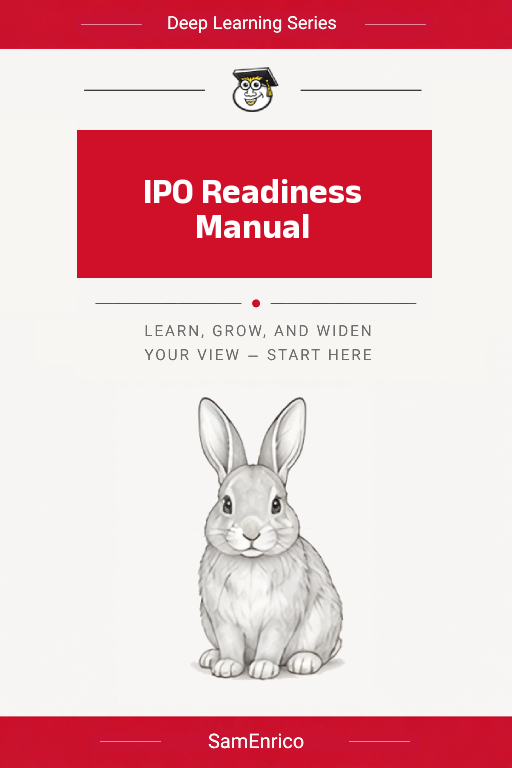
Non-FictionStartup GuidePublic Offering
IPO Readiness Manual eBook
Prepare for an initial public offering including S
Prepare for an initial public offering including S 1 filing, roadshow presentation, SOX compliance, and post listing lockup agreements for founding teams.
Formats
Free sample
Chapter 1: The 24-Month Clock--The night before he was supposed to file the S-1, the founder of a billion-dollar logistics startup called his lead underwriter and said, "I think we need to delay." The banker laughed. "You can't," he said. "We've already booked the roadshow. The investors have cleared their calendars. Your employees are expecting a liquidity event.
You are going public on Thursday, whether you're ready or not."That founder went public. Within six months, his CFO resigned, his audit committee discovered a material weakness in revenue recognition, and his stock dropped 40%. He sold his remaining shares at the lock-up expiry for less than half of what they would have fetched on the day of the IPO. When asked what he would have done differently, he said: "I would have looked at the calendar before I said yes."This chapter is about that calendar. It is about the eighteen months before you ring the bell and the six months after—the full twenty-four-month journey from the moment you first think "maybe we should go public" to the day you can finally sell your first share without restriction.
Most founders focus on the pricing pop. The smart ones focus on the clock.The 24-Month Clock is not a metaphor. It is a literal, unforgiving sequence of regulatory deadlines, audit cycles, quiet periods, and lock-up agreements that will dictate every major decision you make from the day you hire your first banker to the day you file your first post-IPO annual report. Miss a deadline, and you delay the IPO by a quarter—or kill it entirely. Misunderstand a milestone, and you will find yourself explaining to your board why you cannot sell a single share to pay for your child's college tuition even though you are worth nine figures on paper.This chapter gives you the full map.
It covers the Readiness Assessment that will tell you whether you should proceed at all, the CEO's Calendar that will tell you exactly when to do what, and the Top Ten Deal Killers that cause twenty percent of IPOs to be withdrawn before pricing. By the end of this chapter, you will know whether your company is ready, how long it will take, and—most importantly—whether the journey is worth the cost.The Readiness Assessment: Are You Actually Ready?Before you hire a single banker, before you spend a dollar on audit fees, before you tell your head of product that "going public is the next chapter," you need to answer seven questions. These are not the soft questions about "culture" or "mission." These are hard, numerical, verifiable questions that will predict with alarming accuracy whether your IPO will succeed or implode.Question One: Can you close the books in seven days?Private companies often take twenty to thirty days to close their books after a quarter ends. That is fine when your only audience is your board and your bank. It is catastrophic when you are public.
The SEC requires you to file your 10-Q within forty-five days of quarter end. That sounds generous until you realize that your auditor needs at least twenty days to review, your legal team needs ten days to certify, and your investor relations team needs five days to draft the shareholder letter. If your internal close takes more than seven days, you have no buffer. One mistake, one missing invoice, one disputed revenue recognition issue, and you miss the filing deadline. Miss a filing deadline as a public company, and your stock stops trading.
Your investors will sue. Your board will consider replacing you.Run the test today. Take your last completed quarter. Ask your finance team to close the books in seven calendar days. Do not warn them in advance.
Do not let them hire temporary staff. Just tell them on a Monday morning that the books need to be closed by the following Monday. If they cannot do it, you are not ready. If they look at you like you have asked them to build a rocket ship, you are not ready. If they say "we could do it if we had more people," you are not ready—because those people do not exist yet, and hiring them will take six months.Question Two: Do you have an internal audit function?Private companies rarely have internal auditors.
Public companies are required to have them. Not because the SEC hates you, but because the external auditor cannot be everywhere at once. The internal audit function is your early warning system. It tests controls before the external auditor does. It finds the spreadsheet errors, the missing approvals, the segregation of duties violations before they become material weaknesses.If you do not have at least two people whose full-time job is internal audit, you are not ready.
If you have never conducted an internal audit, you are not ready. If your reaction to this question is "what's an internal audit function?", you are not ready—and you should stop reading this chapter and hire a consultant immediately.Question Three: Have you mapped every related-party transaction?Related-party transactions are deals between your company and anyone closely connected to management—a founder's other business, a cousin's consulting firm, a board member's real estate partnership. Private companies treat these as normal. Public companies treat them as potential fraud. The SEC will ask for a complete list.
Your auditor will test every single one. If you have not already documented every loan, every lease, every contract, every handshake deal with a related party, you will spend months untangling relationships that you thought were harmless.Here is the test: Write down the name of every person who has ever received a payment from the company that was not an arm's-length transaction with an unaffiliated third party. If that list takes you more than one hour to compile, you are not ready. If the list has more than ten entries, you are not ready. If you find yourself saying "but that was just a favor" or "that was before we had formal policies," you are not ready.Question Four: Is your revenue recognition audit-proof?Under US GAAP, revenue recognition is governed by ASC 606.
That is a five-step framework that sounds simple but is brutally difficult to implement correctly. The most common material weakness in first-year public companies is revenue recognition error. Not fraud. Not theft. Just honest mistakes about when to book a sale, how to allocate discounts, or whether to defer revenue across multiple periods.Run this test: Pick your ten largest customers from last quarter.
Ask your finance team to produce the documentation that proves each sale was recognized in the correct period, with the correct allocation, and with the correct supporting evidence. If any of those files is missing, incomplete, or stored in someone's email inbox instead of the ERP system, you are not ready. If your team cannot explain why each sale was recognized when it was, you are not ready. If you have ever changed your revenue recognition policy without documenting the change, you are not ready.Question Five: Do you have a whistleblower hotline?Under the Sarbanes-Oxley Act, every public company must have a mechanism for employees to…
This is the end of the free sample. Get the eBook to keep going. Buy now
About this book
Details
- Author
- Greenfield Merideth
- Publisher
- SamEnrico
- Language
- English
- Genre
- Non-Fiction, Startup Guide, Public Offering
- Released
- 2026-06-01
- Pages (approx.)
- 148
- Available as
- eBook, Audiobook

Read better in the ZLOADR app
Your eBooks on your phone or tablet. Sign in with your SamEnrico account and start reading.
More by Greenfield Merideth
 Oral Presentation Fear WorkbookGreenfield Merideth$11.99
 Honor and Respect TriggersGreenfield Merideth$11.99
 SEAL Night Vision Close QuartersGreenfield Merideth$11.99
 Food Addiction and BrainGreenfield Merideth$11.99
 Customer Journey Creative WorkshopGreenfield Merideth$11.99
 The Alchemist’s Secret: Jabir ibn Hayyan and the Birth of Modern ChemistryGreenfield Merideth$11.99
 The Ballot Thief: How a Forgotten Election Changed the WorldGreenfield Merideth$11.99
 ESL Lesson Plan TemplatesGreenfield Merideth$12.99
 How to Start a Skiing Facilities BusinessGreenfield Merideth$11.99
 Understanding GalactosemiaGreenfield Merideth$17.99
 Co ManagerGreenfield Merideth$11.99
You may also like
 Hong Kong Handover 1997Dunn Johnnie$11.99
 Zumba For Postnatal Recovery CourseNeal Christian$11.99
 Zumba for BeginnersLadner Nikia$11.99
 YouTube Comment Mining GuideHumes Pandora$12.99
 Worry Box MeditationCarlin Rudy$11.99
 Workplace Stress MeditationNguyen Lynn$11.99
 Workplace Stress and Sleep RepairHawley Ivory$11.99
 Workplace Perfectionism CureDelaney Jeffry$11.99
 Workplace Injustice Anger GuideWallen Isabelle$11.99
 Work Addiction and Burnout LinkGreenwood Ester$11.99
 Women in Yoga and WellnessBeattie Galina$11.99
 Women in Stand Up ComedyChun Evangeline$11.99