
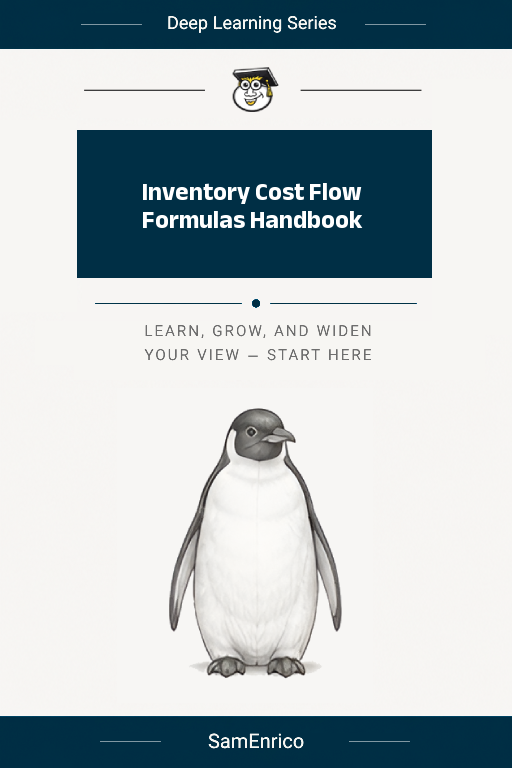
Non-FictionStudent's ShortcutCost Accounting
Inventory Cost Flow Formulas Handbook
Apply FIFO, LIFO, and weighted-average costing to
Apply FIFO, LIFO, and weighted-average costing to inventory valuation problems with clear step-by-step methods.
Formats
About this book
Free sample
Chapter 1: The Inventory Trap--–- Imagine you own a hardware store. You sell the same hammer to one hundred customers this year. Each hammer is identical. You bought fifty hammers in January for 10eachandanotherfiftyin Decemberfor10 each and another fifty in December for 10eachandanotherfiftyin Decemberfor15 each because your supplier raised prices.At year-end, you have sold eighty hammers and have twenty left in stock.Now answer this seemingly simple question: What was your profit for the year?Here is the catch. The answer depends entirely on which hammers you assume were sold.
If you assume you sold the cheaper 10hammersfirst,yourcostofgoodssoldislower,yourprofitishigher,andyourtaxbillisbigger.Ifyouassumeyousoldthemoreexpensive10 hammers first, your cost of goods sold is lower, your profit is higher, and your tax bill is bigger. If you assume you sold the more expensive 10hammersfirst,yourcostofgoodssoldislower,yourprofitishigher,andyourtaxbillisbigger.Ifyouassumeyousoldthemoreexpensive15 hammers first, your cost of goods sold is higher, your profit is lower, and your tax bill is smaller.Same business. Same sales. Same physical inventory. Different profit.
Different taxes.This is not a theoretical exercise. Every business that holds inventory faces this exact decision. The method you choose to assign costs to your sales is called a cost flow assumption. And that choice has real, measurable consequences for your taxes, your reported profitability, your ability to get a loan, and even your survival during economic downturns.Most business owners have no idea this choice exists. They use whatever method their accountant defaults to, usually FIFO (First-In, First-Out), without understanding the trade-offs.
They leave money on the table. They pay taxes they could have deferred. They report profits that make them look more successful than they are—which sounds good until a lender expects those profits to continue and they do not.This chapter establishes the foundation for everything that follows. You will learn what inventory is, why valuation matters, the accounting principles that govern inventory, and the lower of cost or market rule that can override cost-based valuations. You will also learn why the choice of inventory method is one of the most important—and most overlooked—strategic decisions in business.What Is Inventory?
More Than Just Stuff on Shelves Inventory includes goods purchased or manufactured by a business that remain unsold or unconsumed…
This is the end of the free sample. Get the eBook to keep going. Buy now
Contents
- Chapter 1
- Chapter 2
- Chapter 3
- Chapter 4
- Chapter 5
- Chapter 6
- Chapter 7
- Chapter 8
- Chapter 9
- Chapter 10
- Chapter 11
- Chapter 12
Details
- Author
- Benavidez Lan
- Publisher
- SamEnrico
- Language
- English
- Genre
- Non-Fiction, Student's Shortcut, Cost Accounting
- Released
- 2026-05-30
- Pages (approx.)
- 119
- Available as
- eBook, Audiobook

Read better in the ZLOADR app
Your eBooks on your phone or tablet. Sign in with your SamEnrico account and start reading.
More by Benavidez Lan
 Silencing Inner Creative CriticBenavidez Lan$11.99
 Solo Hiking FlowBenavidez Lan$11.99
 Paleo Weight Loss Starter CourseBenavidez Lan$11.99
 Indian BPO Labor Laws GuideBenavidez Lan$11.99
 The Geometric Brilliance of Diophantus of Alexandria: Africa's Unsung Mathematical GeniusBenavidez Lan$11.99
 How to Produce Camera and Optics ManualsBenavidez Lan$11.99
 How to Start a Agents and Agencies in Placement of Books With Publishers Business (Beginners Guide)Benavidez Lan$11.99
 Hospitality ManagerBenavidez Lan$11.99
You may also like
 Hong Kong Handover 1997Dunn Johnnie$11.99
 Zumba For Postnatal Recovery CourseNeal Christian$11.99
 Zumba for BeginnersLadner Nikia$11.99
 YouTube Comment Mining GuideHumes Pandora$12.99
 Worry Box MeditationCarlin Rudy$11.99
 Workplace Stress MeditationNguyen Lynn$11.99
 Workplace Stress and Sleep RepairHawley Ivory$11.99
 Workplace Perfectionism CureDelaney Jeffry$11.99
 Workplace Injustice Anger GuideWallen Isabelle$11.99
 Work Addiction and Burnout LinkGreenwood Ester$11.99
 Women in Yoga and WellnessBeattie Galina$11.99
 Women in Stand Up ComedyChun Evangeline$11.99