
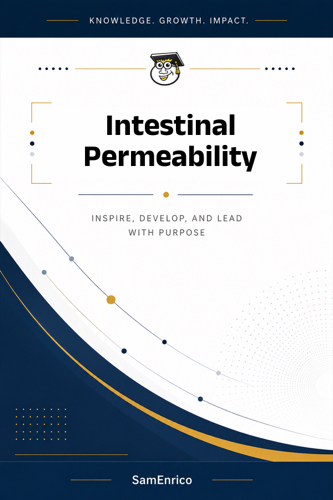
Non-FictionHealth & WellnessGastroenterology
Intestinal Permeability eBook
Explains tight junction dysfunction and zonulin pa
by Orellana Ty
Explains tight junction dysfunction and zonulin pathway.
Formats
Free sample
Chapter 1: The Gatekeeper You Never Knew--–- Your gut is not a tube. This is the first and most important lie you have been told about your own body. For decades, medical diagrams, biology textbooks, and well-meaning doctors have presented the digestive system as a hollow pipeline—a continuous passage from mouth to anus through which food travels, gets broken down, and exits as waste. The implication is clear: the gut is a passive conveyor belt. Put food in one end; wait; collect results at the other.
This model is catastrophically wrong.The truth is far stranger and far more important. Your intestinal lining is not a tube at all. It is a dynamic, intelligent, fiercely selective security system—one that makes the decision, billions of times per second, between welcoming a nutrient into your body or rejecting a toxin, between absorbing a life-giving vitamin or expelling a dangerous pathogen. And like any security system, it can fail. When it does, the consequences reach far beyond your digestive tract, affecting your skin, your liver, your brain, and even your sense of self.This chapter will introduce you to the hidden world of your gut barrier, the microscopic gatekeepers that control it, and the paradigm-shifting realization that most chronic diseases of the modern world begin not in your genes or your environment alone, but at the interface between you and the outside world—the six hundred square meters of intestinal lining that separate your internal organs from the chaos of the external environment.
That is roughly the size of a tennis court, folded into a space no larger than a briefcase. And on that tennis court, your health is won or lost every single day.The Conveyor Belt Fallacy Let us begin with an experiment. Picture a garden hose. Water enters one end, flows through the hollow interior, and exits the other. The walls of the hose are impermeable—water cannot escape through the sides.
That is the standard model of the gut: a muscular tube lined with cells so tightly packed that nothing passes between them. Everything you eat must be broken down into the smallest possible molecules and then dragged through the cells themselves, a slow and energetically expensive process.Now picture a sieve. Water poured onto a sieve does not simply flow across the surface; it passes through the holes. Some particles are too large to pass and remain on top; smaller particles fall through. That is a closer approximation of the gut, but still incomplete.
A sieve has fixed holes—they do not change size based on the needs of the moment. Your gut does.The correct analogy is a gated border crossing with guards who open and close the gates based on specific signals. Sometimes the guards open the gates wide to allow immune cells to pass through and sample the environment. Sometimes they seal the gates completely to prevent invasion. And sometimes—when the signals are wrong or the guards are exhausted—the gates remain partially open, allowing the wrong things to slip through.
This is not a failure of the gut as a tube; it is a failure of the gut as a gatekeeper.The implications of this shift in perspective are profound. If the gut were simply a tube, digestive problems would be limited to what goes in and what comes out—constipation, diarrhea, bloating. But if the gut is a security system, then any breakdown in that security allows the contents of your intestine—bacteria, bacterial fragments, partially digested food proteins, environmental toxins—to enter your bloodstream. And once those substances enter your blood, they travel everywhere: to your liver, your skin, your joints, your brain. Suddenly, a "gut problem" becomes a whole-body problem.The Second Brain To understand the gatekeeper, you must first understand the entity that employs it.
Embedded in the walls of your gastrointestinal tract is a network of neurons so extensive that it has earned its own name: the enteric nervous system. This "second brain" contains over one hundred million neurons—more than the spinal cord. It operates largely independently of your central nervous system (your brain and spinal cord), which is why your gut continues to digest food even when you are unconscious or sleeping soundly.The second brain does not write poetry or solve calculus problems, but it does something arguably more impressive: it makes trillions of real-time decisions about what to absorb, what to reject, and what to attack. It senses the chemical composition of your intestinal contents. It communicates with your immune system, which has seventy percent of its cells located in your gut wall.
It sends signals upward via the vagus nerve—a superhighway of information that connects your gut directly to your brainstem. This is not a one-way street. Your brain sends stress signals down to your gut, which is why you feel "butterflies" before a presentation or a "gut feeling" about a decision. Your gut sends inflammation signals up to your brain, which is why gut dysfunction is now linked to anxiety, depression, and even neurodegenerative diseases.The gatekeeper—the intestinal lining with its tight junctions—is the physical interface where the second brain meets the outside world. It is the border wall, the customs checkpoint, the first and most important line of defense.
When it works correctly, you never notice it. When it fails, you notice nothing else.Tight Junctions: The Zippers of Your Gut Let us zoom in. The intestinal lining is a single layer of cells called enterocytes. These cells are pressed against each other, but they are not fused together. Between each adjacent pair of enterocytes is a microscopic gap.
If that gap remained open, everything in your intestine would leak directly into your bloodstream—a medical emergency that would kill you within hours.The solution is a set of protein complexes called tight junctions. Think of them as zippers that run along the sides of each enterocyte, connecting it to its neighbors. The teeth of the zipper are made of proteins with names like claudin and occludin. These proteins interlock to create a seal that is both strong and dynamic. Under normal conditions, the tight junctions allow only water and the smallest ions to pass between cells—a process called paracellular transport.
Everything else—nutrients, vitamins, larger molecules—must pass through the enterocytes themselves, where they are inspected, processed, and either absorbed or rejected.Here is where the "zipper" analogy becomes powerful. A zipper can be opened or closed. It can be opened partially, or fully, or left slightly unzipped at one point. Tight junctions work the same way. In response to specific signals, the proteins that make up the tight junctions can loosen their grip, widening the gap between cells from less than one nanometer to several nanometers.
This is not a catastrophic failure; it is a deliberate, controlled process called physiological permeability. It allows the gut to sample its environment, to let immune cells pass through, and to adjust absorption based on need.But a zipper that opens and closes hundreds of times per day eventually wears out. The teeth become misaligned. The slider gets stuck. Similarly, tight junctions that are forced to open too…
This is the end of the free sample. Get the eBook to keep going. Buy now
About this book
Details
- Author
- Orellana Ty
- Publisher
- SamEnrico
- Language
- English
- Genre
- Non-Fiction, Health & Wellness, Gastroenterology
- Released
- 2026-06-06
- Pages (approx.)
- 130
- Available as
- eBook, Audiobook

Read better in the ZLOADR app
Your eBooks on your phone or tablet. Sign in with your SamEnrico account and start reading.
More by Orellana Ty
 Sam Sheppard Career After PrisonOrellana Ty$11.99
 Meal Prep for Holiday FeastsOrellana Ty$11.99
 Gates Product LicensingOrellana Ty$11.99
 OSS Agent Behind Enemy LinesOrellana Ty$11.99
 Relationship Induced ApathyOrellana Ty$11.99
 Perfectionism vs Healthy StrivingOrellana Ty$11.99
 Cryptojacking TrendsOrellana Ty$11.99
 The Devil's Tunnel: The Escape That Shook the CartelOrellana Ty$11.99
 The Blood of the Steppe: The Magyar Horde's Last StandOrellana Ty$11.99
 How to Start a Propane Business (Beginners Guide)Orellana Ty$11.99
 How to Produce Filler PuttyOrellana Ty$11.99
 Madrid Language RequirementsOrellana Ty$12.99
You may also like
 Hong Kong Handover 1997Dunn Johnnie$11.99
 Zumba For Postnatal Recovery CourseNeal Christian$11.99
 Zumba for BeginnersLadner Nikia$11.99
 YouTube Comment Mining GuideHumes Pandora$12.99
 Worry Box MeditationCarlin Rudy$11.99
 Workplace Stress MeditationNguyen Lynn$11.99
 Workplace Stress and Sleep RepairHawley Ivory$11.99
 Workplace Perfectionism CureDelaney Jeffry$11.99
 Workplace Injustice Anger GuideWallen Isabelle$11.99
 Work Addiction and Burnout LinkGreenwood Ester$11.99
 Women in Yoga and WellnessBeattie Galina$11.99
 Women in Stand Up ComedyChun Evangeline$11.99