
Non-FictionSelf-HelpInterviewing
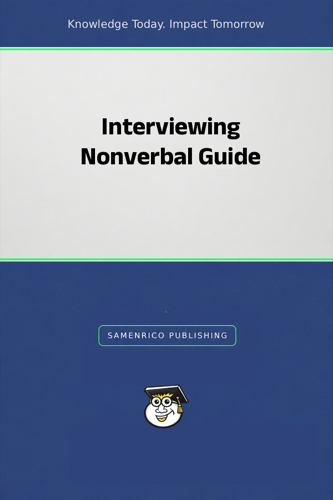
Interviewing Nonverbal Guide eBook
Read job candidates' honesty and engagement during
Read job candidates' honesty and engagement during interviews.
Formats
Free sample
Chapter 1: The Honesty Gap--–- Let me tell you about Brian. Brian interviewed for a regional sales manager position at a mid-sized technology company. He had a perfect resume. He gave perfect answers. He made perfect eye contact.
He used the interviewer's name three times. He wore a perfectly tailored suit. He sent a perfect thank-you note within two hours. He was hired. Within six months, Brian had alienated his entire team, missed every quota, and cost the company $340,000 in lost revenue, severance, and legal fees.
The exit interview revealed that Brian had been terminated from his previous two jobs—information he had hidden, and references he had fabricated. Every person who had ever managed Brian had missed the same thing. They had been looking at the resume. They had not been looking at Brian.Let me tell you about Maria. Maria interviewed for the same role six months later.
She was nervous. She fidgeted. She stumbled over her words when asked about a six-month gap in her resume. She nearly got rejected in the first round. But one interviewer noticed something the others missed: when Maria talked about building teams, her entire body changed.
She leaned forward. Her voice warmed. Her hands animated. Her eyes narrowed slightly—not in suspicion, but in focus. That interviewer pushed for a second round.
Maria was hired. She exceeded quota by 40% in her first year and was promoted within eighteen months. The difference between Brian and Maria was not their resumes. It was not their references. It was not their experience.
It was the truth.What did the first interviewer miss? What did the second interviewer see? The answer is nonverbal behavior—the involuntary, often unconscious signals that reveal what a candidate is actually thinking and feeling, regardless of what they are saying. This book will teach you to see what the first interviewer missed. It will not make you a human lie detector.
Nothing can. But it will give you a systematic, science-based framework for reading behavioral signals, distinguishing between nervousness and deception, and making better hiring decisions.The 80% Problem Let me start with a number that should terrify you: eighty percent. According to multiple studies spanning three decades, between 50% and 80% of job applicants exaggerate their qualifications during interviews. The most common exaggerations are about previous job responsibilities (84% of those who exaggerate), academic degrees (47%), and specific accomplishments (62%). Only 5-10% of applicants engage in outright fabrication—inventing jobs that never existed, claiming degrees never earned, creating references who do not exist.
The rest are stretching the truth. They are embellishing. They are telling you what they think you want to hear.Here is the problem: you cannot tell the difference between embellishment and fabrication by reading a resume. You cannot tell the difference by checking references (the candidate chooses who to list). You cannot tell the difference by asking standard interview questions (every candidate has rehearsed them).
The only way to distinguish between the candidate who is nervously stretching the truth and the candidate who is deliberately deceiving you is to watch them when they are not performing. That means watching their nonverbal behavior during the moments when their cognitive load is highest, their scripts run out, and their true self leaks through.This book is not about catching liars. It is about seeing people. Because when you see people clearly, the liars reveal themselves and the honest ones finally get the chance to be seen.Embellishment vs. Deception: A Critical Distinction Before we go any further, we need to establish a distinction that will run through every chapter of this book.
There is a difference between embellishment and deception. They look different. They feel different. They require different responses.Embellishment is the stretching of the truth under social pressure. The candidate has done something like what they are describing, but they are making it sound better, more impressive, more important.
Embellishment is driven by anxiety—the fear of not being good enough, the fear of being rejected, the fear of being seen as ordinary. Embellishment is usually a one-time thing. An embellisher who is hired in an honest environment will often stop embellishing and start performing.Deception is the deliberate falsification of information with intent to defraud. The candidate is claiming something that never happened. They are hiding something that did happen.
Deception is driven by characterological dishonesty—a pattern of lying that extends across contexts. A deceiver who is hired will not start being honest. They will get better at hiding.Here is the critical insight: you cannot detect deception by looking for nervousness. Because nervousness is also produced by embellishment. And by ordinary interview anxiety.
And by cultural differences. And by the temperature of the room. Nervousness is not diagnostic. What is diagnostic is the pattern of behavior over time, the comparison between baseline and stress, the cluster of cues that appear together, and the congruence—or incongruence—between what someone says and how they say it.This distinction matters because most interviewers react to nervousness as if it were deception. They reject the nervous candidate who is telling the truth and hire the smooth candidate who is hiding everything.
That is the Honesty Gap. This book closes that gap.The Cost of Getting It Wrong Before we learn any techniques, let us be clear about what is at stake. A bad hire is not just an inconvenience. It is a financial catastrophe. The Society for Human Resource Management estimates that the cost of a bad hire ranges from 50% of the employee's annual salary (for a quick replacement) to 200% or more (when you factor in recruiting costs, training, lost productivity, team disruption, and termination costs).
For a $60,000 employee, that is $30,000 to $120,000. For a $120,000 manager, that is $60,000 to $240,000. For a salesperson who misses quota, the cost is even higher.But the cost is not just financial. A bad hire poisons the team. They create more work for everyone else.
They drive away good employees who are tired of carrying the load. They consume management time that should be spent on strategy and development. They create legal risk if they are terminated for cause. They damage your reputation when they leave and tell everyone how terrible your company is.The cost of missing a good hire is also enormous. The candidate you reject who goes to your competitor.
The nervous but brilliant engineer who never got a second interview. The fidgety but visionary marketer who was overlooked because they did not "present well." Every time you reject an honest candidate because they seem nervous, you are sending value to your competition.This book is an investment in getting it right. Not perfect—no system is perfect. But better. Significantly better.The Baseline Concept: You Cannot Detect a Lie Without a Pattern of Truth Here is the single most important concept in this entire book, and the one that most interviewers never learn.
The specific method for establishing baseline is covered in detail in Chapter 3. For now, understand the principle.You cannot detect a lie without first establishing a pattern of truth. This is borrowed from forensic interviewing. When the FBI interrogates a suspect, they do not start with the accusation. They start…
This is the end of the free sample. Get the eBook to keep going. Buy now
About this book
Details
- Author
- Dutton Chantal
- Publisher
- SamEnrico
- Language
- English
- Genre
- Non-Fiction, Self-Help, Interviewing
- Released
- 2026-06-06
- Pages (approx.)
- 134
- Available as
- eBook, Audiobook

Read better in the ZLOADR app
Your eBooks on your phone or tablet. Sign in with your SamEnrico account and start reading.
More by Dutton Chantal
 London School of Economics Alumni NetworkDutton Chantal$11.99
 The Carpet and Rug GuideDutton Chantal$11.99
 Burnout Recovery for NonprofitsDutton Chantal$11.99
 The Sun King's Grand Design: Louis XIV and the Birth of Modern DiplomacyDutton Chantal$11.99
 How to Produce Bicycle Computer AccessoriesDutton Chantal$11.99
 Literature Gap IdentificationDutton Chantal$12.99
 How to Become a Sticker-onDutton Chantal$11.99
 Quettaversal SageDutton Chantal$11.99
You may also like
 Hong Kong Handover 1997Dunn Johnnie$11.99
 Zumba For Postnatal Recovery CourseNeal Christian$11.99
 Zumba for BeginnersLadner Nikia$11.99
 YouTube Comment Mining GuideHumes Pandora$12.99
 Worry Box MeditationCarlin Rudy$11.99
 Workplace Stress MeditationNguyen Lynn$11.99
 Workplace Stress and Sleep RepairHawley Ivory$11.99
 Workplace Perfectionism CureDelaney Jeffry$11.99
 Workplace Injustice Anger GuideWallen Isabelle$11.99
 Work Addiction and Burnout LinkGreenwood Ester$11.99
 Women in Yoga and WellnessBeattie Galina$11.99
 Women in Stand Up ComedyChun Evangeline$11.99