
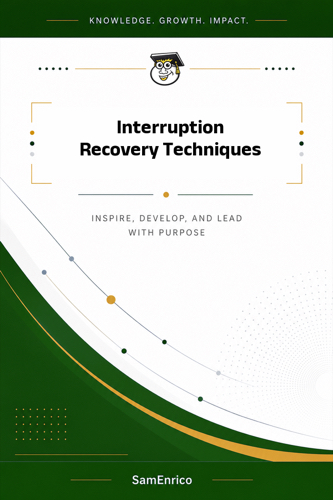
Interruption Recovery Techniques Audiobook
Quickly refocuses after being disrupted.
Quickly refocuses after being disrupted.
Formats
Free sample
Chapter 1: The 23-Minute Lie--–- The email arrived at 9:47 AM. You were halfway through drafting a response to your boss, your fingers moving with the kind of fluid confidence that comes only when you've finally found the right words. Then Slack pinged. A colleague needed "just one quick thing." You switched tabs, answered the question (forty-five seconds, tops), and returned to your email. And then you sat there.
Staring. The cursor blinked at the end of an incomplete sentence: "Based on the Q3 numbers, I believe we should—" Should what? You read the paragraph three times. Nothing. The thought was gone.
Evaporated. You spent the next seven minutes re-reading previous paragraphs, checking your sent folder for context, and finally—defeated—deleting the sentence and starting over. The colleague who interrupted you? They forgot they even asked. But you didn't forget.
You spent the rest of the morning feeling slightly off, slightly slower, slightly more irritated every time another notification buzzed. By lunch, you'd accomplished roughly half of what you'd planned. And you went to bed that night convinced that the problem was you. Your focus. Your discipline.
Your increasingly fragile attention span.You are not the problem.This book exists because nearly every professional on earth has been sold a lie: that interruptions are an annoyance, that willpower is the solution, and that "just getting back to work" is a reasonable expectation. The lie is seductive because it places all responsibility on your shoulders. If you can't refocus, the thinking goes, you must be lazy, or distracted, or fundamentally broken. But the research tells a very different story—one that will likely make you angrier than you've ever been at every productivity guru who told you to "just turn off your phone."The truth is that your brain is not designed to switch tasks quickly. It was never meant to.
The neural architecture that allows you to focus deeply on a single problem is the same architecture that resists being yanked in another direction. Every time you switch tasks—even for a moment—you leave a piece of your cognitive processing power behind, stuck on the previous task like a record needle in a skipping groove. And the more incomplete that previous task feels, the more of your brain stays trapped there. This is not a character flaw. This is neuroscience.By the time you finish this chapter, you will understand why your…
This is the end of the free sample. Get the Audiobook to keep going. Buy now
About this book
Details
- Author
- Pinkerton Kerstin
- Publisher
- SamEnrico
- Language
- English
- Genre
- Non-Fiction, Self-Help, Recovery
- Released
- 2026-06-05
- Pages (approx.)
- 156
- Available as
- eBook, Audiobook

Listen in the VoxFlicks app
Audiobooks and audio dramas wherever you go. Sign in with your SamEnrico account and press play.
More by Pinkerton Kerstin
 Anki For PhysicsPinkerton Kerstin$11.99
 Forced Connections for BusinessPinkerton Kerstin$11.99
 The OKR Hope GuidePinkerton Kerstin$11.99
 Forgiving a CheaterPinkerton Kerstin$11.99
 CrossFit Mobility ManualPinkerton Kerstin$11.99
 Mindfulness for Bipolar BeginnersPinkerton Kerstin$11.99
 Colombian Jungle Cocaine TrailPinkerton Kerstin$11.99
 The Alchemists of Light: Huygens, Hooke, and the Birth of Microscopic SciencePinkerton Kerstin$11.99
 The Last Wyvern of the Black ForestPinkerton Kerstin$11.99
 How to Produce a Radar DetectorPinkerton Kerstin$11.99
 The Essential Guide to Christian RapPinkerton Kerstin$11.99
 How to Produce an Energy RegulatorPinkerton Kerstin$11.99
You may also like
 Hong Kong Handover 1997Dunn Johnnie$11.99
 Zumba For Postnatal Recovery CourseNeal Christian$11.99
 Zumba for BeginnersLadner Nikia$11.99
 YouTube Comment Mining GuideHumes Pandora$12.99
 Worry Box MeditationCarlin Rudy$11.99
 Workplace Stress MeditationNguyen Lynn$11.99
 Workplace Stress and Sleep RepairHawley Ivory$11.99
 Workplace Perfectionism CureDelaney Jeffry$11.99
 Workplace Injustice Anger GuideWallen Isabelle$11.99
 Work Addiction and Burnout LinkGreenwood Ester$11.99
 Women in Yoga and WellnessBeattie Galina$11.99
 Women in Stand Up ComedyChun Evangeline$11.99