
Non-FictionSelf-HelpInterruptionsFocus
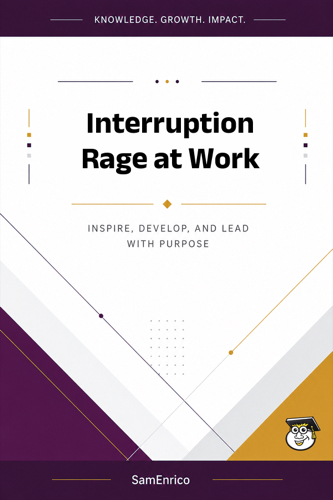
Interruption Rage at Work eBook
Stay calm when constantly interrupted during focus
by Conyers Nyla
Stay calm when constantly interrupted during focused deep work time.
Formats
Free sample
Chapter 1: The Hidden Grenade--–- It begins, as it always does, with a click. Not a loud one. Not a dramatic one. Just the soft, almost imperceptible sound of your office door swinging open, a Slack message pinging, a hand tapping your shoulder, or a voice saying, "Got a minute?" And in that fraction of a second, something inside you detonates. Your neck tightens.
Your jaw clenches. Your vision narrows. You feel a hot, irrational surge of what can only be described as rage—not at the person standing there, necessarily, but at the sheer, violent disruption of your concentration. You were in the flow. You were solving something important.
You were, for one glorious moment, doing your best work. And now it is gone. The intruder has no idea what they have just done. They see a calm professional sitting at a desk. They do not see the grenade that just went off in your nervous system.This is not a metaphor.
This is neuroscience.Welcome to Interruption Rage at Work. Before we fix anything—before we build fortresses, write scripts, or rewire your team’s culture—we must understand what is actually happening inside your skull when someone interrupts you during deep work. Because here is the truth that will change everything you think about your own frustration: your rage is not a character flaw. It is not a sign of poor emotional control. It is not something you should feel ashamed of.
It is a predictable, ancient, and utterly normal biological response to a perceived threat. And once you understand that, you can stop fighting yourself and start fighting the real enemy: the interruption itself.This chapter will take you on a journey into the architecture of your own brain. We will explore why interruptions trigger the same neural circuitry as physical danger, why your rational mind seems to vanish exactly when you need it most, and why the phrase “just stay calm” is about as useful as telling someone to stop bleeding. By the end of this chapter, you will never again blame yourself for snapping. You will understand the hidden grenade inside your own head—and, more importantly, how to defuse it before it explodes.The Myth of the Calm Professional Let us start with a thought experiment.
Imagine you are sitting at your desk, writing a complex report. You are deep in concentration—the kind where time seems to disappear and the words flow effortlessly. Now imagine someone walks up to you and throws a cup of cold water in your face. What would you feel? Startled, certainly.
Angry, probably. Maybe even enraged. Now imagine someone walks up to you and says, “Hey, quick question—do you know where the sales numbers from last quarter are?” Same startle. Same interruption of flow. But would you feel the same anger?
Most people say no. A question is not an assault. A question is just... a question.But your brain does not see it that way.Here is the uncomfortable truth that organizational psychology has been discovering for decades: from the perspective of your nervous system, an unexpected interruption during deep focus is neurologically similar to a physical threat. Not identical, of course.
You are not going to flee or fight for your life. But the same ancient alarm system—the one designed to protect you from predators and falling rocks—lights up like a Christmas tree when someone disrupts your focused work.Why? Because your brain treats goals as survival resources. When you are deeply focused on a task, your prefrontal cortex—the “executive” part of your brain responsible for planning, reasoning, and impulse control—has committed significant energy to pursuing a specific objective. That objective might be writing a proposal, debugging code, or analyzing data.
To your ancient brain, that goal is not just a task. It is a mission. And anything that threatens that mission is interpreted as a threat to your safety and status.Let me say that again: Your brain treats goal interruption as a survival threat.This is not speculation. This is measurable. Neuroscientists using functional MRI (f MRI) have shown that when people are interrupted during a meaningful task, the same regions of the brain activate as when they experience physical pain—specifically, the anterior cingulate cortex and the anterior insula.
These are the regions that process distress, whether that distress comes from a stubbed toe or a sabotaged project. The interruption does not have to be malicious. It does not have to be loud. It just has to be unexpected and consequential. And in the modern workplace, interruptions are not only unexpected—they are relentless.The Anatomy of an Amygdala Hijack To understand interruption rage, you need to meet two parts of your brain: the amygdala and the prefrontal cortex.
Think of them as an alarm system and a fire chief, respectively.The amygdala is a small, almond-shaped cluster of neurons deep in your brain’s temporal lobe. Its job is simple: scan the environment for threats, and do it fast. The amygdala does not think. It does not reason. It does not ask whether a threat is real or imagined, physical or social, dangerous or merely annoying.
It just detects something unexpected and triggers a cascade of stress hormones—cortisol, adrenaline, norepinephrine—that prepare your body for fight or flight. Your heart rate increases. Your breathing quickens. Your muscles tense. Your peripheral vision narrows.
Your digestion slows. All of this happens in milliseconds, long before your conscious mind has even registered the interruption.Now meet your prefrontal cortex (PFC). The PFC is the rational, planning, impulse-controlling part of your brain. It is located right behind your forehead, and it is what separates humans from most other animals. The PFC can delay gratification.
It can consider long-term consequences. It can say, “I am angry, but I will not scream.” The problem is that the PFC is slow. It takes several seconds to fully engage. And in those few seconds, the amygdala has already sounded the alarm.When the amygdala hijacks your brain, the PFC is temporarily sidelined. Blood flow shifts away from the frontal lobes and toward the more primitive regions.
Your working memory—the mental scratchpad you use to hold multiple pieces of information at once—shrinks dramatically. Your ability to think creatively, consider alternatives, or regulate your emotions plummets. This is why, when you are interrupted during deep work, you do not respond with a calm, rational request to come back later. You snap. You glare.
You say something passive-aggressive. Or you simply sit there, frozen, while the rage simmers beneath the surface. That is not a moral failure. That is a neurological inevitability.Dr. Daniel Goleman, who popularized the term “amygdala hijack” in his work on emotional intelligence, describes it this way: “The amygdala acts as a emotional sentinel, scanning every situation for trouble.
When it detects a threat, it can take over the rest of the brain—including the thinking brain—in a matter of milliseconds. The result is that we often act before we think, and we think poorly after we act.”That is interruption rage in a nutshell. You act before you think. Then you…
This is the end of the free sample. Get the eBook to keep going. Buy now
About this book
Details
- Author
- Conyers Nyla
- Publisher
- SamEnrico
- Language
- English
- Genre
- Non-Fiction, Self-Help, Interruptions, Focus
- Released
- 2026-06-10
- Pages (approx.)
- 156
- Available as
- eBook, Audiobook

Read better in the ZLOADR app
Your eBooks on your phone or tablet. Sign in with your SamEnrico account and start reading.
More by Conyers Nyla
 Postpartum Worry GuideConyers Nyla$11.99
 Cybersecurity Capital GuideConyers Nyla$12.99
 The Body Language Across CulturesConyers Nyla$11.99
 Weekly Wins Journal MethodConyers Nyla$11.99
 The Rainbow Six Siege Ranked RushConyers Nyla$11.99
 The Green Alchemist: Thomas Jefferson's Unsung BotanistConyers Nyla$11.99Cybersecurity Capital GuideConyers Nyla$12.99
 Lease Agreement Analysis GuideConyers Nyla$12.99
 Avocado HarvestingConyers Nyla$11.99
 Understanding Microvillus Inclusion DiseaseConyers Nyla$17.99
 How to Start a Bulk Road Haulage Business (Beginners Guide)Conyers Nyla$11.99
You may also like
 Hong Kong Handover 1997Dunn Johnnie$11.99
 Zumba For Postnatal Recovery CourseNeal Christian$11.99
 Zumba for BeginnersLadner Nikia$11.99
 YouTube Comment Mining GuideHumes Pandora$12.99
 Worry Box MeditationCarlin Rudy$11.99
 Workplace Stress MeditationNguyen Lynn$11.99
 Workplace Stress and Sleep RepairHawley Ivory$11.99
 Workplace Perfectionism CureDelaney Jeffry$11.99
 Workplace Injustice Anger GuideWallen Isabelle$11.99
 Work Addiction and Burnout LinkGreenwood Ester$11.99
 Women in Yoga and WellnessBeattie Galina$11.99
 Women in Stand Up ComedyChun Evangeline$11.99