
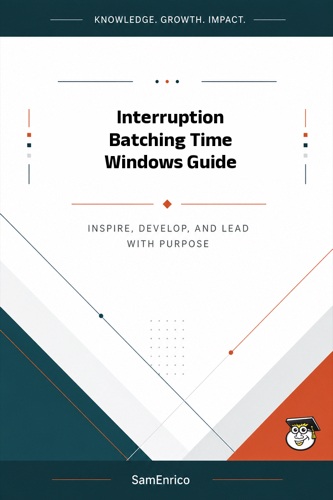
Interruption Batching Time Windows Guide eBook
Designates specific hours for handling all interru
by Oaks Demetra
Designates specific hours for handling all interruptions.
Formats
Free sample
Chapter 1: The 25-Minute Lie--–- Sarah had been staring at the same paragraph for forty-seven minutes. It was only three sentences long. She had read it eleven times. She still could not tell you what it said.The cursor blinked at her from the middle of the screen, patient and indifferent. Her fingers hovered over the keyboard.
Nothing came. Her mind was not empty—it was the opposite. It was overstuffed with fragments. A Slack message she had answered twenty minutes ago. An email from her boss that arrived during that Slack message.
A calendar notification reminding her of a meeting that had started two minutes ago. A text from her spouse asking about dinner. A notification from a group chat about someone’s new puppy.None of these things had taken more than sixty seconds to address. She had replied to the Slack message in fifteen seconds. She had glanced at the email—did not even open it, just read the preview—in four seconds.
She had dismissed the calendar notification in one second. She had texted back “sounds good” in three seconds. She had looked at the puppy photo and tapped a heart reaction in two seconds.Twenty-five seconds of cumulative interruption time. Forty-seven minutes of staring at a cursor.Sarah is not real. But her experience is so universal that you probably filled in your own name and your own screen while reading that paragraph.
You have lived this. You are living it right now. And like Sarah, you have been told—by productivity blogs, by your well-meaning boss, by the little voice in your head—that the problem is your focus. That you lack discipline. That you need to try harder.This chapter will show you something far more unsettling: the problem is not your focus.
The problem is that you have been systematically lied to about the true cost of an interruption.The Mathematics of Destruction Let us begin with a simple question. How much time do you think you lose when someone interrupts you for five minutes?Most people guess five minutes. Slightly more sophisticated people guess ten minutes—accounting for the time it takes to get back on track. A handful of people who have read productivity books will guess fifteen to twenty minutes.The correct answer, based on decades of research in cognitive psychology and workplace productivity studies, is approximately twenty-five minutes. A five-minute interruption costs twenty-five minutes of productive time.
That is a 5:1 loss ratio.This number is not a metaphor. It is not an inspirational quote. It is a measured, replicated, peer-reviewed finding. Let me show you how the math works.The Five Time-Loss Factors When an interruption strikes, you do not lose only the minutes the interruption lasts. You lose five distinct things.
I call them the Time-Loss Factors.Factor One: Diversion Diversion is the moment your attention leaves your primary task. It feels instantaneous. It is not. Neuroimaging studies show that the brain takes approximately 0.3 to 0.5 seconds to disengage from a task. That sounds trivial.
But here is the catch: during that half-second, your brain stops encoding new information from the primary task. If you were reading, you stopped comprehending. If you were writing, you stopped generating. If you were calculating, you stopped computing.The half-second of diversion is not the cost. The cost is that you have broken a cognitive spell.
Deep focus is not a light switch you can flip on and off. It is a campfire that requires careful tending. A single diversion does not dim the fire; it extinguishes it completely, and you must rebuild from ash.Factor Two: Restart Once the interruption ends, you must restart your primary task. This is not automatic. Researchers at the University of California, Irvine, observed software developers in their natural work environments and found that after an interruption, it took an average of twenty-three minutes and fifteen seconds to return to the original task with the same level of focus.Twenty-three minutes.Not because the developers were lazy.
Because their brains had to answer a series of questions before any real work could resume: Where was I? What was I doing? What was I about to do next? What had I already done? Is there anything I forgot?
What was that idea I had right before the interruption? Did I save my work? Was I waiting for something?These questions are not trivial. They represent the cognitive work of reconstructing a mental context that was destroyed by the interruption. You cannot skip this reconstruction.
You can only suffer through it.Factor Three: Momentum Loss Before the interruption, you may have been building momentum. This is the psychological experience of flow—that effortless, timeless state where ideas come easily and actions feel automatic. Momentum is not binary; it exists on a spectrum from zero (just starting, feeling stuck) to one hundred (fully immersed, losing track of time).Interruptions do not reduce momentum by a few points. They zero it out completely. You cannot be “a little bit in flow.” You are either in flow or you are not.
An interruption shatters flow as surely as a hammer shatters a glass. And flow cannot be repaired; it can only be re-entered from the beginning.This is why the second hour of focused work is often exponentially more productive than the first fifteen minutes. You are not just doing more work; you are doing qualitatively different work—more creative, more intuitive, more connected. Interruptions rob you not only of time but of the conditions that make your best work possible.Factor Four: Do-Overs When you lose your place in a complex task, you often have to redo work. This is not always literal redoing—though sometimes it is, if you forgot to save or lost your train of thought mid-sentence.
More commonly, do-overs are partial: you re-read a paragraph you had already understood, you re-check a calculation you had already verified, you re-consult a source you had already digested.Do-overs are insidious because you rarely notice them. You tell yourself you are just “reviewing.” But review is not progress. Every minute spent re-establishing ground you already covered is a minute stolen from moving forward. In tasks involving sequential logic—coding, writing, design, data analysis—do-overs can consume 10–30% of total work time in interruption-heavy environments.Factor Five: Distress The final factor is the most overlooked and the most damaging. Distress is the emotional residue of being interrupted.
It includes frustration (at the interrupter, at the situation, at yourself), anxiety (about falling behind, about missing deadlines, about appearing incompetent), and a low-grade sense of being out of control.Distress does not end when the interruption ends. It lingers. It colors your perception of the next task. It makes you more reactive, less patient, and more likely to be interrupted again—because a distressed brain scans the environment for threats, and in an office, “threats” include new notifications, new emails, new people approaching your desk.Researchers have measured the performance decrement from distress. After a frustrating interruption, study participants performed 20–40% worse on subsequent cognitive tasks, even when those tasks were unrelated to the interrupted work.
You are not just upset. You are literally dumber for a period of time after each interruption.Putting It Together: The…
This is the end of the free sample. Get the eBook to keep going. Buy now
About this book
Details
- Author
- Oaks Demetra
- Publisher
- SamEnrico
- Language
- English
- Genre
- Non-Fiction, Self-Help, Time Batching
- Released
- 2026-06-09
- Pages (approx.)
- 132
- Available as
- eBook, Audiobook

Read better in the ZLOADR app
Your eBooks on your phone or tablet. Sign in with your SamEnrico account and start reading.
More by Oaks Demetra
 Construction Site Anger ManagementOaks Demetra$11.99
 Jamaican Agent Career LadderOaks Demetra$11.99
 Marketing Essay PromptsOaks Demetra$11.99
 The Obesity Testosterone Link GuideOaks Demetra$11.99
 The Snows of Kilimanjaro: The Legal Battle That Saved African Extreme SkiingOaks Demetra$11.99
 YouTube Playlists for BrandingOaks Demetra$12.99
 BIM CoordinatorOaks Demetra$11.99
 Dental Lab M&A GuideOaks Demetra$12.99
 Understanding Poland SyndromeOaks Demetra$17.99
 How to Become a Last-model MakerOaks Demetra$11.99