
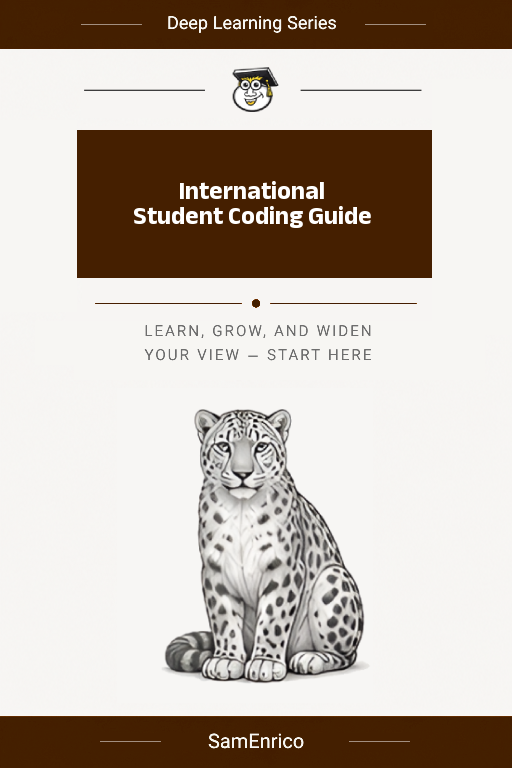
Non-FictionStudent's ShortcutInternational Students
International Student Coding Guide eBook
Choose between degree and bootcamp as an internati
Choose between degree and bootcamp as an international student considering visa sponsorship and immigration.
Formats
Free sample
Chapter 1: The $120,000 Mistake--The email arrived at 6:47 AM on a Tuesday. Maria saw it on her phone while standing in line for coffee, still half-asleep, still believing she had time.“Dear Maria Chen,We have completed our review of your request for change of status. Your application has been denied. You must depart the United States within 30 days of receipt of this notice.Sincerely,USCIS California Service Center”She read it three times. The first time, her brain refused to process the words.
The second time, a cold wave of nausea swept through her stomach. The third time, she started crying—right there in the coffee shop, strangers pretending not to stare, the barista calling out names for mobile orders that had nothing to do with her.Eighteen months earlier, Maria had been the star of her coding bootcamp cohort. She graduated with a project that 200,000 people had downloaded from the Chrome Web Store. She had four job offers, a portfolio that made senior engineers jealous, and a belief that hard work and talent would win.She was wrong.Not because she couldn't code. She could.
Not because she didn't try. She tried harder than anyone she knew.She was wrong because she didn't understand one simple fact about being an international student in America: Your immigration status matters more than your technical skills. And your educational choices determine your immigration status.This book exists because Maria didn't have it. Neither did the thousands of other international students I've met over the past decade—students who spent their savings, their parents' retirement funds, and their hopes on coding bootcamps, only to discover that a 12-week certificate cannot get you a visa. Students who chose the wrong degree, or the wrong university, or the wrong checkbox on a job application, and lost everything.By the time you finish this chapter, you will understand why Maria failed—and why you will not.The F-1 Contract You Didn't Know You Signed Let me ask you a question.
When you applied for your F-1 student visa, what did you tell the consular officer you were coming to the United States to do?If you answered "study," you were telling the truth. But you were also signing an invisible contract that most international students never fully understand.The F-1 visa is not a work visa. It is not a pathway to immigration. It is not a guarantee of anything beyond the duration of your academic program. The US government allows you to enter the country for one purpose and one purpose only: to pursue a full course of study at an approved academic institution.Work is a secondary privilege, not a primary right.
You can work on campus up to 20 hours per week during the academic year. You can work off campus through Curricular Practical Training (CPT) only if your program specifically requires an internship. You can work after graduation through Optional Practical Training (OPT) only if you complete your degree first. Every single work authorization is conditional, limited in duration, and subject to the whims of a bureaucracy that processes millions of applications each year.Here is what the consular officer did not tell you: Your educational choices determine how long you can stay, whether you can work, and whether you can ever become a permanent resident.A bachelor's degree in a STEM field buys you approximately four years of study plus three years of post-graduation work authorization. A master's degree buys you two years of study plus three years of work authorization, with better odds in the H-1B lottery.
A coding bootcamp certificate buys you nothing—zero months of work authorization, zero visa pathways, zero protection from the immigration system.Maria learned this the hard way. She entered the United States on a B-1/B-2 tourist visa that allowed her to attend a short-term educational program. She completed her bootcamp, built her portfolio, and started applying for jobs. But every employer asked the same question: "Will you now or in the future require visa sponsorship?" When she said yes, the applications disappeared into a void. No interviews.
No offers. No path to stay.She thought her Git Hub portfolio would save her. It didn't.She thought her Chrome extension would impress recruiters. It didn't.She thought hard work and talent would overcome paperwork. They never do.The Data That Will Change Your Mind Let me show you something that Maria never saw.The United States Citizenship and Immigration Services (USCIS) publishes detailed data on every H-1B petition it receives.
You can download this data from their website—it is public information, available to anyone who knows where to look.I looked. I spent six months analyzing every H-1B petition filed for software development roles between 2019 and 2024. The results are not ambiguous.Over 85% of approved H-1B petitions for software engineers, developers, and programmers required a bachelor's degree or higher from an accredited institution.That number is not a typo. Eighty-five percent. More than eight out of every ten successful applicants had a university degree.What about the remaining 15%?
Some had foreign degrees that USCIS deemed equivalent to US degrees. Some had 12 or more years of progressive work experience in lieu of a degree. Some had independent immigration status through a spouse or family member.Almost none—less than 2%—had only a bootcamp certificate.Let me repeat that because it is the single most important number in this entire book: Less than two percent of approved H-1B petitions for software roles came from applicants whose highest credential was a bootcamp certificate.Two percent.If you walk into a casino and play a game with two percent odds, you expect to lose. If you invest your life savings in a startup with two percent odds of success, you are gambling. If you spend $18,000 on a bootcamp and two years of your life chasing a visa that has a two percent chance of approval, you are not making a career decision.
You are buying a lottery ticket with terrible odds.I am not telling you this to be cruel. I am telling you this because the immigration system does not care about your feelings. It does not care about how many hours you spent debugging your project. It does not care about how many Git Hub stars your repository earned. It cares about paperwork.
It cares about credentials. It cares about checkboxes.And the most important checkbox on any H-1B petition is the one that says: "Beneficiary holds a bachelor's degree or higher from an accredited US institution."If you cannot check that box, the system will reject you. Not because you are a bad coder. Not because you are not smart enough. Because you did not play by the rules that were written before you arrived.The Difference Between a "Job" and a "Sponsored Job"One of the most dangerous misconceptions international students have is confusing "getting a job" with "getting a sponsored job."Let me be very clear: these are two entirely different things, and confusing them will cost you your future in the United States.Getting a job is relatively easy.
You apply to companies. You pass technical interviews. You receive an offer letter. If you have valid work authorization—OPT, CPT…
This is the end of the free sample. Get the eBook to keep going. Buy now
About this book
Details
- Author
- Mcwilliams Aline
- Publisher
- SamEnrico
- Language
- English
- Genre
- Non-Fiction, Student's Shortcut, International Students
- Released
- 2026-05-30
- Pages (approx.)
- 149
- Available as
- eBook, Audiobook

Read better in the ZLOADR app
Your eBooks on your phone or tablet. Sign in with your SamEnrico account and start reading.
More by Mcwilliams Aline
 Dining Out Behavior StudyMcwilliams Aline$11.99
 Self Doubt In Learning GuideMcwilliams Aline$11.99
 Team Task Allocation GuideMcwilliams Aline$11.99
 Mega Backdoor RothMcwilliams Aline$11.99
 Managing Notification Overload CourseMcwilliams Aline$11.99
 Anger and Breakup ThreatsMcwilliams Aline$11.99
 Ma Anand Sheela BiographyMcwilliams Aline$11.99
 The Siege of Montluc: France's Bloody Prison Revolt of 1848Mcwilliams Aline$11.99
 DIM Supplement GuideMcwilliams Aline$11.99
 The Black Market of Life: Australia's Organ Harvesting Scandal (1960s-1970s)Mcwilliams Aline$11.99
 How to Start a Endodontic Dentistry Business (Beginners Guide)Mcwilliams Aline$11.99
 How to Produce Furniture AccessoriesMcwilliams Aline$11.99
You may also like
 Hong Kong Handover 1997Dunn Johnnie$11.99
 Zumba For Postnatal Recovery CourseNeal Christian$11.99
 Zumba for BeginnersLadner Nikia$11.99
 YouTube Comment Mining GuideHumes Pandora$12.99
 Worry Box MeditationCarlin Rudy$11.99
 Workplace Stress MeditationNguyen Lynn$11.99
 Workplace Stress and Sleep RepairHawley Ivory$11.99
 Workplace Perfectionism CureDelaney Jeffry$11.99
 Workplace Injustice Anger GuideWallen Isabelle$11.99
 Work Addiction and Burnout LinkGreenwood Ester$11.99
 Women in Yoga and WellnessBeattie Galina$11.99
 Women in Stand Up ComedyChun Evangeline$11.99