
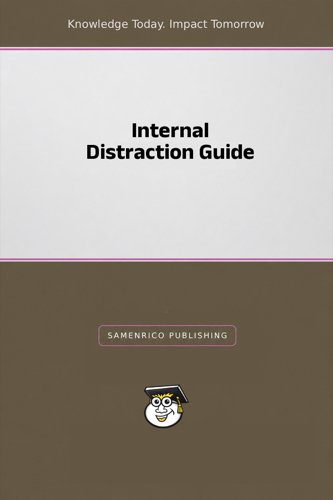
Non-FictionSelf-HelpMindfulness
Internal Distraction Guide eBook
Manages wandering mind and rumination.
Manages wandering mind and rumination.
Formats
Free sample
Chapter 1: The Leaky Boat...--–- Imagine waking up one morning to find a small leak in your boat. Nothing dramatic—just a thin trickle of water seeping through a crack in the hull. You are not a skilled sailor, but you know enough to understand that if you ignore it, the water will rise. So you bail. You scoop and scoop, and for a while, you keep up.
But the leak does not stop. And eventually, you realize that bailing has become your full-time job. You are no longer sailing toward any destination. You are no longer looking at the horizon. You are just trying not to drown.This is what it feels like to live with a chronically wandering, ruminating mind.The water is every intrusive thought, every replay of an old mistake, every catastrophic prediction about a future that has not happened yet.
The bailing is the mental effort you expend trying to push those thoughts away, to focus on your work, to be present with your children, to fall asleep at night. And the boat is your attention—the only vessel you have for navigating your one and only life.If this metaphor resonates with you, you are not alone. You are not broken. And most importantly, you are not the cause of the leak.The Epidemic No One Is Talking About Let us begin with a number that should stop you cold. According to a landmark study by Killingsworth and Gilbert (2010) at Harvard University, the average human mind wanders from its current task forty-seven percent of the time.
Nearly half of your waking life, you are not paying attention to what you are doing. You are eating dinner while thinking about an email. You are playing with your child while rehearsing a work conversation. You are lying in bed next to your partner while mentally rewriting an argument from three years ago.Let that sink in. Half of your life is happening without you.The same study found that this mind-wandering is not neutral.
When people's minds wandered, they were consistently less happy than when they were focused on the present moment—even when they were thinking about pleasant topics. A mind that is not where the body is, is a mind that is, on average, less content.Now consider a more troubling statistic. The World Health Organization estimates that depression and anxiety disorders—both closely linked to chronic rumination—cost the global economy over one trillion dollars per year in lost productivity. But the personal cost is far higher than any economic number can capture. It is the parent who cannot enjoy bedtime stories because their mind is trapped in a loop of financial worry.
It is the young professional who cannot celebrate a promotion because they are already imagining getting fired. It is the student who cannot absorb a lecture because their internal narrator will not stop replaying a social embarrassment from high school.We are living through an epidemic of internal distraction, but we have not yet given it a name that captures its true nature. We call it "stress" or "overthinking" or "anxiety." But those words are too clinical, too distant from the lived experience of it. The lived experience is this: you are trying to live your life, but your mind keeps dragging you somewhere else. And the more you try to stop it, the stronger it gets.The Fundamental Mistake We All Make Here is the most important idea in this entire book, and I need you to understand it before we go any further.
Brace yourself, because it might contradict everything you have been told about focus, willpower, and self-discipline.The wandering mind is not a malfunction. It is a feature.Yes, you read that correctly. Your brain was designed—by millions of years of evolution—to wander. It was not designed to sit still in a chair for eight hours staring at a spreadsheet. It was not designed to listen attentively to every word of a forty-five-minute meeting.
It was not designed to lie down at 10 PM and instantly fall into peaceful silence.Your brain was designed to survive on the savanna. And on the savanna, the brain that stopped scanning the horizon for threats was the brain that got eaten by a lion. The brain that failed to simulate what the other tribe members might be thinking was the brain that was exiled from the group—a death sentence for a social primate. The brain that did not consolidate memories of which berry bush made you sick was the brain that poisoned itself again next week.The Default Mode Network (DMN), which we will explore in detail throughout this book, is the neural machinery responsible for this constant mental activity. When you are not actively engaged in an external task, the DMN lights up.
It starts generating autobiographical memories, simulating future scenarios, and constructing a running narrative about "you"—who you are, what others think of you, what you should have done differently, what you need to do tomorrow.This is not a flaw. This is a survival system.The problem is that you are no longer on the savanna. You are in a world of emails, deadlines, social media, and abstract financial instruments. The threats your brain is scanning for are no longer lions; they are passive-aggressive Slack messages and retirement account fluctuations. The social simulations that once helped you navigate a tribe of fifty people are now running overtime trying to decode the behavior of five hundred Facebook friends.
The memory consolidation that once helped you avoid poisonous berries now replays your most embarrassing moments on a loop at 3 AM.The machinery is not broken. The environment has changed. And the mismatch between your ancient brain and your modern life is the source of nearly all internal distraction.The Vocabulary Problem: Why "Distraction" Is the Wrong Word Before we go any further, we need to talk about language. The words we use to describe our problems shape the solutions we can imagine. And most of the words we currently use to describe internal distraction are actively unhelpful.We say we are "distracted." But distraction implies an external object that has stolen our attention—a phone notification, a loud noise, someone interrupting us.
When we say "I am distracted," the implied solution is to remove the distractor. Turn off the phone. Close the door. Work in a quiet room.But what happens when you turn off the phone, close the door, sit in a completely silent room—and your mind still will not focus? What external distractor do you remove then?You cannot remove yourself from yourself.We say we are "overthinking." But this phrase is vague to the point of uselessness.
Overthinking what? How much thinking is too much? When does careful consideration become rumination? The phrase gives us no handle to grab onto.We say we are "anxious." But anxiety is an emotion, not a behavior. Telling someone they are anxious does not tell them what to do about it.Throughout this book, I am going to ask you to adopt a more precise vocabulary.
Not because I want you to become a neuroscientist, but because precision creates leverage. If you cannot name what is…
This is the end of the free sample. Get the eBook to keep going. Buy now
About this book
Details
- Author
- Jacobson Isobel
- Publisher
- SamEnrico
- Language
- English
- Genre
- Non-Fiction, Self-Help, Mindfulness
- Released
- 2026-06-05
- Pages (approx.)
- 137
- Available as
- eBook, Audiobook

Read better in the ZLOADR app
Your eBooks on your phone or tablet. Sign in with your SamEnrico account and start reading.
More by Jacobson Isobel
 Susan Burton Recovery InsideJacobson Isobel$11.99
 From Rickshaw to RichesJacobson Isobel$11.99
 Overcoming Loneliness for CaregiversJacobson Isobel$11.99
 P 3 Orion Sub HunterJacobson Isobel$11.99
 Fear of Failure for ScientistsJacobson Isobel$11.99
 Comfortable Bedding MeditationJacobson Isobel$11.99
 Antipsychotic Emotional BluntingJacobson Isobel$11.99
 The Siege of the British Embassy: Seoul's Desperate Stand (1950)Jacobson Isobel$11.99
 Blood and DNA: The Boer War's Genetic LegacyJacobson Isobel$11.99
 How to Produce Vehicle Safety and SecurityJacobson Isobel$11.99
 Unemployment Rate FormulasJacobson Isobel$12.99
 FAR Compliance HandbookJacobson Isobel$12.99
You may also like
 Hong Kong Handover 1997Dunn Johnnie$11.99
 Zumba For Postnatal Recovery CourseNeal Christian$11.99
 Zumba for BeginnersLadner Nikia$11.99
 YouTube Comment Mining GuideHumes Pandora$12.99
 Worry Box MeditationCarlin Rudy$11.99
 Workplace Stress MeditationNguyen Lynn$11.99
 Workplace Stress and Sleep RepairHawley Ivory$11.99
 Workplace Perfectionism CureDelaney Jeffry$11.99
 Workplace Injustice Anger GuideWallen Isabelle$11.99
 Work Addiction and Burnout LinkGreenwood Ester$11.99
 Women in Yoga and WellnessBeattie Galina$11.99
 Women in Stand Up ComedyChun Evangeline$11.99